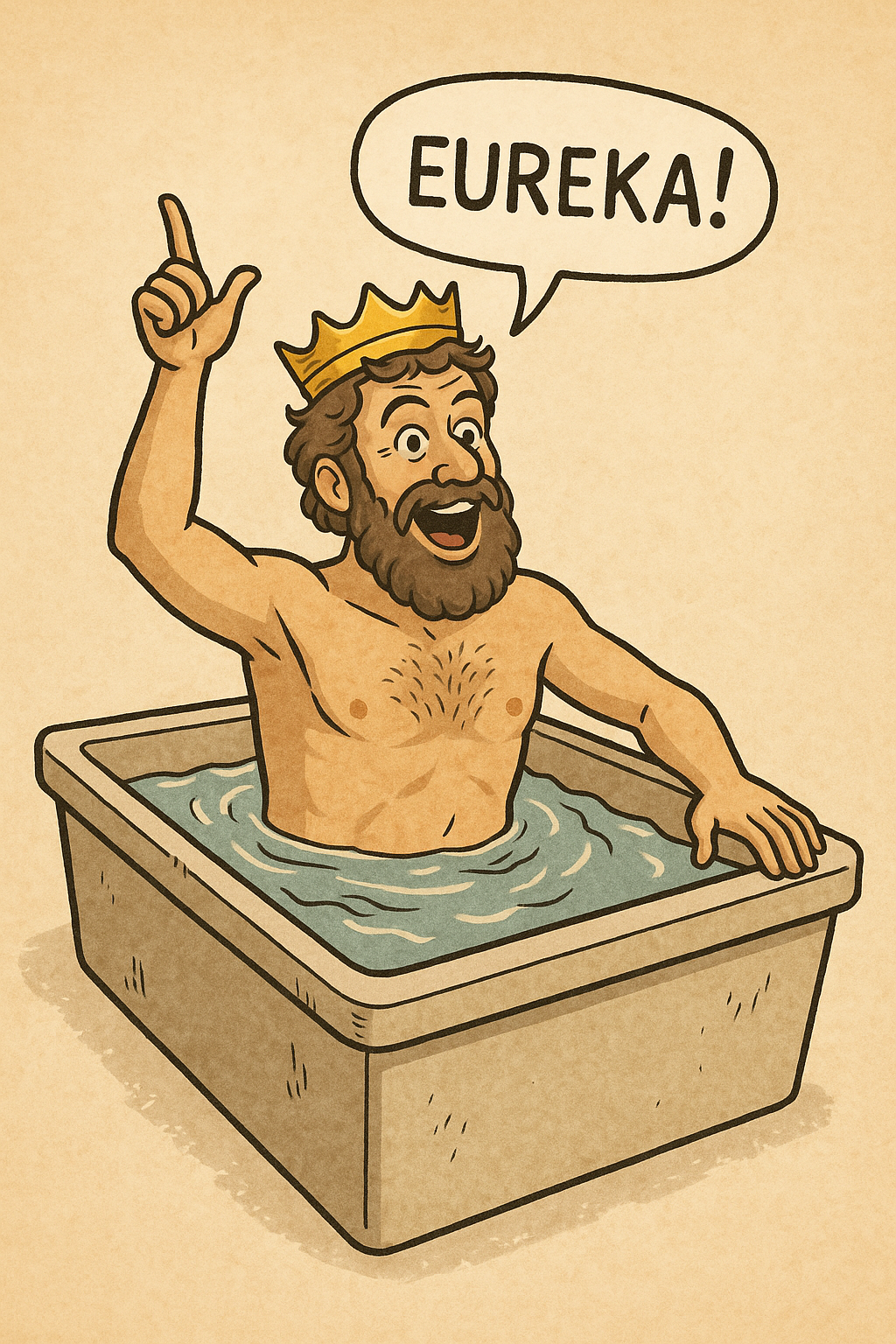
The popular imagination remembers Archimedes as the eccentric genius. He leapt from his bathtub and ran naked through the streets of Syracuse shouting, “Eureka! Eureka!” The real brilliance lay not in the drama. It lay in the quiet depth of thought moments earlier. He stood waist-deep in water, confronted with a royal dilemma and the laws of nature.
It proves that the solid world is not at all what it seems.
The Case of the King’s Crown 👑
Our story begins over two thousand years ago with the brilliant thinker, Archimedes. A king had a beautiful new crown made of pure gold, but he had a nagging suspicion. He thought the goldsmith might have stolen some gold and mixed in cheaper, lighter silver. The crown weighed the correct amount, but how could the king prove the fraud without destroying the crown itself?
Archimedes was stumped, until one day he stepped into his bathtub and noticed the water level rise. In a flash of insight—a “Eureka!” moment—he realized the solution. An object submerged in water displaces a volume of water equal to its own volume. This was the key.
Silver is less dense than gold. Therefore, a fake crown mixed with silver would have to be slightly bigger to have the same weight. He submerged the crown. He then submerged a block of pure gold of the same weight. By comparing them, he could see which one displaced more water. The crown, indeed, displaced more water, revealing the fraud.
What All Emerged From the Bath
Density: The Marriage of Mass and Volume
The crown and the gold bar had equal mass but different volumes. The only explanation: a difference in density. Archimedes thus formalized the idea of density — mass per unit volume — long before it was systematically used. This principle is now fundamental in physics, chemistry, material science, and engineering.
Buoyancy and Apparent Weight
Archimedes’s Principle states: A body submerged in a fluid experiences an upward buoyant force equal to the weight of the fluid it displaces. This gives rise to the concept of apparent weight — how objects seem to weigh less in water. The notion that weight and mass are distinct becomes clear here.
Accurate Measurement of Volume
Before this, volume measurement for irregular objects was clumsy or impossible. Archimedes showed that you could use displacement — a clean, fluid-based method — to measure the volume of oddly shaped objects.
Specific Gravity
Density of liquids
The idea of comparing the density of a substance to that of water — specific gravity — originated from Archimedes’s approach. This comparison came naturally. It allowed a practical way to distinguish materials, test purity, and calculate buoyancy.
The Urinometer: Archimedean Principles in Medical Diagnosis
A urinometer is a medical device. It uses the principle of buoyancy—just like Archimedes’ original insight. Its role is to measure the specific gravity of urine. It is essentially a hydrometer calibrated for clinical use. The specific gravity provides critical diagnostic clues about the concentration ability of the kidneys and overall fluid balance.
By floating in urine, the hydrometer rises or sinks depending on the density of the fluid. This makes it possible to detect medical conditions such as:
- – Acute and chronic renal failure (low specific gravity)
- – Syndrome of inappropriate ADH secretion (SIADH)
- – Dehydration (high specific gravity)
- – Water intoxication or overhydration (very low specific gravity)

Illustration: A urinometer in use. The height to which the hydrometer floats correlates with the specific gravity of urine—a vital clinical measurement derived from Archimedes’ ancient principle.
The Concept of Shape and Hidden Volume
The crown appeared “larger” than the gold brick. Archimedes made the profound distinction between apparent bulk and true volume. This leads into later ideas of porosity, voids, and the difference between solid mass and composite structure.
A New Measurement Technique
Archimedes effectively invented the principle of displacement measurement — still used today in fluid displacement tests, from hydrometers to pycnometers.
Precision and Quantification in the Natural World
Most crucially, Archimedes brought mathematics to bear on the physical world. Geometry became a tool to weigh, measure, and judge. He showed that logic and observation could unite — and do so with life-and-death stakes.
The Human Drama: The Fate of the Goldsmith
The story often ends with the cry of “Eureka!”, but it began with a legal and ethical dilemma that had a serious human consequence. According to the primary source, the Roman architect Vitruvius, Archimedes’ method successfully proved the fraud. The goldsmith had indeed stolen some of the gold. In the justice system of the 3rd century BCE, this was not a simple breach of contract. It was a betrayal of a king. While records don’t specify the punishment, we can assume the goldsmith faced severe consequences. This added a life-and-death gravity to Archimedes’ scientific investigation.
Bricks, Beads, and What Water Knows
To truly grasp Archimedes’ genius, imagine you have a solid brick of gold and a pile of tiny gold beads. Both weigh exactly one kilogram. If you put them in separate boxes, the beads would take up much more space. This happens because of all the little air gaps between them. This is their bulk volume.
But if you submerge them in water, something amazing happens. The water flows into every nook and cranny between the beads. In the end, both the solid brick and the pile of beads displace the exact same amount of water. The water ignores the “bulk” and measures only the true volume of the gold itself. This is precisely how Archimedes exposed the crown’s true, less dense nature.
The Birth of a Discipline: Non-Destructive Testing (NDT)
King Hiero’s challenge was not just to test the crown’s purity, but to do so without melting it down. In modern terms, Archimedes was tasked with performing Non-Destructive Testing (NDT). This story is arguably the first documented case of this crucial scientific and engineering field. Today, NDT includes a wide array of techniques. These range from X-rays and ultrasounds checking for cracks in airplane wings. They also involve magnetic resonance imaging analyzing materials at a molecular level. All of these methods are rooted in Archimedes’ solution. It signifies the quest to understand an object’s internal properties while preserving its external integrity.
Iron Ships and the Triumph of Buoyancy
One of the most powerful and practical applications of Archimedes’s discovery came centuries later. People realized that even iron, a material much denser than water, can float. How? The answer lies not in the material itself, but in the shape and total volume of water displaced.
An iron ship, though made of heavy metal, is constructed with a hollow hull. The air inside the hull plays a crucial role. It ensures that the ship’s average density is less than water. This is achieved by dividing the ship’s mass by its total volume. As long as the weight of the water displaced equals the ship’s weight, the vessel floats.
This is not magic. It’s the deliberate use of Archimedean physics — balancing the force of gravity with the buoyant force. Modern engineering owes this principle its very foundation in naval architecture.
Iron ships float because their shape ensures they displace enough water to balance their weight.
A Deeper Secret: Spaces in Water Itself! 🧂
The idea of hidden spaces doesn’t stop with solids in air. What if we look at the water itself? Fill a glass with water to the brim. Then, carefully stir in a spoonful of salt. You will notice the level barely rises. The salt seems to vanish.
Where did it go? It tucked itself into the invisible, interstitial spaces that exist between the individual water molecules. This simple experiment proves that even liquids, which seem continuous, are made of particles with empty spaces between them.
The Ultimate Emptiness: Rutherford’s Revolution ⚛️
For centuries, this was where the story ended. But in the early 20th century, a physicist named Ernest Rutherford decided to probe the very nature of the atom. In his famous experiment, he fired tiny particles at a sheet of gold foil so thin it was practically transparent.
Rutherford’s Scattering Experiment: The Birth of Nuclear Physics
This revolutionary yet straightforward experiment shattered the classical image of the atom. When alpha particles were fired at a thin sheet of gold foil, most passed through undisturbed, but a few were deflected at large angles. This indicated that atoms are mostly empty space, with a small, dense, positively charged nucleus at the center — a discovery that redefined modern physics.

Diagram: Rutherford’s scattering experiment revealed the nucleus and the emptiness within the atom.
The result was astounding. Almost all the particles shot straight through as if nothing was there. Only a tiny fraction were deflected or bounced back. Rutherford had discovered that atoms are not solid balls but are, in fact, almost entirely empty space. All their mass is concentrated in a tiny, dense center called the nucleus. The solid world had suddenly become a void.
The Illusion of Solid: Feynman’s Force of Touch 👇
This leads to the final, mind-bending question: If matter is 99.99% empty space, why can’t I push my hand through this table? Why does the world feel solid?
The brilliant physicist Richard Feynman provided the answer. When you “touch” an object, the atoms of your hand never actually make contact with the atoms of the table. Instead, the electron clouds surrounding the atoms in your hand get incredibly close. They approach the ones in the table. These electron clouds push each other away. This interaction occurs with enormous force.
What you feel as “solidity” is not contact; it’s the powerful electromagnetic force of repulsion. You are, in a sense, floating on a force field just above the table’s surface.
Our journey spans from a king’s crown to the fundamental forces of the universe. It shows us that science is a process of unmasking hidden realities. The solid world is a grand and beautiful illusion. It is built first on the density of its materials. Then, it is formed on the spaces between its molecules. Ultimately, it relies on the vast emptiness within its atoms, held together by invisible forces.
#Reflections on the Eureka Moment#
“Give me a place to stand, and I will move the earth.”
— Archimedes
“Eureka! I have found it!” — attributed to Archimedes on discovering the principle of buoyancy
Comments
3 responses to “Archimedes’ Real “Eureka”: What Rose From the Bath”
Information with insight
Yup, a kilo of gold foil and a brick will displace equal amount of water!
[…] Archimedes’ Real “Eureka”: What Rose From the Bath […]