https://www.britannica.com/place/Assyria
The Fall of the Assyrian Empire: Middle Eastern Turbulence
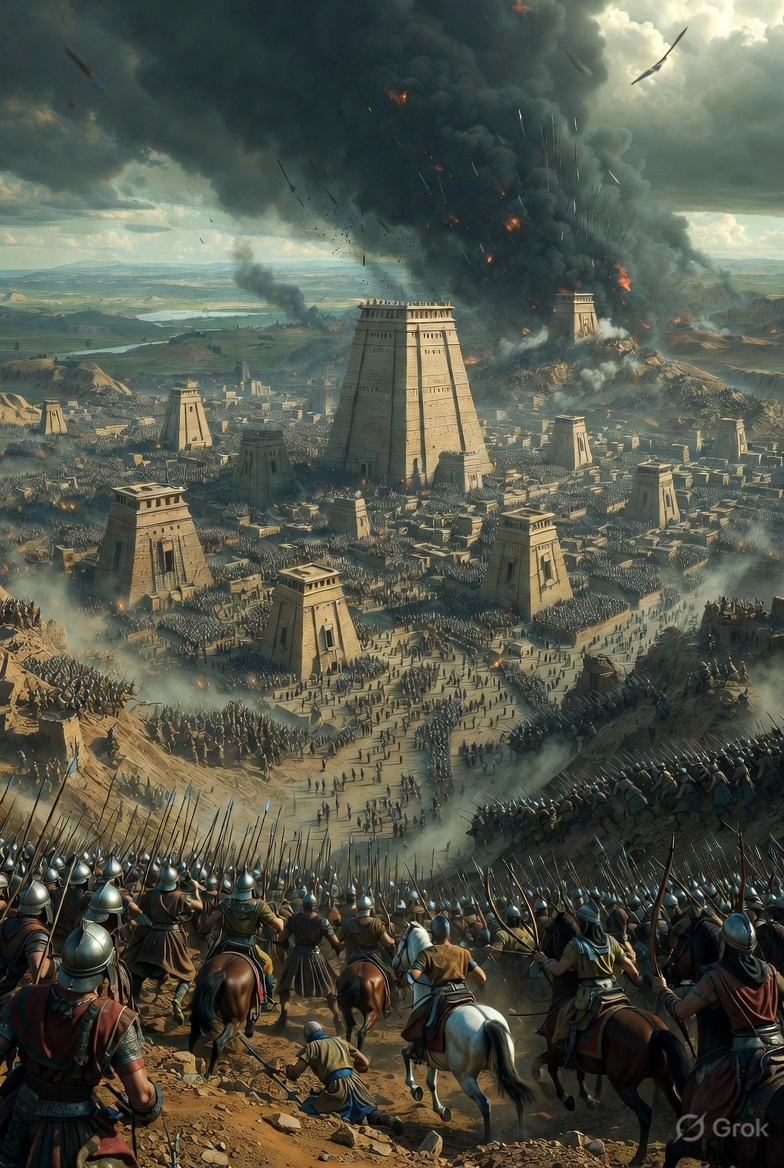
The Neo-Assyrian Empire is at its peak in the 7th Century BCE. The empire was based on the ruthless subjugation of its neighbors and controlled vast territories from Egypt to Anatolia and the Zagros Mountains. But sustaining power meant further conquests, more repression, brutal extermination; they were deeply hated and feared. They were the superpower of the day. Nineveh was a super city like New York. However, internal growth could not keep pace with prosperity; the problems of succession and the empire’s overextension led to its downfall. The downfall was so rapid that it has yet to be matched in terms of rapidity, spanning only 3 years from 612 to 609 BCE.
Civil War
Internal factors, such as civil wars (e.g., between brothers Ashur-etil-ilani and Sin-shar-ishkun around 627 BCE), economic strain, population booms followed by droughts, and leadership instability, created vulnerabilities. This “time of weakness” allowed a coalition of former victims and rivals—primarily the Babylonians (under Nabopolassar), Medes (under Cyaxares), and possibly Scythians or other groups—to unite and sack key cities like Nineveh (612 BCE) and Assur (614 BCE), turning the empire into “ruin heaps.” The empire didn’t “disappear” overnight but fragmented, with its territories absorbed by the victors, marking the end of Assyria as a dominant force. The ending was so complete and the empire’s absorption so total that the original Ozymandias could have been a lamentation for this fall; it was for Rameses II, I think.
But the seeds of decline had been sown many years back in 626 BCE. External coalition and hatred: Resentful former subjects united against Assyria. Nabopolassar (Chaldean leader) led a Babylonian revolt from ~626 BCE. He allied with Cyaxares of the Medes (from modern Iran) and possibly with the Scythians or Cimmerians. This Medo-Babylonian alliance exploited Assyria’s vulnerabilities. When the Greek historian Xenophon marched past the ruins of Nineveh only 200 years later, he didn’t even know it had been the capital of an empire; he thought they were just old Median ruins. The erasure was that complete.
The Mediterranean Cauldron
The cauldron has been simmering ever-since and the whole Mediterranean region has not seen lasting peace, seething tribal rivalries have kept the pot boiling, The wandering God Of Israelites the punisher, would punish anybody sometime its own people for praying to Rival Gods, so the Gods were at war too the pagan Gods and the one God, all fought, that was the only enjoyment. The Israelites introduced the radical idea that their God was using the conqueror (Assyria) as a “rod of anger” to punish them. This internalized the conflict, making religion a matter of survival and identity rather than just a state ritual
In the 7th century AD, one God triumphed, ushering in even more strife. Now, a larger entity than any tribe, it took everybody in its fold. This God had high ambitions. Earlier, it wanted only one tribe; now, in its new Avatar, it wants the whole of Humanity. Crusades happened, fighting and war, all around till the present day. Mithra of the Druids was wiped out, but the tribes remained to marry within, secure common frontiers so internal strife never quite went away, and inter-tribal warfare was a dash of spice in an otherwise humdrum existence.
The Road map
| Era | Power Dynamic | The “Spice” of Conflict |
|---|---|---|
| Neo-Assyrian | Hegemony through Terror | Subjugation & Tributary states. |
| Medo-Babylonian | Coalition Warfare | The “Ruin Heaps” of former masters. |
| 7th Century AD | Universalist Expansion | One God, one fold, total humanity. |
| Modern Day | Ideological/Proxy War | The “Cauldron” boiling over into global politics (US-Iran). |
The Soul Collector
There is a dark place in the Human heart; nobody has seen it, but all bow to it. It is the war-making fetish and bending a will to your own purpose for myriad reasons, Gods are full participants, nay, as clapping, goading and instigators. Humans are willing or unwilling slaves, but the news of somebody being worsted is the best newsworthy event in this boring existential world. From Troy to modern proxy wars, the eastern Mediterranean has remained history’s most persistent battlefield — where geography, empire, religion, and trade continually collide.
Conflict Timeline: Eastern Mediterranean & Near East
| Period | Dominant Power | Key Conflict / Event | Historical Meaning |
|---|---|---|---|
| ~1200 BCE | Mycenaean Greeks vs Anatolian states | Trojan War | Mythic beginning of Mediterranean warfare tradition |
| 1274 BCE | Egypt vs Hittites | Battle of Kadesh | One of the earliest recorded large battles |
| 900–612 BCE | Neo‑Assyrian Empire | Assyrian conquests across Levant and Egypt | Empire built on terror and deportation |
| 614–609 BCE | Medes & Babylonians | Fall of Nineveh | Rapid collapse of Assyrian superpower |
| 550–330 BCE | Achaemenid Empire | Rise of Cyrus the Great and Persian expansion | First great trans-continental empire |
| 499–449 BCE | Persia vs Greek city states | Greco‑Persian Wars | Defense of Greek independence |
| 334–323 BCE | Macedonian Empire | Campaigns of Alexander the Great | Persian Empire destroyed; Hellenistic world begins |
| 53 BCE | Rome vs Parthia | Battle of Carrhae | Roman expansion checked by eastern cavalry empire |
| 636 CE | Arab Caliphate vs Byzantium | Battle of Yarmouk | Beginning of Islamic Middle East |
| 1095–1291 | European Crusaders vs Islamic states | Crusades | Religion becomes transcontinental warfare |
| 1453 | Ottoman Empire | Fall of Constantinople | End of Byzantine Empire |
| 1914–1918 | European Empires | World War I Middle Eastern Campaigns | Collapse of Ottoman imperial order |
| 1948–present | Regional states | Arab–Israeli wars | Modern geopolitical struggle |
| 1980–1988 | Iran vs Iraq | Iran–Iraq War | Industrial-scale trench warfare in modern era |
And it is only a small sample
The current US- Iran war
Iraq is already rolling in the dust, Afghanistan is in oblivion, no neighbor in the Middle East trusts the other, and it is the turn of Iran. At present, the situation is Assyria-like; it is an external Coalition that is against the very idea of Iran as it is today, and they would drum it into submission. That they will do maybe tomorrow or by this very evening, who knows the war that is happening now, and who knows the morrow of desolation, and how long it will last. There are those who think it is a Dangal, a wrestling match; tomorrow, Iranians shall have to breathe again; the seed will hopefully grow less crooked than it was before. It might be the last tribal/ God warfare, next will be the secular egalitarian war of Haves and have nots.
“Whether the next war will be waged over gods, ideology, or resources remains to be seen. But the machinery of the Soul Collector—indifferent to the banner under which it operates—suggests that the calendar may change while the appetite remains eternal. The question is no longer what we fight about. It is whether we can imagine fighting no more.”