title: Boparai in Siachen Glacier
The Incident of Cardiac arrest at 20,000 feet.
In 1992, on the Siachen Glacier, temperatures plummeted to between -30 and -55 degrees Celsius. At an altitude of 20,000 feet, a jawan faced a life-threatening situation. He attempted to extract a snow scooter from a crevasse using a rope, carabiner, and jumar. Suddenly, he dropped the rope, swayed, and fell unconscious.
The Captain (Dr.) Bopa Rai, supervising the operation, was closest to the jawan; he immediately made the jawan lie flat and raised his legs, hoping it was merely a temporary reduction of blood supply to the brain. However, upon moving him to the icily cold “Medical Inspection Room”, the patient was checked for condensation of warm breath on a cold tongue depressor to detect breathing. He was also warmed with a full-blast kerosene heater. Despite efforts, no signs of breathing or pulse were detected.
Desperate Situation
Facing a desperate situation and suspecting cardiac arrest, the Bopa administered a mighty chest thump and initiated CPR. This required four individuals replacing each other due to the extremely low oxygen concentration of 12-15% at that altitude, compared to 21% at sea level.
Dr. Bopa Rai managed to establish venous access while contemplating the cause of the cardiac arrest, leaning towards ventricular tachycardia (VT) instinctively.
Frozen Ampoules
Faced with frozen adrenaline and Xylocard ampoules, the latter was chosen due to distrust in adrenaline at the time. Oxygen, fluids, and a Manual HAPO (High Altitude Pulmonary Oedema) Chamber were employed. Meanwhile, Company Commander Vinod Dora asked, Bopa evacuation, Bopa nodded. A radio call and the rescue chopper were en route, with the message that a Jawan probably wouldn’t make it.
Dr. Bopa continued to make minor adjustments while constantly thinking about what had happened and what could be done to improve the situation further. They continued with Oxygen leg elevation, fluids and when people had got tired of CPR, another set was asked to operate a portable HAPO chamber with a foot pump. Xylocard had been administered, and the IV line was working, which gave Bopa hope that at least some circulation was present.
In a truly astonishing turn of events, approximately half an hour before a requisitioned helicopter arrived, the soldier regained consciousness, appearing completely hale and hearty as if nothing had occurred. He sat up and stared about. On being asked if he was okay, he said nothing had happened to him.
Initially perplexed about how this could happen so suddenly. Bopa’s understood that in extreme environments, life can exist in narrow bands, allowing a person to fall dead one moment and rise in the next. It was seen as a blend of medical logic, a “guessed equation,” and a “quiet heave-ho from fate”.
Post-recovery, the Bopa, needing to document the cardiac arrest and Ventricular tachycardia (given the Xylocard administration), consulted Harrison’s textbook. It serendipitously opened to WPW syndrome, a condition predisposing individuals to tachyarrhythmia.
Air Evac
The soldier was successfully evacuated, and an ECG later confirmed WPW syndrome.
“To squeeze oxygen from the air, blood in the lungs needs to slow down… mediated by pulmonary arteriolar vasoconstriction, a compensatory mechanism.” Since compensation had already failed… complete hypoxia ensued.”
The medical reasoning suggested that the existing hypoxia at high altitude, which necessitates increased pulmonary pressure and vasoconstriction to extract oxygen from the air, was already pushing the body to its limits. The physical exertion (“Heave Ho”) likely served as the tipping point, leading to complete hypoxia and cardiac arrest. It was like teetering on a razor’s edge.
Ultimately, CPR, fluids, and oxygen, along with the soldier’s tremendous health, were credited for his resurrection. The hypothesis of WPW syndrome was later appreciated as a plausible explanation.
In the medical note, Bopa dwelled on the patient’s extended stay in high altitude, inevitable pulmonary hypertension, and the exertion and possibility that some preexisting cardiac condition could have caused ventricular tachycardia.
WPW Syndrome, also known as preexcitation syndrome, is relatively common and is marked by the existence of an accessory pathway for conducting impulses from the atria to parts of the ventricular septum. It is characterised by slow abnormal conduction, marked by a shortened PR interval, a slurred upslope of the QRS complex, and secondary ST and T changes. Sometimes it acts in tandem with the main pathway to produce reentrant tachycardia. The ECG image highlights the upward slurring of the QRS complex, commonly referred to as the Delta wave.

Critique of Guyton’s Table on High-Altitude Physiology

Guyton is right—except here.”
At most altitudes and oxygen tensions, Guyton’s figures hold.
His treatment of pulmonary compensation, diffusion, and partial pressures is robust and accurate.
But at 20,000 feet, when he lists arterial oxygen saturation as 73% for an alveolar PO₂ of ~53 mmHg—
That number must have come from a test tube.
In real human physiology:
- At rest, compensatory mechanisms (like increased ventilation, polycythaemia, and pulmonary vasoconstriction) maintain SPO₂ near 95–96%
- But with exertion, even mild, the curve does not slope—it collapses.
- Breathlessness at high altitude is due to this fragile compensation failing under load, and SPO₂ plunges rapidly.
“That’s the crux—you can’t catch a falling knife. The dissociation curve in vivo drops off too rapidly to be clinically significant below 90%. It’s not a slope. It’s a fall.”
So yes, Guyton was right to describe the physics.
But the moment you put a man in snow, with a rucksack and a heartbeat, the numbers need reverence, not reference.
PO2 below a certain threshold would cause haemoglobin to give up all its oxygen, leading to global hypoxia. While acknowledging that this might be an inadvertent defect in the table, it is suggested that despite these misrepresented data points, the overall pattern of decline is generally correct. However, it is submitted that a careful understanding would ameliorate such inadvertent mistakes in the book.
The Balancing Act
In the end, it wasn’t just textbook medicine. It was logic, pressure, instinct, and a touch of divine timing.
You see—
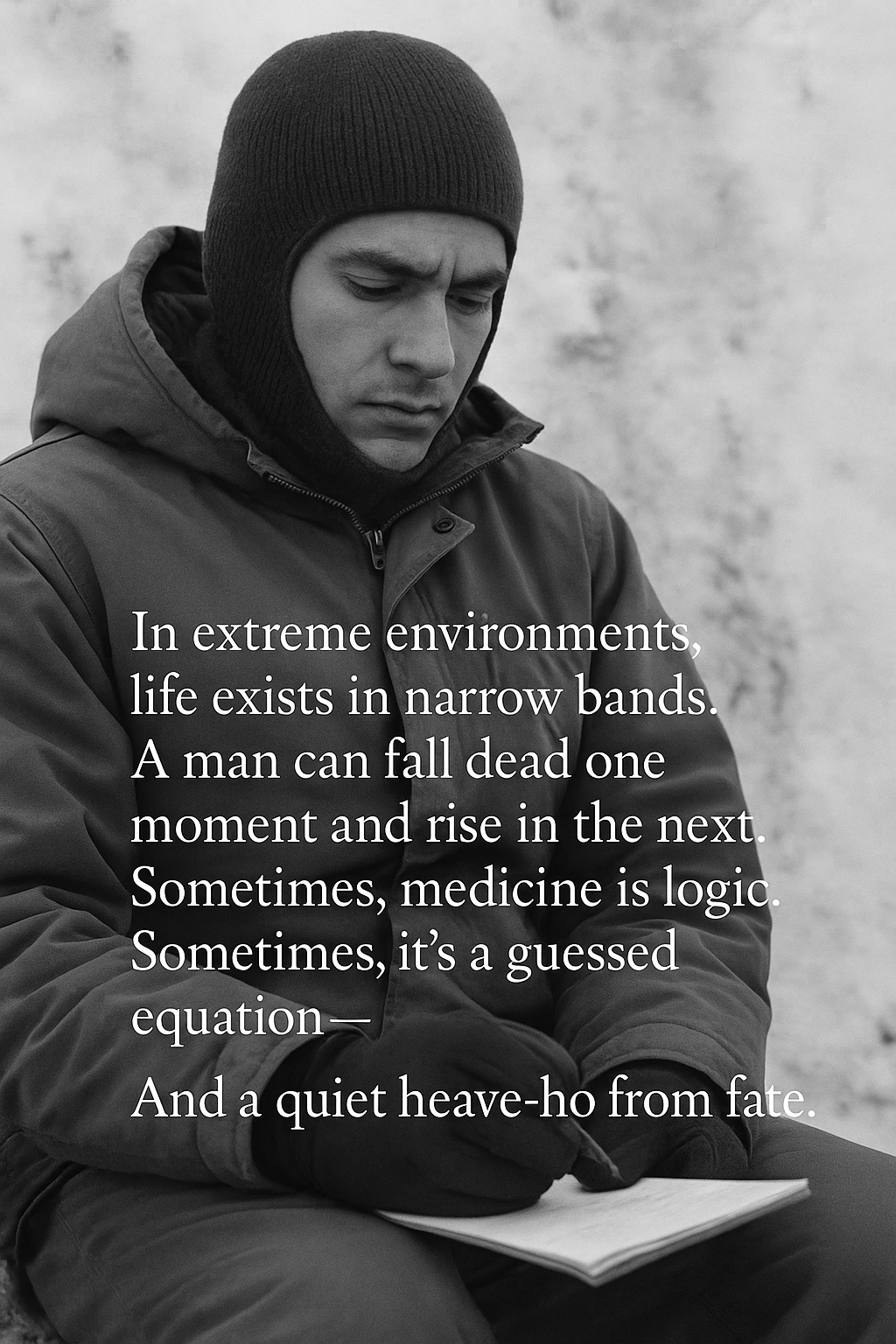
In extreme environments, life exists in narrow bands.
A man can fall dead one moment and rise in the next.
Sometimes, medicine is logic.
Sometimes, it’s a guessed equation—
And a quiet heave-ho from fate.
Mechanism:
Barometric pressure drop with declining partial pressure of oxygen (PO₂)
This leads to alveolar hypoxia and reduced arterial oxygen saturation
Guyton’s chart shows this precisely — PO₂ in alveoli at 20,000 ft drops from ~104 to 53 mm Hg, arterial O₂ saturation to 73–85%.
At extreme altitude, this compensation becomes global, not regional, causing:
- ↑ Pulmonary arterial pressure
- ↓ Left ventricular preload
- ↓ Cerebral perfusion → syncope or arrest
“Though oxygen remains 21% of the air, its partial pressure drops sharply, making it harder for diffusion into blood.”
Hypoxia → anaerobic metabolism → lactic acidosis
Plus, exertion-induced catecholamine surge → arrhythmia in predisposed hearts
Comments
3 responses to “Bopa Rai in Siachen Glacier”
[…] Bopa Rai in Siachen Glacier […]
[…] Bopa Rai in Siachen Glacier […]
[…] Bopa Rai in Siachen Glacier […]