Chronicles of Dr. Bopa Rai
Dr. Bopa’s Clinical Notebook
Jul 18, 2025 – The phrase “Rum Mein Base Hain Ram” has been gaining popularity recently.
Case 72B – Hepatic Encephalopathy
Location: Ward 7 (Yellow Block), Bed 11
Name: Rashid Khan
Age: 64
Diagnosis: Decompensated cirrhosis, portal hypertension, recurrent encephalopathy
✎ Entry – 2:47 AM
The fog has returned. Patient has ceased making sense. Muttering in verse, referring to long-dead relatives, and giving directions to a railway station that hasn’t existed since Partition. The family is distraught, assuming this is madness. I tell them it is not madness. It is chemistry pretending to be madness.
✎ Entry – 5:03 AM
Protein Catabolism
It’s muscle now doing the liver’s work. His quadriceps have vanished in two weeks. He weighs as much as a schoolboy. Serum albumin: 2.1 g/dL. SGOT/SGPT ratio inverted. Ammonia rising again. Muscles take up ammonia and synthesize glutamine—until they burn themselves out.
✎ Entry – 9:17 AM
Essential vs Non-Essential
Irony strikes hard here. The “essential” amino acids—valine, leucine, isoleucine—are all low. These are the very ones that help oppose encephalopathy, yet he’s depleted. They are used up in muscle wasting. Meanwhile, the aromatic ones (phenylalanine, tyrosine) rise and cross the blood-brain barrier, misbehaving like drunken diplomats. “In cirrhosis, the good ones are missing, and the bad ones take their place. As in life, so in metabolism.”

✎ Entry – 12:42 PM
Why Not IV Feeding?
Junior doctor asks me why we’re not doing total parenteral nutrition. I ask her to imagine this: pouring more water into a flooded engine.
- Parenteral protein increases nitrogen load.
- Nitrogen becomes ammonia.
- Liver is comatose.
- The brain is the casualty.
Instead, we use branched-chain amino acid-enriched enteral feeds, slowly, as tolerated. IV feeding is a last resort, not a first reflex.
✎ Entry – 3:10 PM
Philosophical Note
I once read somewhere that the soul is shaped by what it can no longer digest. “He once died of this, in another life,” the patient had said yesterday. I am beginning to believe him.
✎ Entry – 6:45 PM
Prognosis
Guarded. He has responded to lactulose but remains frail. Today, he asked if this was a real place. I told him: “Only just.”
After 3 days of lactulose and antibiotics, Rashid wakes up fresh. “I would like to have a chilled Vodka with ice and a dash of lemon, please.”
He was denied the bottle and kept on lactulose for a few more days. He was discharged in a walking condition. He was certified to have a sound mind. He reached home and straight away opened the cupboard. He took out a Lemon Bacardi.
He thought whisky was the culprit. Rum is OK because ”Rum mein Base Hain Ram”. His better part was scolding and hovering over him, spoiling the taste of Somras.
For some reason, the left lobe of his liver had suffered less damage. It was able to handle the little alcohol he was having. He continued with life, drinking only a little.
His wife noticed that her normally taciturn and recalcitrant husband was speaking very animatedly. She persuaded him to undergo a routine medical checkup. He agreed. Dr Bopa was his lifelong friend. Dr Bopa was only 10 years younger. He was once a kid but is now a contemporary at 54 years of age.
LFT normal, animation likely mania. Bopa noted he was referred to a Psychiatrist.
The psychiatrist, Dr. Minhas, was a deeply religious man. Between patients, he counted the beads of his Rudraksh Mala. He lip-synced with inner Gurbani Jap. He gradually discovered that the patient had a history of Bipolar disorder. The patient had stopped taking Lithium during Rashid’s army service. He was in medical category for the same.
Rashid had a cunning moment. He went to the personnel branch and got hold of his medical file. He discreetly dumped it in the dustbin outside. Ever since he had been free of the interfering medical branch and his compulsory hospital visits.
Dr. Minhas realised that the mania he gets is mild. His wife is capable of handling that much excitation or depression. He, anyway, restarted Lithium as it is a reasonably effective and safe membrane stabiliser. Dr Minhas knew that elderly Rashid was stubborn. Therefore, he requested that his highness take lithium and eat pumpkin daily. This was necessary if he wanted to continue with alcohol. Rashid complied.
On his own however, he augmented lithium with marijuana. As tolerance developed, he switched to Opium. Years passed.
First Wicket
After six years, Fatima, his wife, developed gallstones. One of these stones got stuck in the pancreatic duct. She developed pancreatitis and severe pain in her tummy. She also developed pneumonia causing breathlessness. She was put on a ventilator and treated conservatively. Her blood had turned white due to the breakdown of a massive amount of fats. She died on the fifth day.
Rashid, at 70, was often visited by her Ghost. The Ghost tried to say something. However, every ghost would disappear after he took two large pegs of Rum or sometimes whisky. He had become ambivalent. These were his nightcaps. Soon they turned into two Patiala pegs. The measuring technique for Patiala size peg is simple. One finger equals 30 ml. Two fingers equal 60 ml. Four fingers make a Patiala, which is 120 ml. Add 4 more, and it is large Patiala; two large Patialas equal half a bottle. Rashid reached this level.
Second Wicket
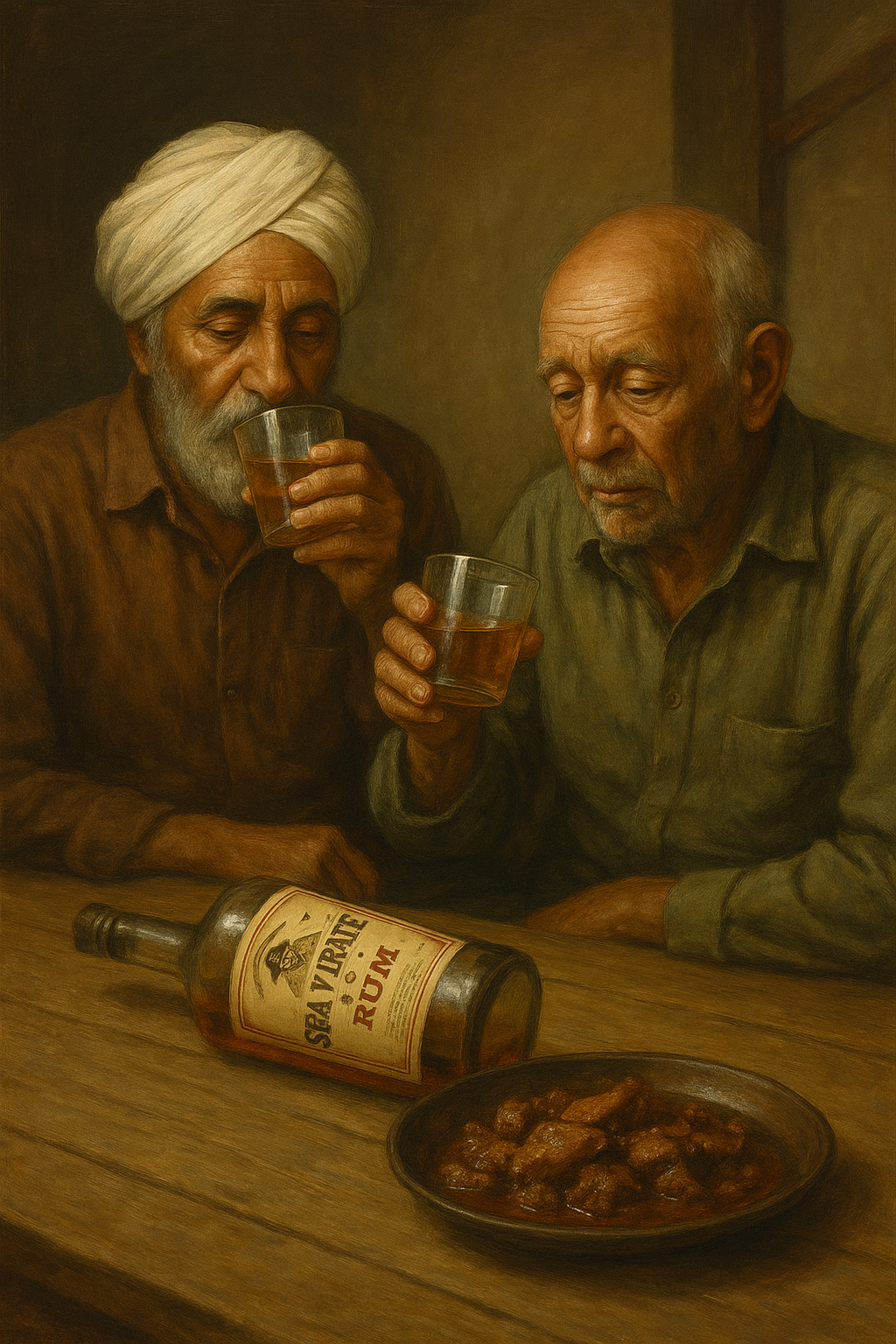
His Doctor, Bopa Rai, visited him often, sometimes with a bottle of Rum. Rashid had prepared Sukha mutton for the visit that day. It was his 75th birthday. Together they had four large Patiala each. The bottle lay horizontal.
Dr Bopa Rai, as he stumbled back home, thought, this guy is a goner. However, he thought ruefully and admitted that mania colored his encephalopathy an oversight.
At home, he opened his cupboard and took another Patiala. Tomorrow, he remembered he had a night duty. Let’s finish the quota today, he thought. He repeated the sacred procedure and fell on the bed, dead to the world and its noise. At night, he woke up trembling, went to the bathroom and vomited a basin full of blood. Bopa Rai collapsed.
The next day, his colleagues came to check on him and found him dead. Bopa lived alone, unmarried. Rashid came to know of it on the thirteenth day (Teharwin). The hospital had arranged a Puja for the soul to pass into the next realm. Rashid watched and smiled; his own destiny was to be buried and rise on the day of the reckoning.
Rashid was 75 then; out of courtesy, a young man escorted him back home. Rashid quietly made two large Patiala pegs and offered one to the young man “for Dr Bopa Rai”; they cheered.
“As Rashid stood up for the second round, what is your name, son?”
“The young man said Bopa Rai.”
“Any relation of Doctor?”
“Distant,” young Bopa Rai said.
We can choose when to go and where to go, he looked at Young Bopa Rai. who raised his glass in agreement.
Wife gone, companion Dr Bopa gone, his wife’s Ghost reappeared and said Khuda Ke liye ab to band karo. You don’t even listen to me these days. Rashid quietly got up and made another Patiala. To dispel her.
Rashid was now 90 years old, and his Batman Mehar, at 70, was finding it difficult to look after Rashid. He said he would call his son, as a young man is needed to look after the house.
“Why don’t you get married?” Rashid asked him.
“Arre Sahib, what is the guarantee of my living any further?”
“I will give you 10 years of life,” Rashid said. “Bring a widow who is 60 years old and your son too.”
At this, Mehar Singh laughed, almost doubling over. “You’d better complete your century, Sahib.”
“I am not joking, Mehar,” Rashid said. “Just do as I said, get your unemployed Son and give him a mother too.”
“Yes, Sir,” 70-year-old Mehar said.
“Plan is Mehar Singh. I guarantee you at least 90 years of life. This house and all my property are yours. Stay here with your son and a new wife.”
— An Unbroken Century —
Mehar Singh, true to his Sahib’s wishes, brought a woman from his village. She was a sturdy, good-hearted widow named Santosh. He also brought his son, Jaswant. Rashid, true to his word, had the property papers drawn up, a testament to his own peculiar brand of honour. He watched the subtle shift in the household. Santosh brought a bustling energy, the smell of fresh rotis and spices that were not just for him. Jaswant, a strong lad of thirty, took over the heavier chores. He tended to the garden and ran errands in Panchkula. He always showed a respectful deference to the ancient man. Occasionally, he seemed slightly bewildered by this man who occupied a permanent, almost geological, space in the house.
Third Wicket
Years blurred into decades. Mehar Singh, despite Rashid’s audacious guarantee, quietly passed away at 88, a peaceful end in his sleep. His prediction of Rashid completing a century had been half-right. Rashid had, indeed, completed many centuries. These were not of age, but of seasons. Santosh mourned her husband, but the house, now truly theirs, continued its rhythm. Her son, Jaswant, grew into a man in his prime, then silvered at the temples, then became an elder himself. He had children, then grandchildren.
Rashid remained.
He sat on the verandah, a constant fixture, like the ancient Banyan tree in the courtyard. The younger generations knew him as “Baba Rashid,” the great-great-grandfather of their line, though he was not of their blood. They’d heard the stories—whispers of his military past, his legendary drinking, the way he outlived everyone. But mostly, he was just there. He no longer spoke much, his voice a gravelly whisper lost to time. He still took his Patiala pegs. Sometimes two, sometimes three. They were no longer about dispelling ghosts. Nor were they about celebrating life. They were simply a habit, a ritual for a man beyond all ritual.
His memory, once sharp and cunning, had become a vast, untamed wilderness. Names faded. Faces blurred. He sometimes called Jaswant by Mehar’s name, then by his own son’s name, a son he’d long outlived and forgotten. He would look at the children playing in the courtyard, their laughter bright and ephemeral, and see ghosts. Not Fatima, no, her spectre had long ceased to visit. These were the ghosts of his own past, vibrant and real in his mind, superimposed on the living. He was forgotten in his own house, a silent, ageless sentinel in a stream of transient lives.
Final Call
One morning, the sun rose over the Shivalik foothills, casting long shadows across the familiar streets of Panchkula. Rashid, now well past his 120th year, rose from his cot. He felt an unusual clarity, a lightness he hadn’t known in decades. He looked at the faces around him—the latest generation of Mehar’s family, strangers caring for a stranger. He walked to the old cupboard, took out a dusty Bacardi bottle, and poured a single, precise peg. He didn’t drink it.
He simply walked out.
He passed through the familiar gate, out onto the lane he had known for over a century. The houses had changed. New shops had sprung up. The morning air was eternal. The distant sound of traffic was eternal. The smell of damp earth after a recent shower was eternal. He walked with a steady, unhurried gait, a man finally moving with purpose.
And there, leaning against a lamp post at the end of the lane, was a figure. Not the young man who had escorted him home all those years ago. This Bopa Rai was ageless, yet familiar. His eyes held the same knowing, weary compassion Rashid remembered. He wore simple clothes, a faded kurta, but there was an unmistakable aura about him, ancient and profound. He looked like he had been waiting.
“Took you long enough, Rashid,” Bopa Rai said, a faint smile touching his lips. He held out a small, unassuming bottle of Rum, just like the old days. “I thought you’d never tire of their comings and goings.”
Rashid looked at the bottle, then at the eternal Bopa Rai, his oldest, most enduring companion. The memories flooded back. They were clear and sharp. He remembered the hospital ward and the clinical notes. He recalled the shared bottle on his 75th birthday and the tragic fall. The ghost of Fatima, for the first time in an age, did not appear. There was no need.
“Rum mein Base Hain Ram,” Rashid rasped. His voice was a dry whisper. However, his eyes held a glint of the old cunning.

The Departure
Bopa Rai chuckled, a sound like wind chimes in an empty hall. “Indeed, old friend. And in us, there is only… us.”
Rashid took the bottle, not to drink, but to hold. Together, they turned and began to walk. They moved away from the house, away from Panchkula. They left behind the fleeting world of mortals. Two eternal figures were finally reunited on an endless journey. They had all the time in the world.
Comments
3 responses to “Rum Me Base Hain Ram”
[…] Rum Me Base Hain Ram […]
[…] Rum Me Base Hain Ram […]
[…] Rum Me Base Hain Ram […]