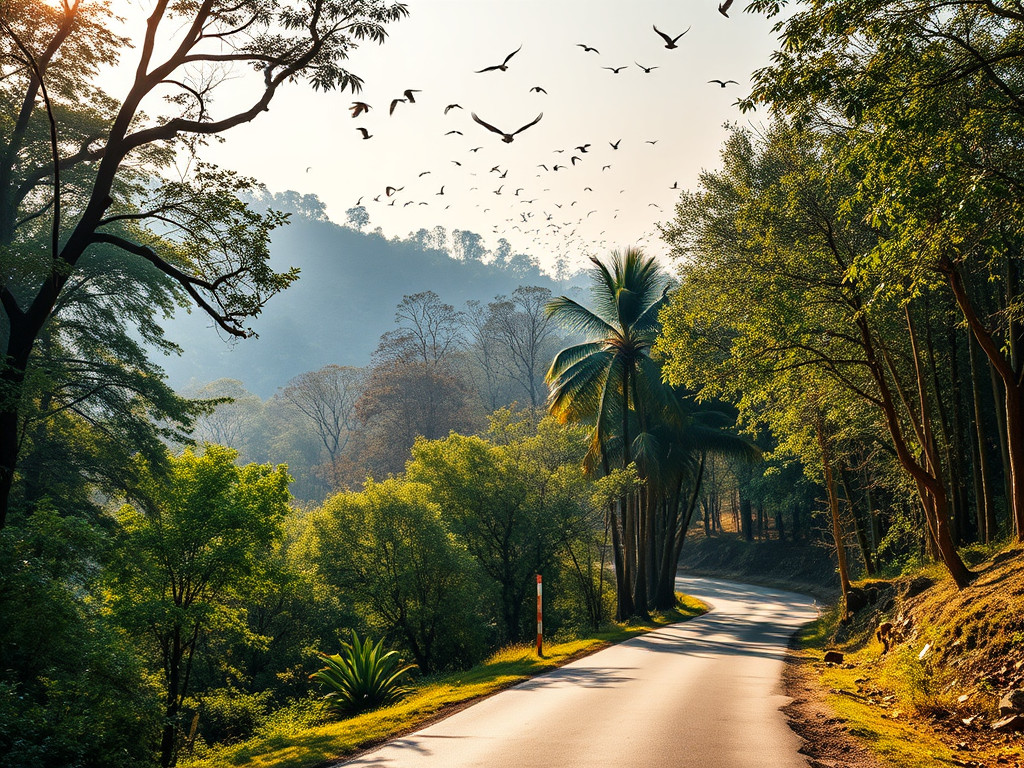
In Solan, it was seven degrees, but the sun was kind. The jungle in front of me was tamed but not disciplined—teak, siris, deodar, tun, eucalyptus, bamboo, and here and there a confused date palm. A teak tree blocked my sun. Behind it, an apple orchard waited in winter patience. The birds had already come and gone. A woman feeds them every morning at seven, and they keep time better than any clock. Tomorrow, I told myself, I will photograph them.
I was thinking of kiwi. There had been 125 vines. Some survived, some did not. A few had even fruited. Now I was going to Rajgarh to fetch fifty replacements. Everything has to be done by oneself. Labour is scarce. Hills does not believe in delegation. They believe in endurance.
It was Lohri, or Makar Sankranti—depending on which calendar you trust—and I left knowing there would be one bad stretch. The narrow patch near Garkhal. The Balaji temple. God save you there on a Sunday. Pilgrimage turns geometry into fate. On that road, one side is Scylla, the other Charybdis: cliff and collision. Once you enter, you do not choose. You wait.
And it was on that drive that Shannon walked into the car.
$$
H = – \sum p(x) \log p(x)
$$
Entropy is not chaos. It is uncertainty. It is the number of plausible worlds still standing.
On narrow roads, jams are expected. Their surprise is low. Their information content is poor. A cow, a bus, a tractor, a pilgrim—take your pick. It teaches you nothing. It only tests your patience.
But on good roads, a jam is a message.
At Dharampur, NH-5 opens like a promise. Smooth as butter. Engineered. Predictable. The brain relaxes—probability thins. So when a truck overturns, there—apples spilling like sudden theology—chaos erupts, not because of volume, but because of violation. This is a low-entropy system being forced into misbehaviour.
Apples are perfect agents of entropy: round, numerous, rolling, uncontrollable. Gravity becomes the transport minister. Slope becomes itinerary. People stop. People pick. People argue. Traffic freezes. Narrative begins.
The apples do not fall. They defect.
And then Panchkula appeared in the fog.
No sun. No horizon. No depth. Just grey thickness. The city is undecided. The world reduced to headlamp cones and guesses—entropy in the air.
Fog is not darkness. Darkness is honest. Fog is deceptive. Light exists, but direction does not.
Somewhere between Solan sun and Panchkula fog, between kiwi replacement and apple chaos, I was thinking of a man.
I met him for fifteen minutes. He came to deliver milk. Freshly bathed. Presentable. Gentle. Related to me. Fifty-two, he said. Once an engineering student. Then a calamity. All treatments tried. Even tantrik ones. Now on clozapine, clonazepam, and atorvastatin. He nodded off softly as we spoke. Not dramatically. Just… the head dipping, returning, dipping again.
He could reverse a car from a narrow space. Help with cows. Perform small daily competencies. He forgot things. Admitted it. Said “I don’t know” when he didn’t. No drama. No bitterness.
What struck me was not his cognition.
It was his posture.
He stood as if waiting to be dismissed from the presence. Not fear. Not crude subservience. Something older. As if his presence was provisional. And beneath it, unmistakably, honour.
He has two beautiful daughters. So anhedonia is not complete. Asociality is not full. Love has happened here.
What is damaged is something else.
Conation.
The will-to-act. The inner vector. The pressure that points a human being into the world.
He does not initiate. He does not project. He does not intrude.
But when a role is offered, he enters it.
Likely, his wife told him to deliver the milk. So he came. Freshly bathed. Unsupervised. Gentle. He accepted the task. He executed it. He stood. He waited.
Not passive. Responsive. Not inert. Externally animated.
His will has not vanished. It has been outsourced.
He is like a cow. Not in stupidity. In temperament. In the absence of wildness. In the soft obedience of a being that does not challenge the field it inhabits.
Gentle. Harmless. Useful.
Heartbreaking.
Because you can feel that this was once a man with a trajectory. A mind that leaned forward into the world. And now he exists in the outer rings of himself.
Clozapine and clonazepam have done their work. The psychotic fire damped. The danger neutralised. Society safe. Family relieved. This is not a moral failure of medicine. It is the price of peace.
But the price is direction.
And then there is the woman.
The one he was lucky to marry.
He was already diminished when she married him. Already dependent. Already fragile. It is not clear why she chose this life. Hope, pressure, kindness, calculation, resignation—families rarely articulate these decisions. They enact them.
Marriage can be therapeutic. But only when there is still a self to be strengthened.
When illness has gone too far, marriage does not cure. It contains.
It becomes care, affection, and management.
Nothing else.
She looks after him in all things. Food, clothes, medicines, instructions. His will has been outsourced to her, and she has accepted the contract without signing it. Not dramatically. Not martyr-like. With the quiet efficiency of a woman who has stopped asking the universe questions.
This is not romance. This is the administration of life.
Surrendering your soul to whatever absurdity life throws at you. Accepting it graciously. Give your best to it. Until it becomes a small story of fortitude, independence, and acceptance.
Not heroism. Not sainthood. Just staying.
And then there are the daughters.
Two of them. In college now. One in Shimla, one in Chandigarh. Both beautiful. Both are well adjusted. Both matter-of-fact about their father being mentally unstable, placid, affectionate, and limited.
They do not flinch around him. They do not dramatise him. They do not deny him.
They accept him.
Which is a far more advanced psychological achievement than tolerance.
He showers affection on them. They receive it without awkwardness. There is no embarrassment in the exchange. No discomfort. No apology. It is clean. It is natural. It is untheatrical.
They have grown up with a father who does not lead, but loves. Who does not command, but caresses. Who does not project, but protects in the only way he can.
And they have adapted.
Children are brilliant at this. They calibrate reality faster than adults. They don’t mourn what never was. They map what is.
So life goes on.
Not heroically. Not tragically.
Like a trundling cart.
Slow. Uneven. No acceleration. No collapse. Just movement.
And suddenly everything aligned.
The man without conation. The woman with surplus courage. The daughters with calibrated acceptance. The jam at Garkhal where belief collapses probability into certainty. The apples at Dharampur where rarity explodes into chaos. The fog at Panchkula, where uncertainty thickens. The kiwi vines that survived. The ones that didn’t. The replacements are on their way.
All of it was about direction.
Who decides it? Who loses it? Who borrows it? Who waits for it? Who carries it for others?
The man had lost his internal vector. The apples gained one from gravity. The pilgrims surrendered themselves to faith. The fog erased everyone’s. The woman became his. The daughters learned to live without one.
Driving between Solan sun and Panchkula fog, fetching kiwi plants to replace the fallen, I thought:
Some losses are total. They can be mourned. Some losses are partial. They must be carried.
The man who waited to be dismissed. The woman who married the calamity. The vine that did not survive. The road that betrayed its promise. The city that forgot its outline.
Not tragedies.
Just life, doing what it does.
Persisting. Unevenly. Unheroically. But… faithfully.