https://en.wikipedia.org/wiki/Strobilanthes_callosa ——Karvy rare blooming flower

🏞️ Prelude: Almora, the Hill of Misheard Borders
Bopa Rai pulled over at a tea stall in a niche under the Rocky hang, formed in one of the curves, which gave a feel as if it were a cave, a natural boundary between two distinct terrains. He was driving from Pithoragarh to Delhi. The next district was Almora.
A shopowner, in a desultory exchange, asked me where I was from. “Army,” Bopa said.
“Posted here?” he asked.
“No, just passing through.”
“Tourism?”
“Not quite.”
Then, with a quiet certainty, he said: “Nepalese live there.”
His inflexion of Hindi was Almora style—rounded, lilting, half-sung. He truly believed that across the hill was Nepal, and he was in India.
Pithoragarh does share a boundary with Nepal, and it was part of the large Gurkha empire. They have a dialect of their own—part Pahari, part Nepali. Yet they distinguish themselves from Nepalis.
Faces are the same everywhere, but the dialects change, mispronunciation, really, they vary from person to person. Even if they share adjacent land. Even if they marry each other.
The sticker goes with the mispronunciation. Borders are not drawn in ink. They are spoken in error.
And mispronunciation is not a flaw—it is a flag.
🏔️ Prologue: The Tryst in Almora
It was not a pilgrimage. It was a misstep.
A tryst with a cracked syllable in the hills of Almora, where the saints do not speak—they cough. I met her on the third bend past the peepal tree, where the road forgets its name. She wore a shawl stitched with dialects no scripture could decode. Her voice was a slur of lullabies and curses, and when she spoke, the air mispronounced itself.
“You’ve come to correct the tongue?” she asked.
“No,” I said. “I’ve come to let it bleed.”
What is on the shawl? Bhujanga Slokas by Adi Shankaracharya, sung in the Bhujangaprayata meter. We sat by the temple that had no idol, only echoes. She, it’s a hiss of the thousand-headed Shesh Nag, praise for Siva. She stood up with her shawl like a hood on one leg and hissed those incantations. Swaying. Hypnotised. Bopa, in reverence, bent down with folded hands as the divine hisses echoed, amplified thousands of times from the temple walls. She fell down in a heap. Bopa repositioned her and waited for her to open her eyes.
She stood up and pointed to a trail, “Go this way,” she said. “There, you would meet Karavi, Adi Shankaracharya’s flower. It blooms unpredictably after many years, and today it has bloomed for you.” Take a left turn till you see a lantern light, and Surya’s consort Chaya dancing in the flickering light, weaving a dance so exquisite that tears come, and language is forgotten. She will teach you the language of silences and Karvi the unpredictability.
“Leave your red cap here, they say a Churail attacks the bearers of red cloth, in a bend.” Bopa said, “Do you believe it?” “No,” she said, “but you might.” Reluctantly, Bopa parted with his red fur Russian Cap, a relic of Napoleon’s disastrous Russian campaign, which he had taken from the body of a Russian General in Moscow.
He took his leave eagerly, looking for Adishankara’s Karavi, Strobilanthus Callosa, a sacred Rigvedic flower. He muttered Strobilanthus Callosa and Karavi alternately, almost like a Mantra. He took a left, leaving the thick growth of karavi shrubs behind with their translucent blue flowers, and a short distance away, he saw the interplay of light and shadow. Chaya danced, letting in meagre light from a lantern now and then, soft and sinuous, paced and disturbing, she danced till Arun appeared in the east with his 16 pink horses, the shadow dance ceased, and Bopa turned back toward the temple silently. There was no temple, no woman, and his Russian cap too had disappeared. He said Svaha, and walked toward his Jonga. He is on his way.
📜 In the Beginning Was the Mispronunciation
Bopa Ra, while driving, lapses into a memory, a reverie, a memory really, soundless transactions in a story that made him laugh so much that he had to stop the Jonga and reflect.
🍎 A Myth of Language, Saints, and Sacred Error
I write this knowing I will mispronounce the sacred. I will slur saints, spell Artaud without enough despair, mistake a Bhakta for a beggar. And that is the only honest way to begin.
Philology has long worn robes. It sits in academies and mouths vowels like prayers. It footnotes its urges, italicizes its doubts, and translates filth into footnotes.
Apple’s Silent Journey
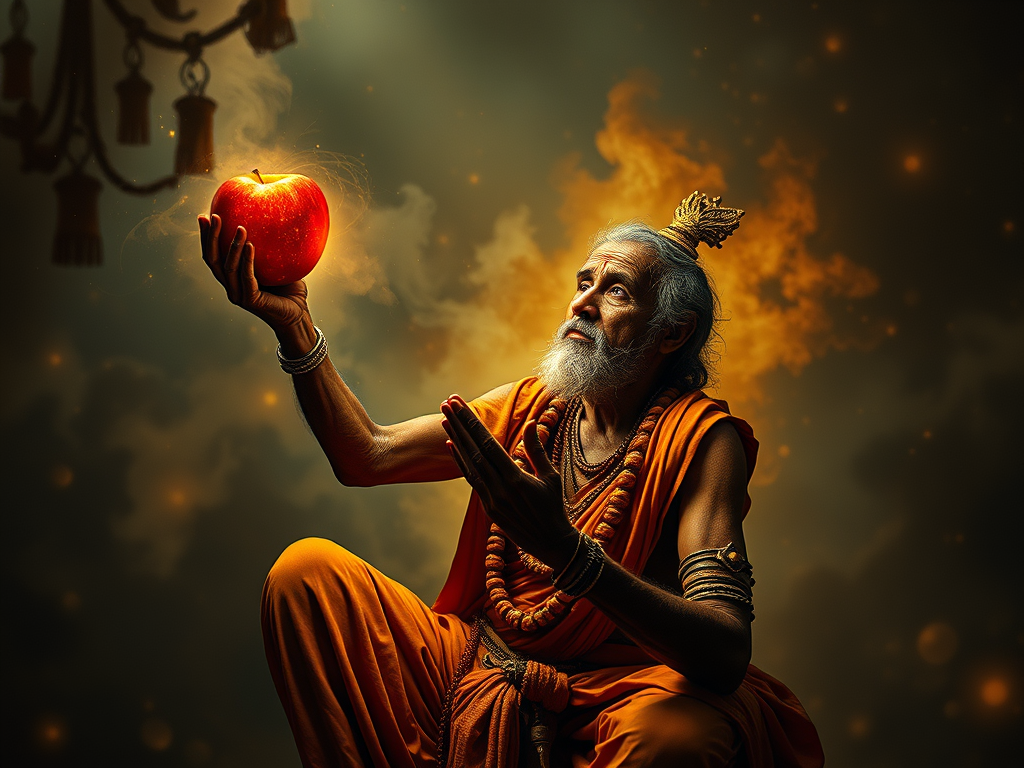
It begins with theatrical silence. A Brahmin so impoverished his ribs mimed a cage—unemployed, unloved—performs exaggerated penance. Not from devotion, but desperation of poverty. A pantomime so convincing that even Indra laughs. Brahminy would accept some alms; they were just enough to keep the body and soul together.
Indra, amused by the charade of holiness, “laughs” and gifts an apple of immortality—not from compassion, but cosmic irony, and as a punishment. The Brahmin holds it and dwells on the implications of immortal poverty, realizing Brahminy had become jealous. She will age and die, but the Brahmin will live, though impoverished, he will live. Brahmin could read that in her eyes; he fears jealousy and consequence, and the enormity of immortality utterly overpowers him with fear; he offers it to Brahminy, and she gets the same demoralizing feel. She said it is not immortality that I need, I need you.
They decided to gift it to the King, hoping he could prolong his happy life and rid them of the leprosy-like poverty they faced. Indeed, they get a handsome remuneration and leave happily; now, instead of penance, they splurged to assuage the mountain of wants that had grown in their mind, and they live in luxury now.
The apple meanwhile in the King’s hand, and the same futility of existence filled his mind, what is my life, he said, it is happy only if my loved ones are with me, so he calls his favorite queen and gifts it to her. She gifts it to her paramour, the Senapati. The Senapati, thought like Charvakas that Ghee Khao even as a loan, gifts it to his favored prostitute, so she could be there always for him. The apple thus journeys silently through desire, betrayal, and unrequited love, the futility of life. It is traded without speeches, passed through gestures and glances. The Prostitute, the courtesan, had a great regard for the saintly King. She was content with her lot; the king had given her shelter, and it was enough. She decided to return the favour. The King receives it back, reflects on the loneliness of power, and eats the fruit. He becomes an itinerant immortal—a broken syllable wandering across time.
Bopa Rai laughed at the remembrance of conceit spoken silently. He thought that before language, there were only grunts, which were sufficient to attract attention and communicate. He thought of words like conceit, greed, love; they were not words, they were books, and thus understood differently by different people. Really, how could books be spoken, in poetry and mispronunciation? The King had become an itinerant eighth immortal, a folly an absurdity of the highest order, from frank laughter, he had reached a smile that Buddha must have had after the Kheer given by the women. Bopa drove off, thinking of the red apple and red Russian cap the goddess had taken in the non-existent temple.
🗣️ A Dialogue at the Riverbank
Kabir: You chant in Sanskrit, brother, as if God is a grammar test. Do mantras heal the hungry? Do footnotes fill a child’s stomach?
Tamnuhan: I gather chants not to chain, but to teach the weaver, the washer, the widowed queen. Even mispronounced syllables carry fire.
Kabir: Ritual without truth is a tongue without taste.
Tamnuhan: Even silence must be taught to speak. The Vedas say: “Let speech be the horse, and silence its reins.”
Kabir: Let the reins be loose, friend. Let the horse gallop into broken villages where God wears patched robes.
Tamnuhan: Perhaps we are both sacred in error.
⚖️ The Tension: Submission vs Spontaneity
Camus teaches: Meaning-seeking human + indifferent universe = Absurdity
- Submission to Society: safety through obedience, tradition, inherited meaning
- Spontaneity & Revolt: lucidity, freedom, joyful rebellion without escape
The Brahmin and King live this contradiction. Indra laughs not at faith, but at the absurd beauty of it.
🧵 Point Counterpoint
| Theme | Guardians of Sanity & Sacred Speech | Dissenters, Madmen & Free Tongues |
|---|---|---|
| The Moral Law-Giver | Gandhi | Makkhali Gosala |
| The Grammar Master | Panini | Bauls of Bengal |
| The Evangelical Purifier | Martin Luther | Antonin Artaud |
| The Harmonizer | Buddha | Digambara Monk |
| The Ethical Confucian | Confucius | Zhuangzi’s Madman of Wu |
| The Institutional Saint | St. Augustine | Mansur al-Hallaj |
| The Enlightened Renouncer | Shankara | Kabir |
💔 Across Traditions
Kabir mocks hollow rituals with laughter. Tamnuhan opens the Vedas to wandering hands. Charvaka seduces reason with satire. Camus walks beside the king, who questions meaning after biting the fruit.
Dissenters and Madmen, so-called, had their books torn. Still, their traces were left, even in illustrating their mistaken ways, thus Makkhai Gosala, born of a mendicant in a Gosala a cowshed, he walked naked, as ascetic as Budhha and Mahavir, just like Christ, a contemporary of Mahavir and Buddha, has been reviled in both literature, to prove a point and to establish the reigning deities, just like Santoshi Mata, who formed a cult following in Northern India, and then disappeared in the larger Pantheon of 53 Crore Gods and Goddesses. Godless all of them, the Buddha, the Mahavir, the Charvaks, Mikhali Gosala, Kabir, yet resonated with Nasadya Sutra. Some were social commentators, some ascetics, some had progressed to masochism, all flavours in saint and madmen.
The Sutra – “Wherefrom this creation has arisen— whether he made it or not— He who surveys it in the highest heaven, He alone knows, or perhaps he does not know.” resonates still.
Philology isn’t just love of language — it’s reckoning. Not order, but invocation. Not clarity, but sacred confusion.
❤️ Let Us Mispronounce — With Love
Let this be a treatise of imperfection. A scripture of flawed saints and twisted metaphors. Let us begin not with clarity, but with a cough. A cracked syllable. A wrong but beautiful sound.
“In the beginning was the Mispronunciation.”
And it made the saints uncomfortable.
And it was good.
Comments
6 responses to “The Problem of Language”
[…] Bopa didn’t think; he moved. His friend grabbed a stick and together they plunged in, his boot catching the attacker. A snarl, a bite at the boot leather — and the mad thing fled into the dark. […]
[…] The Problem of Language […]
[…] The Problem of Language […]
[…] The Problem of Language […]
[…] The Problem of Language […]
[…] The Problem of Language […]