Essays on the Fragile Human Empire
by
Col Narinder Jarial (Retd), AMC
“Man is the animal that cleans and still attracts the fly.”
— Anonymous Sanitary Inspector, 1923
The Shallow Dip:
The Deep Dive
PREFACE — THE GENERAL RETIRES
After forty years of chasing malaria, training cadets, and memorizing transmission cycles, I now study a different battlefield. It is the kitchen. The campaigns are smaller here, the weapons humbler: a ladle, a rolled-up newspaper, a perforated fly-swat. Still, the enemy remains ancient and undefeated. The grand doctrines of Preventive and Social Medicine have found their simpler expression at home. It means washing hands, covering food. It also means hoping that the power doesn’t go out during dinner. This little manual is for those who wish to observe the drama of life and disease from a chair. It is not for those who prefer the lecture hall. This is Kitchen-Level Preventive Medicine: The Fly and the Mosquito.
I. ARMCHAIR DISSECTION OF A FLY
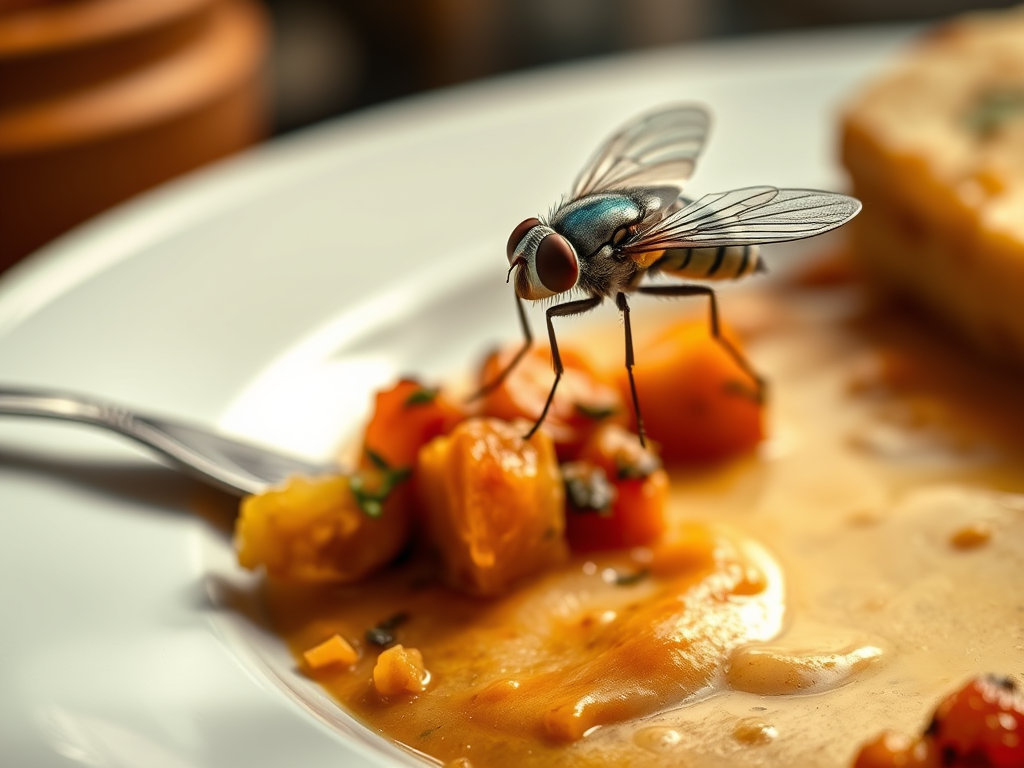
They are not creatures of light but of shade. Their great compound eyes do not seek brightness, only the tremor between stillness and movement. Beneath the eyes dangles their hammer — an instrument that tastes, tests, and proclaims the worth of the world.
They fly not for pleasure but for purpose: brief sorties into the warm eddies of air, drawn by the promise of sweat, salt, and decay. Each dart and pause is a calculation, a random geometry of hunger.
When they find the right spot — a plate’s rim, a wound, a shining pate — they unfold their tongue like a tiny piston, mapping the terrain by touch and flavour. The better the food, the more they dream of eggs.
They are drunk on the human body, on salt, on sunlight made edible. And when they gorge too long, they lose their gift of flight — the fatal price of satisfaction.
One once landed on Bopa Rai’s bald crown. However often he waved or slapped, it took a short aerial detour and came back, amused. Only the perforated slapper can defeat such persistence; it lets the air slip through, denying the fly its cushion of escape.
Thus ends the domestic epic: the small voyager of garbage and gold, tasting, circling, falling — forever between flight and fall.
II. ARMCHAIR DISSECTION OF A MOSQUITO
They live like little field marshals of disease: lean, efficient, disciplined in their hunger. Where the housefly gorges, the mosquito sips; where the fly dances, the mosquito stalks. Their wars are not of abundance but of precision — one bite, one drop, one life disturbed.
Their body is a marvel of minimalism: a head with a needle, a chest like a pump, and a pair of scaled wings that whisper rather than hum. Eyes are hemispheres of emerald glass, detecting the faintest exhalation of carbon dioxide from twenty metres away. To them, we are moving furnaces — islands of warmth and breath.
Only the females bite; the males, romantic fools, live off nectar and die young. The female drinks to lay — her bloodlust is maternal, not malicious. In every droplet of blood, she finds iron and protein enough to nurture her small white brood.
Their flight is a study in restraint. They do not dart like flies; they hover in reverent circles, gauging wind and flesh. The hum we hear is no song — it is the whine of wings vibrating at 600 beats per second, a radar note that tells other mosquitoes of sex, distance, and danger.
They breed where the careless leave water — in lids, pots, tyres, and temple lamps. Their armies rise silently from puddles after rain, each larva a small torpedo in stagnant peace.
Swatting them is a ritual failure. The hand arrives too late; the mosquito has already injected anaesthetic and anticoagulant, finished the theft, and gone. When the itch blooms, the war is over.
Bopa Rai once said, watching one trace circles over his elbow, ‘Even God needs couriers. This one carries fever.’ He did not slap. He turned out the light and went to bed, offering himself to history’s smallest general.
EPILOGUE — THE FRAGILE HUMAN EMPIRE
Civilisation swats, sprays, and sanitises. We launch satellites and edit genes, yet every night, the fly lands on our lips and the mosquito sings in our ear. Perhaps they are here to remind us that conquest is temporary and coexistence is eternal. We have built empires of hygiene, but they still share our kitchens, dining tables, and dreams.
If there is a lesson in these small creatures, it is humility. Preventive medicine began as cleanliness and remains, at heart, an act of patience — one more slap, one more rinse, one more dawn without dengue.
Written in gratitude to all students of life and cleanliness.