
Lilavati’s Garden of Mathematics: A Tale from Ancient India https://en.wikipedia.org/wiki/Indian_mathematics
Kings and well-to-do citizens all donated to the temple in terms of land, money, and other necessities. These contributions discharged duties towards the deity, which required a thousand things from preparing food for the devotees to more personal service. Another group of Brahmins were left free to pursue learning disciplines like mathematics, astronomy, astrology, polity, grammar, and more. Excess revenue supported building construction, trade financing, and other societal needs. In short, a temple was the heart of Indian society, around which much life revolved, though not exclusively; the King operated through a council of elders governing other affairs.And in this peaceful world was a garden named as Lilavati’s Garden of Mathematics
Temple Life and the Sacred Garden
In one such temple complex, a large, square unroofed space grew sacred basil on a pedestal at the center. Nearby stood a pipal tree with aerial roots hanging and ancient ground roots forming knobbly bumps. A single building with a slate roof and lined rooms surrounded the square.
A raised plinth encircled the Pipal tree, serving as a pleasant place for conversation, games like Chausar, cooling respite, and children climbing the aerial roots to explore secret nooks of the tree.
The area between the Pipal and basil plants was for feeding birds: sparrows, crows, magpies, peacocks, parrots, thrushes, quarrelsome babblers, and marionette-tailed bulbuls chittered and chirruped. Ants, always hungry, scurried about, momentarily greeting each other and sharing directions to the next “whisky bar,” carrying snacks securely in their mouths. Unlike humans, ants never ferry resources on their backs but rely on scent trails to reach goals unerringly. Squirrels darted up and down the tree while armies of termites secretly chewed through the wood searching for cellulose. A dung beetle rolled a giant dung ball many times its size—like King Sisyphus’s futile hill task. There was never a dull moment.
Bhaskar looked up from his writing as the door cracked open, a twinkle in a peering eye revealing his daughter’s laughing brown face. “Come, my baby,” he said in Kannada. “Come inside, Lila.”
“Won’t you get bothered? Mother said not to bother you,” she responded.
“No, no, come in, coolness of my heart. Have some chiki.” Lilavati entered laughing, took the sweet, and jumped up to sit behind him. “Papa, what are you writing?” she asked, sucking on her candy.
“I have prepared a puzzle for you.”
“Oh yeah! What’s it?” she said eagerly.
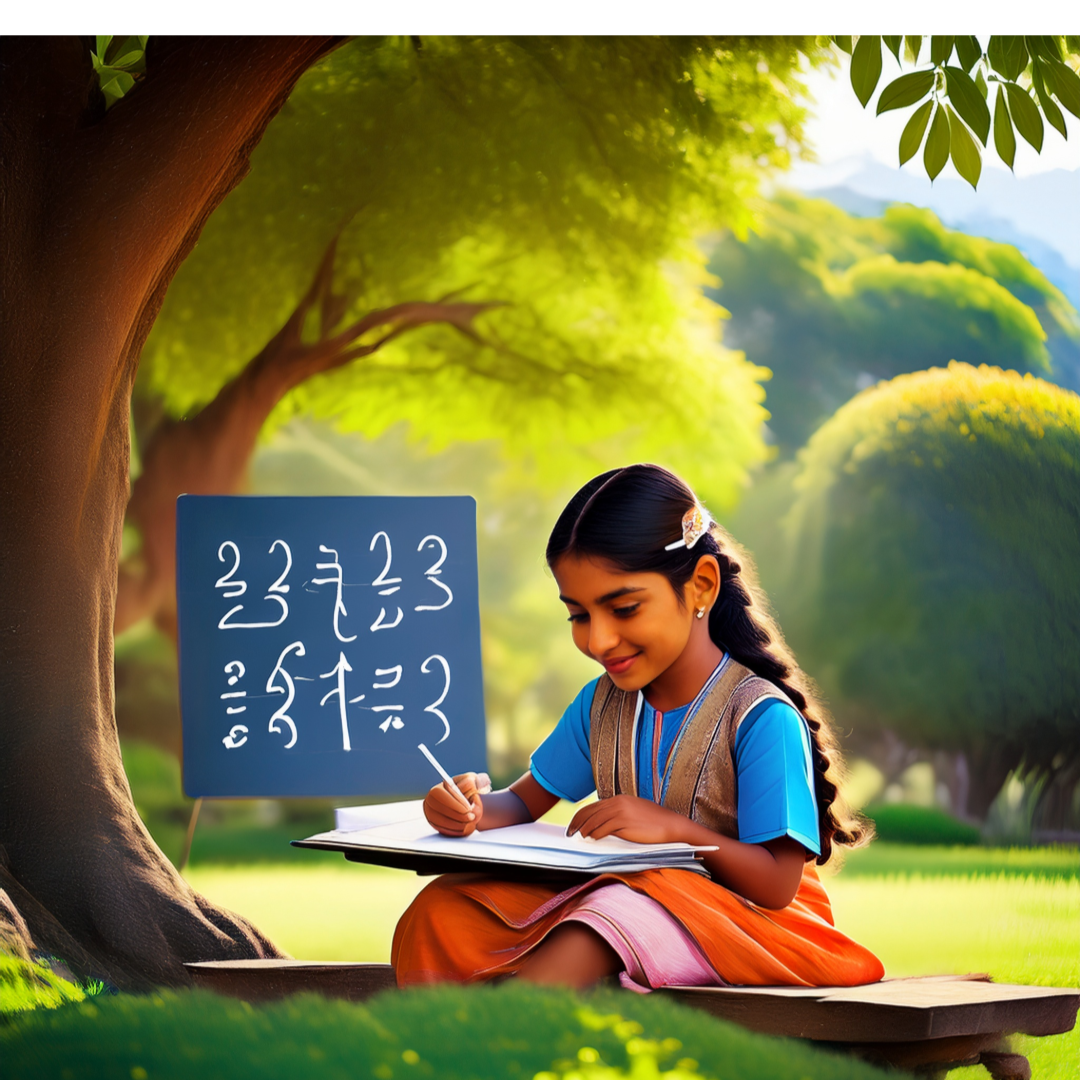
Bhaskar passed her a palm leaf leaf and said, “Here, take your slate and tell me the answer.”

A fifth part of a swarm of bees rested on the flower of Kadamba, and a third on the flower of Silinda. Three times the difference between these two numbers flew over a flower of Krutaja, and one bee remained flying confusedly here and there.
Lilavati, an intelligent and precocious girl, was the apple of her father’s eye—though he sorrowfully foresaw astrological difficulties in her life with only one auspicious marriage time. He indulged her curiosity with puzzles and stories.
“At barely eleven, she craved puzzles, raw mangoes, swinging on banyan tree swings, and asking a thousand questions,” Bhaskar thought with barely suppressed tears.
She mused, “Kadamba, Silinda, and Krutaja—they are the trees from my garden, aren’t they?” Bhaskar nodded. “But they are just props in the question,” she said.
She solved the problem using algebra but preferred a simpler method of adding and subtracting all fractions from one; the remaining fraction equaled the single confused bee. The reciprocal gave the swarm’s size: fifteen bees.
“Fifteen bees, correct?” Bhaskar smiled and ruffled her hair.
Historical Reflections on Numerals
Leonardo of Pisa, Fibonacci, was a near contemporary of Bhaskar and the first European to use Hindu numerals, learned from an Arab merchant. By the late 13th century, these numerals were extensively used but briefly banned in Italy for potential dishonesty by altering zeros to nines.
Brahmagupta used zero extensively, studying Aryabhata, who wrote numbers literally rather than numerically. Bhaskaracharya credited predecessors, including his father Maheswar, for advancing these concepts.
Newton later echoed, “If he has seen so far, it was by standing on the shoulders of giants,” arguably referring to Indian mathematicians like Madhava, who solved Pell’s equation and approached calculus.
Number Systems and Place Value
India has known the place value system for over 2,000 years, based on zero and exponentiation—multiplying a number repeatedly by itself.
- In decimal (base 10), any number is expressed as digits multiplied by powers of 10.
- In binary (base 2), numbers use digits 0 and 1.
- In hexadecimal (base 16), digits go from 0 to 9 and then a, b, c, d, e, and f representing 10 to 15.
Raising the base to increasing powers denotes place value; moving right decreases the power.
Fractions, Decimals, and Infinite Numbers
The idea of fractions arises naturally, with all fractions between zero and one. For example, $ \frac{2}{3} = \frac{1}{3} + \frac{1}{3} $.
Decimals may be terminating, repeating (both rational), or non-repeating and non-terminating (irrational), like . Greeks discovered incommensurable numbers, though they approximated
as $ \frac{22}{7} $. Negative numbers were visualized as repeated subtraction beyond zero, leading to the concept of infinity.

The Lotus Puzzle: Geometry and Pythagoras

Bhaskar was visited by a pilgrim from Sri Lanka who told of peace between the Cholas and Chalukyas. The conversation turned to mathematics, prompting Lila to ask about the significance of “one” in math.
Bhaskar gave her a new puzzle:
A lotus plant standing one foot above water rocks in a breeze, dipping its tip in water three feet away from the central position. How deep is the pond?
Lila sketched the problem and, with Bhaskar’s guidance, used the Pythagorean theorem to solve it:

Solution: The pond is 4 feet deep, and the lotus is 5 feet tall.
Mathematical Properties and Arithmetic Laws
Lilavati learned fundamental number properties:
- One is the multiplicative identity; zero is the additive identity.
- Addition, subtraction, multiplication, division are tied to these identities.
- Commutative laws:
,
.
- Associative laws and the distributive law also govern operations.
- Additive inverses: The negative of
is
.
- Multiplication of two negatives is positive.
Advanced Concepts: Compound Interest and Euler’s Number
Bhaskar explained compound interest as:

where is the interest rate and
the number of periods. The accumulation approximates
as periods increase infinitely with decreasing
, revealing early concepts of exponential growth.

Mystical Letter and Friendship with Numbers
Lilavati found a mysterious letter, aged yet clear, bearing a tilted Pascal’s Triangle—referred to as Meru Prastar—implying messages passed through time linking her to a future writer named Kalawati. She dreamt of numbers as friends, dancing and changing, embodying unity and infinity.
Women Scholars and Royal Patronage
The story honors queens like Akka Devi and Chandala Devi who were military leaders and patrons of knowledge, affirming that women could be great kings and scholars.
Bhaskar was soon to join Nalanda University as Mathadheesh (head), with hopes that Lilavati would receive royal patronage if she remained unmarried.
Leela’s Speculation & Bhaskara’s Reflection
One thought glimmered in Leela’s mind—simple, yet strangely profound. When she multiplied a great number by something smaller, the product began to fade, like a shadow at dusk. The smaller the number grew, the more the product shrank—until, at one, the number stood unchanged—the quiet law of unity, the identity.
But what if she dared go smaller than one? Then numbers whispered of fractions—broken wholes and equal parts—as though multiplication had turned into division, the great number gently fractured by its own measure. And as that small number drifted toward zero, the answer swelled beyond reckoning, until, at the breath of nothingness, it burst into infinity.
Perhaps zero was not emptiness at all, but the passage through which the finite becomes eternal.
“You have seen well, my child. Multiply a great number by a smaller one and the product lessens, approaching nothing; at one, the number returns unchanged—the mark of unity, the multiplicative identity.
Below one, multiplication mirrors itself as division: the whole is shared among equal parts. And as the smaller number nears zero, a reversal begins—the quotient grows without bound; the lesser the divisor, the greater the result.
At zero, measure dissolves and the number leaps toward infinity. Thus, from infinitesimal to infinite is one continuous circle: multiplication and division, vastness and void, bowing to the same law.”
Together, father and daughter glimpse the idea later called limits—approaches to zero and infinity where continuity hides behind apparent opposites. Under a pipal tree beside basil, a girl’s wonder finds law.
Evening breeze in the colonnade. Bhaskara returns to palm leaves; Lilavati to her swing. Numbers are not lifeless figures but living companions. Somewhere in the quiet twilight, mathematics becomes poetry.
Bopa Rai back with Vikramaditya’s contingent came to meet Bhaskaracharya, saw Lila and became a statue, having forgotten all, Vikrama himself came looking him looking at a beautiful girl, disturbed his reverie and took him back to Royal pavilions. Vikramaditya thought abot his ADC and the little girl just marriageable ” why they shouldn’t get married Bopa seems besotted with Lila, and girl was laughing and playing overmuch, first love, what about prophecy he spoke to the queen. She agreed, as you say, Bopa is anointed by the deity himself , he got his elevation instead of your wrath, I will send our Panditji with the proposal. and rest is history. Bopa and Lila got married , a marriage made in heaven.
Comments
5 responses to “Lilavati’s Garden of Mathematics”
[…] Lilavati’s Garden of Mathematics […]
[…] Lilavati’s Garden of Mathematics […]
[…] Lilavati’s Garden of Mathematics […]
[…] Lilavati’s Garden of Mathematics […]
[…] Lilavati’s Garden of Mathematics […]