https://en.wikipedia.org/wiki/Immortal_Game
The Physics of Defeat: From the Immortal Game to Waterloo
By Bopa
Observer of the Pao
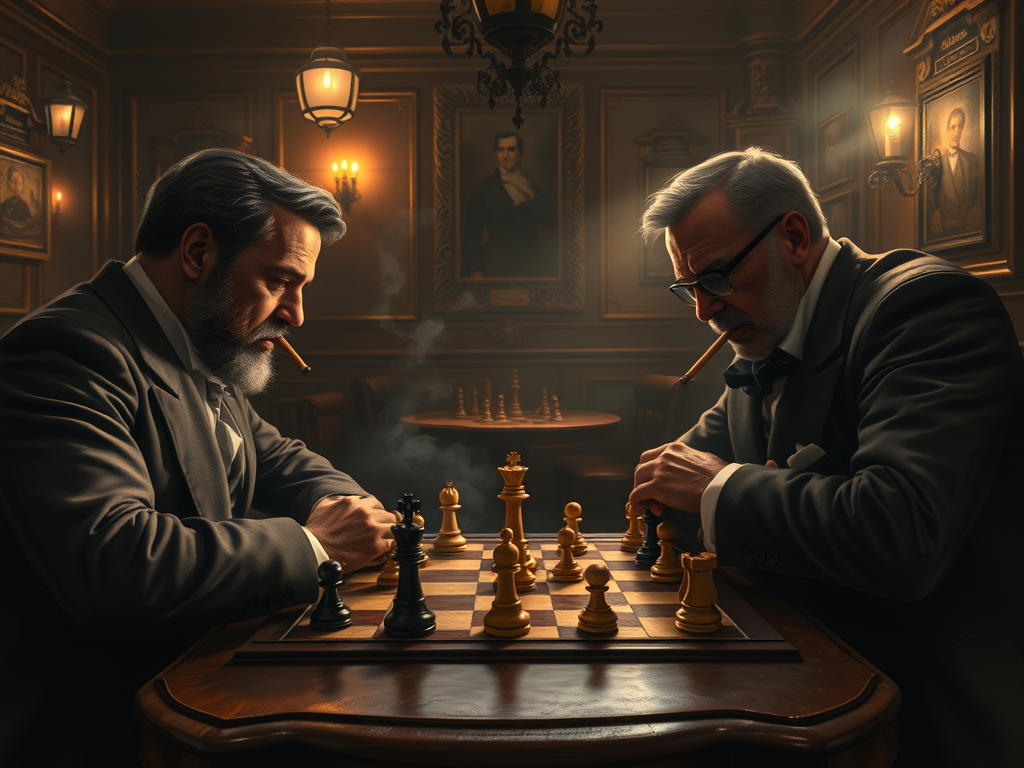
I am sitting in Simpson’s Divan, 101 Strand, London. The year is 1886. The cigar smoke is thick enough to chew, hanging over mahogany tables where serious men play serious chess.
I am reviewing a game played here thirty-five years ago. They call it “The Immortal Game.” Adolf Anderssen versus Lionel Kieseritzky. The patrons admire it for its artistry. I am watching it for the data.
In my eternal observation of conflict, I have found that we often confuse Power with Mass. We look at an army with 100,000 men, or a chessboard with a Queen and two Rooks, and we assume strength.
But Mass is merely potential. True power is a function of Freedom. My notebook records a simple equation for the combat power (CP) of any system:
CP = (Presidual – Pinert) × log2(b) × S
- P: The Material Power (The Mass).
- b: The Branching Factor (The number of viable options).
- S: The Surprise Coefficient (The shock multiplier).
When b drops to 1, the logarithm becomes 0. The system suffocates. It does not matter how much gold or how many cannons you possess; if your entropy hits zero, you are dead.
1. The Micro View: The Immortal Game (1851)
The Combatants: Adolf Anderssen (Open System) vs. Lionel Kieseritzky (Closed System).
Kieseritzky played like an accountant, accumulating assets. Anderssen played like a physicist, manipulating space. Let us analyze the telemetry of the match through the Pao of Physics.
Phase 1: The Exothermic Reaction (Moves 1-2)
Move: 1. e4 e5 2. f4 (King’s Gambit)
Anderssen sacrifices a pawn immediately. In physics terms, this is an Exothermic Reaction. He sheds Mass (P) to drastically increase the temperature (Entropy) of the board. He knows that high-entropy environments favor the bold.
Phase 2: The Containment (Move 11)
Move: 11. Rg1!
Kieseritzky accepts a “passive piece sacrifice.” He grabs material, but in doing so, his Queen gets boxed in. She technically has power (P=9), but she is trapped in a lead-lined container. Her effective Branching Factor (b) begins to decouple from her Mass.
Phase 3: Retrograde Motion (Move 14)
Move: 14... Ng8
To survive, Black moves his Knight back to its starting square. This is Negative Velocity. In physics, Momentum = Mass × Velocity. By returning to the start, the Knight’s velocity becomes zero. It has become Inert Mass. It exists on the board, but contributes zero kinetic energy to the fight.
Phase 4: The Black Hole (Move 18)
Move: 18. Bd6!
Anderssen sacrifices both Rooks to lure the Black Queen into the corner. He creates a Black Hole. The Queen captures the Rooks, but she crosses an Event Horizon. She is now too far away to affect the center. She has infinite wealth, but zero relevance.
Phase 5: The Singularity (Move 22)
Move: 22. Qf6+!
The move that secured immortality. Anderssen sacrifices his Queen to force a specific response.
- Black’s Material (P): Astronomical. He owns the board.
- Black’s Choice (b): One. (He must play
...Nxf6). - The Calculation: Power = Massive × log(1) = 0.
Kieseritzky died of suffocation, crushed under the weight of his own useless riches.
2. The Mechanics: The Bopa Combat Table
How do we quantify these tactical constraints? Over the centuries, I have developed a reference table to assign “Entropy Penalties” to standard combat events.
| Tactical Event | Physics Analogy | The Bopa Penalty |
|---|---|---|
| The Check | System Interrupt | 0.1x (System focus narrows to survival). |
| The Pin | Binding Energy | 0.0x (Ghost Mass. Visually present, kinetically zero). |
| The Sacrifice | Heat Exchange | Variable Multiplier. Converts Mass (P) into Shock (S). |
| The Dark Forest | Fog of War | b → 1. Forcing the enemy into a zone where they cannot compute the branches. |
As Mikhail Tal once said: “You must take your opponent into a deep dark forest where 2+2=5, and the path leading out is only wide enough for one.” He was describing the manipulation of b. The “path for one” is the reduction of the opponent’s entropy to zero.
3. The Macro View: The Mud of Waterloo (1815)
If Chess is a duel of minds, War is a duel of thermodynamics. My archives contain the telemetry for the Battle of Waterloo.
Napoleon faced a “Double-Barreled Gun”: Wellington on the ridge (Static Defense) and Blücher arriving on the flank (Kinetic Attack). To survive, Napoleon needed Speed to jam the first barrel before the second could fire.
But the universe intervened. The eruption of Mount Tambora in Southeast Asia had disrupted the global climate, unleashing unseasonal, torrential rains upon Belgium.
The Tambora Coefficient
The rain turned the battlefield into a swamp, altering the physics of the French Army:
- Friction (μ): The mud nullified the French “Ricochet Fire.” Cannonballs thudded into the sludge instead of skipping through ranks. The artillery’s effective Power (P) was halved.
- Time Delay: Napoleon waited until noon for the ground to dry. Those three hours were the margin of error.
- Entropy Collapse: The mud reduced the Branching Factor (b) to near 1. The cavalry could not maneuver. The “House of Cards” collapsed because it became rigid.
The Emperor was not defeated by strategy alone. He was defeated by a volcano that robbed him of his entropy.
Bopa’s Final Note
Whether you are a general, a grandmaster, or a writer, the rule remains the same:
“Do not hoard Mass. Hoard Options. When the path leading out is only wide enough for one, it doesn’t matter how big you are. It only matters if you are the one holding the map.”
— Bopa