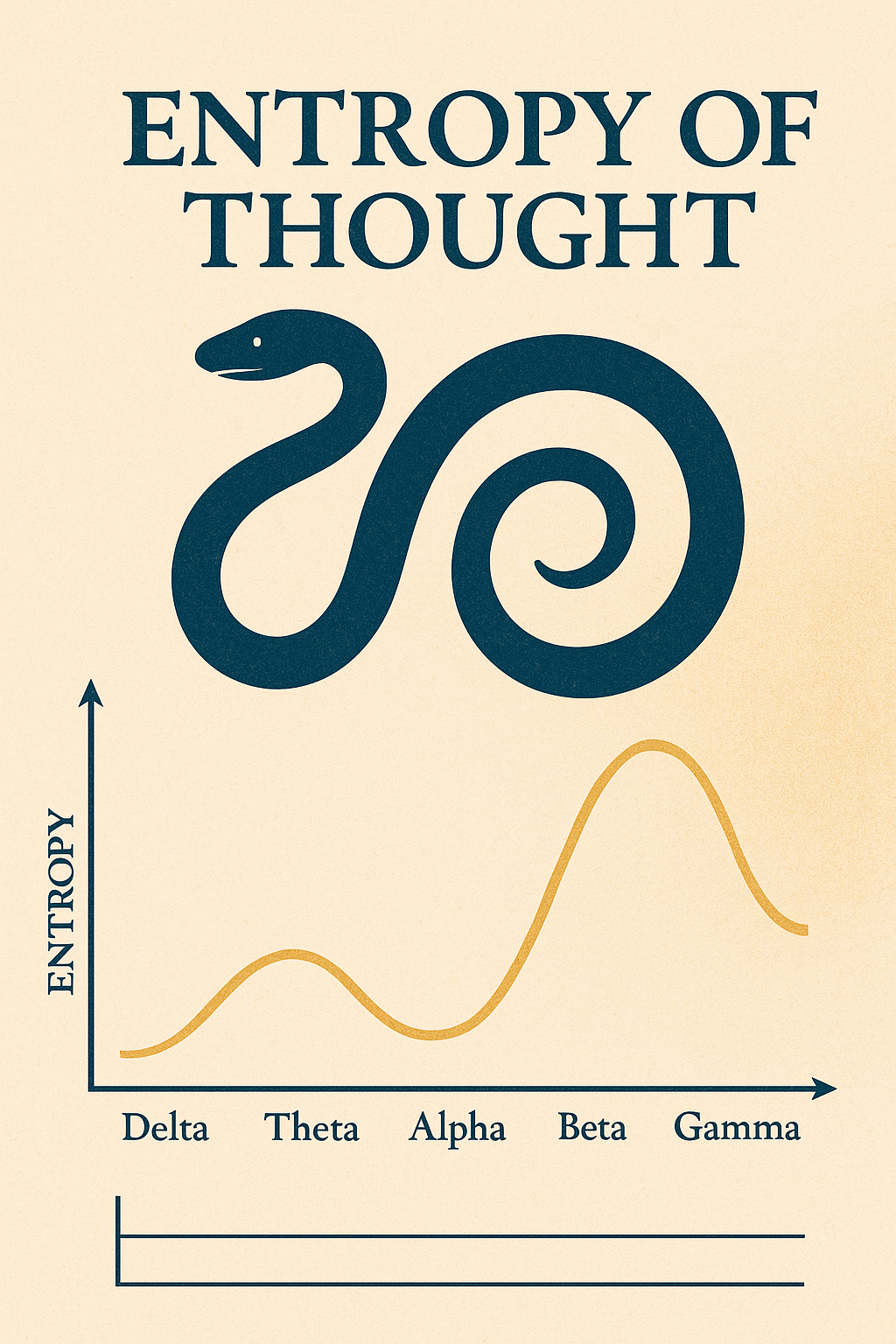
“A thought is only a snake if you see it move.”
The Original Ridiculous Thought
“A snake is a food pipe that crawls.”
It began as a joke Bopa’s mind played on itself—half absurd, half anatomical poetry. A spontaneous glitch in the alpha drift, a misfired metaphor that turned out to be the first scale on the serpent’s skin. From that single ridiculous line began the entire pursuit: the chase through memory, noise, entropy, and the long rope down which K once descended.
Entropy of Thought
How to Read Shannon’s Equation
Shannon wrote:
[ H = – \sum p(x) \log p(x) ]
A single clean line — but full of meaning.
How to read it simply:
- Every thought has a probability p(x).
- log p(x) is always a negative number when p(x) is less than 1.
- So p(x) × log p(x) becomes a small negative product.
- Adding a minus sign in front (the “–” in the formula) makes the final entropy positive.
Now the miracle:
- Common thoughts → large p(x), small negative log → tiny contribution.
- Rare thoughts → tiny p(x), large negative log → still a small product, but high in surprise.
Entropy is the sum of all these tiny weighted surprises.
Imperative vs. Surprise: Two Kinds of Thought
Bopa realises there are thoughts that command, and thoughts that astonish.
1. Biological Imperative
My hands are cold → wear gloves.
A near-reflex. Predictable. Low entropy. High probability. The mind does not think this — it simply executes. These thoughts live at the top of the probability curve, contributing almost nothing to surprise.
2. Cognitive Surprise
A snake is a moving food pipe.
Absurd. Low probability. High entropy. No survival value, yet immense psychological weight. This kind of thought rises like a rogue wave in alpha drift — improbable, irresistible, and capable of triggering an entire chain of escalation: serpent → rope → helicopter → Siachen → K → memory → noise → Shannon.
Bopa smiles as he sees the difference:
“Cold hands instruct.
A snake interrupts.
One keeps me alive.
The other wakes my memory.”
In one ultra-simple sentence:
Entropy is just the sum of all your possible thoughts, each one weighted by how surprising it would be if it appeared..
In one ultra-simple sentence:
Entropy is just the sum of all your possible thoughts, each one weighted by how surprising it would be if it appeared. — the mind’s average unpredictability.
- Each possible thought x has a probability p(x) of appearing.
- When a thought is common, p(x) is large, but its surprise is small.
- When a thought is rare—like the sudden serpent—p(x) is tiny, but its surprise is immense.
The equation multiplies these two opposing forces:
- A small probability multiplies a large negative log, creating a balanced contribution.
- Then it sums over all possible thoughts, all possible mental events.
The result is H, the total uncertainty—the entropy—of the mind’s landscape in that moment.
Bopa realises: the serpent thought was a contribution from the tail-end of the sum—one of those improbable terms, tiny in probability but vast in informational weight.
Before that insight settles, Bopa pulls out a scrap of paper — a habit from his days in the high mountains, when a pencil and a patch of calm were the only instruments needed to steady the mind.
He decides to make the serpent behave mathematically.
A Layperson’s Example (for the math-afraid)
Bopa imagines three kinds of thoughts:
- Everyday thoughts (like tea, weather, routine)
- Probability: 0.8
- Contribution: 0.8 × log(1/0.8) → small
- Occasional thoughts (friends, old stories)
- Probability: 0.19
- Contribution: 0.19 × log(1/0.19) → moderate
- Rare thoughts (like the sudden snake)
- Probability: 0.01
- Contribution: 0.01 × log(1/0.01) → still small, but this is where the surprise lives
Bopa circles the last line.
“So even if the rare thought adds only a small number,” he mutters, “its shock value is huge. The mind notices it more than the maths does.”
He taps the paper.
A Small Word-Painting
Bopa crouches on a grey boulder, the wind from the high ridges combing through his hair. Snow crunches under his boots. His pencil trembles slightly in the cold as he sketches tiny numbers on the scrap. A serpent—no bigger than a vein in a leaf—peeks over the edge of the page, its head cocked as if checking Bopa’s arithmetic.
“Even you want to see the sum?” he asks it with a smile.
The serpent blinks once, solemnly. It understands probability far better than men ever will.
“Shannon measures the average surprise of all thoughts. But the serpent… the serpent measures me.”
The mind is a summation, he thinks—a great adding-up of unlikely products.
Claude Shannon, father of information theory, defined entropy as the average measure of uncertainty or surprise in a message.
[ H = -\sum p(x)\log p(x) ]
In this equation lies a mirror for the mind. Every thought, every recall, every metaphor is a message transmitted across the synapses of our own nervous system. The probability of a thought’s emergence, (p(x)), defines its informational weight.
A common thought—like the routine turning of the key, the expected memory—carries little surprise, little information. But a rare, seemingly random thought—a snake rising from the depths of long memory—has low probability yet immense surprise, a spike in mental entropy.
The Neural Spectrum
| State | Dominant Band | Frequency | Cognitive Mode | Entropy Level |
|---|---|---|---|---|
| Delta | 0.5–4 Hz | Deep sleep | Minimal awareness | Very low |
| Theta | 4–8 Hz | Memory formation, creative flow | Moderate-high | |
| Alpha | 8–12 Hz | Relaxed wakefulness, associative | Moderate | |
| Beta | 13–30 Hz | Active thinking, analysis | Controlled | |
| Gamma | 30–100 Hz | Integration, insight, consciousness | High but coherent |
When you read, your mind dances between theta and gamma—a structured duet, compressing and expanding information. When you drift into reverie, alpha waves loosen the grip of logic and allow metaphors to rise, as they did when the serpent appeared: not random, but a coded symbol crawling up from the archives of stored experience.
The Dance of Entropy and Order
The brain is not a static computer; it is a dynamic field of oscillations. Too little entropy, and you become mechanical; too much, and you dissolve into chaos. Somewhere in the middle—between theta’s rhythm and gamma’s spark—lies creativity, comprehension, and poetic insight.
In deep focus, entropy narrows, producing clarity. In free association, entropy expands, yielding discovery. Together, they form the living pulse of thought—the information economy of the self.
The Serpent’s Lesson
The snake that appeared in your alpha state was not a random visitor. It was the mind’s way of equalizing its own entropy—reaching back thirty years to find the missing link between sensation, descent, and rescue. It slithered across layers of memory, embodying motion itself—the peristalsis of thought.
The mind does not recall at random; it recalls by resonance.
Each remembered image is a frequency that found its matching tone.
The Entropy Curve
Below is a conceptual sketch of how entropy rises and stabilizes across states of awareness:
Entropy ↑
│               Gamma – Insight, synthesis (high but coherent)
│            /
│         /      Beta – Analytical thought (controlled entropy)
│      /
│   /         Alpha – Associative drift (moderate entropy)
│ /
│/ Delta – Sleep (low entropy)
└──────────────────────────────→ Time / Cognitive Activation
At the midpoint between Alpha and Gamma lies the creative threshold—where entropy is neither chaotic nor flat, and the mind transforms randomness into revelation.
Closing Reflection
When the brain hums at its natural frequencies, Shannon’s entropy becomes a living principle—not a formula on paper, but a rhythm of consciousness. Each rare thought is a low-probability event—an improbable yet meaningful signal.
The poet, the scientist, and the wanderer all live at this edge: between order and surprise, between gamma’s coherence and alpha’s wandering light.
Bopa Rai and the Serpent of Entropy
Bopa Rai did not intend to think of a snake that morning. It rose on its own—an undulation in the mind’s undergrowth, a muscular thought sliding up from alpha waves. One moment he was idle, drifting; the next, the serpent flickered before him like an unfinished memory.
He followed it.
The serpent wriggled into a crease of time, and at its tail stood K—thirty years younger, frost-bitten, eyes squinting at the Siachen sun. The rotor wash of the helicopter stung like needles. Bopa remembered the moment: hand on harness, lowering K down the rope, the body descending in a controlled peristalsis. The snake in his mind had been the rope all along.
Memory was not random. It was perturbed.
Kahneman would have smiled quietly. Noise, he would say—not chaos, but variability. The mind drifts when searching for a missing page; it loops around the problem, perturbs itself to escape a local mental trap. While chasing the snake, Bopa Rai was merely obeying the mathematics of deviation.
The serpent hissed again—not menacingly, but as a reminder: thought is never a straight line. It coils. It doubles back. It reveals origin when least expected.
Bopa squinted at the landscape of his own cognition. He felt the shift as he approached deeper reasoning—the brain’s rhythm tightening into theta–gamma coupling. With each step, the snake paused and turned its head as if waiting.
Then Shannon appeared—not as a man, but as an equation floating mid-air, crisp as a mantra:
[ H = – \sum p(x) \log p(x) ]
The serpent slithered around the formula, encircling it like a guardian coil. Bopa realized: this was the architecture of the chase. Every rare thought—every improbable flash—was a low-probability event with high informational weight. The snake was not random; it was the statistically necessary disturbance, the perturbation needed to reveal the hidden memory of K.
K stood now only a few feet away, looking bewildered and amused. “Still chasing ghosts?” he asked.
“Not ghosts,” Bopa said, “just entropy.”
K laughed—the same laugh from the ice shelf so long ago. “You always overthink. The rope was a rope. The snake is a snake.”
“But the memory,” Bopa said softly, “wakes only when probability dips low enough to surprise me.”
K nodded. “Then follow the surprise. It knows where it came from.”
The serpent coiled once, then faded, leaving Bopa standing between noise and signal, randomness and meaning, mathematics and memory. The trail was no longer serpentine. It was a curve—an entropy curve—leading him back to himself.
And as the thought settled, Bopa Rai realized something Proust never needed to know:
Madeleine biscuits dissolve only on the tongue. But a serpent dissolves in the mind and returns with a tail made of time.
The Final Reflection: Avoiding the Local Minima
Later, when the serpent’s echo had quieted and K’s laughter folded back into memory, Bopa Rai sat alone on a flat stone, high above a valley where clouds drifted like half-forgotten equations.
He realised something simple yet immense: the mind does not escape its traps by logic alone. No climber avoids a crevasse by calculating angles; he avoids it by a subtle drift of instinct, by letting his awareness widen until the danger reveals itself. The brain does the same. When thought narrows, when it sinks into a local minimum, a perturbation must arrive—a flicker, a noise, a serpent thought—to shake it free.
In that sense, the wandering image was not a distraction. It was guidance.
Kahneman’s perturbation, Shannon’s entropy, the theta–gamma hum of deep reasoning—all of them conspired to free Bopa’s mind from its own snare. The snake was not the memory; it was the ladder to the memory. A creature of probability, wriggling up through alpha waves to pull him toward the past.
Bopa Rai smiled, touching the air where the serpent had vanished.
“Sometimes,” he murmured, “the shortest path to truth is the long way around—through noise, through entropy, through a snake that remembers what I had forgotten.”
Postscript: Where the Serpent Turns Back
Long after the numbers, long after the paper cooled in his hand, Bopa Rai walked down the ridge. Evening gathered like a shawl around the mountains. The serpent no longer appeared beside him, and yet its presence lingered—felt rather than seen.
He realised that every thought has two lives:
- the one that arrives, unbidden, like a spark or a hiss, and
- the one that returns, shaped by reflection, polished by meaning.
The snake had completed a circle.
It began as a ridiculous image. It grew into a chase through noise and probability. It led him to K, to memory, to Shannon, to the mathematics of surprise—and finally back to himself.
As the last light dimmed, Bopa paused, remembering the simplest of all distinctions: the mind obeys an imperative, but it follows a surprise. Cold hands instruct; a serpent interrupts. One keeps him alive. The other leads him into forgotten corridors of time.
He whispered to the darkening sky:
“A thought returns only when it has something new to show.”
The serpent did not answer. It didn’t need to.
Its tail had already curled neatly back into the very place where it first appeared.
Comments
2 responses to “⭐Bopa Rai and Serpent of Entropy”
[…] ⭐Bopa Rai and Serpent of Entropy […]
[…] ⭐Bopa Rai and Serpent of Entropy […]