Understanding Dark Adaptation and The Unseen Dance of Being
by Narinder
Pao of Physics Series
The First Pao
Understanding Dark Adaptation and the Unseen Dance of Being
by Narinder
Pao of Physics Series — The First Breath
“What the eye does in darkness, the heart does in silence.”
I. Understanding Dark Adaptation and the Unseen Dance of Being
The human eye possesses a remarkable ability to adjust to varying light conditions, a process known as adaptation. This allows us to perceive our surroundings effectively, whether in bright sunlight or near darkness.
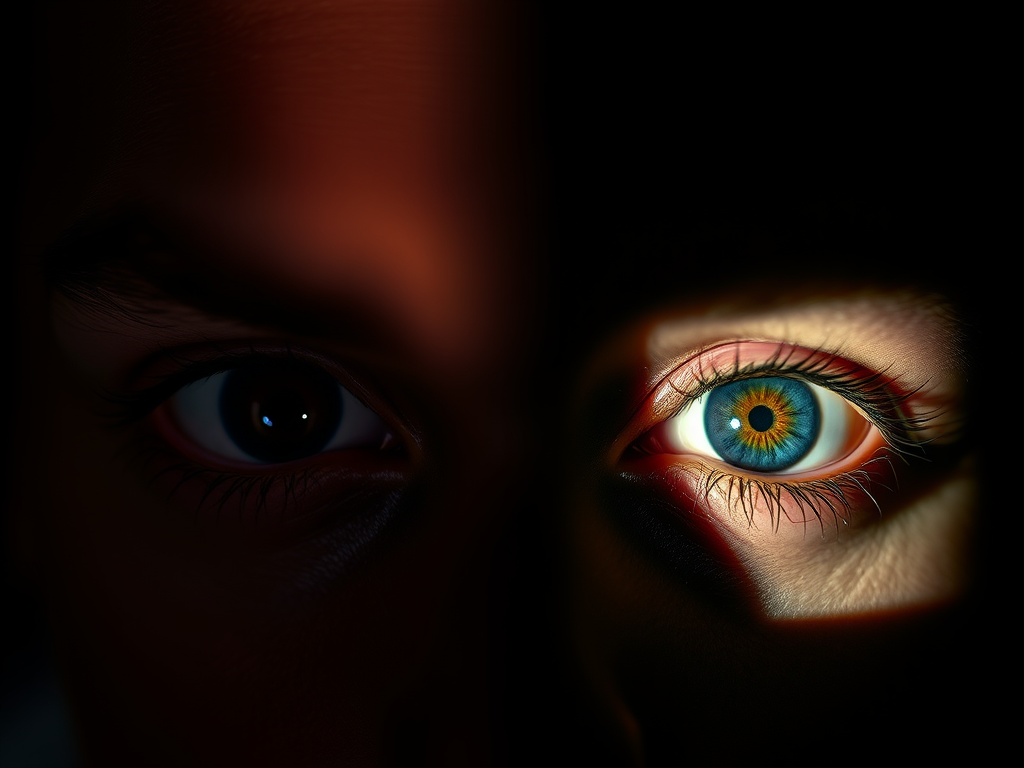
Our eyes undergo a process called dark adaptation. This happens when we transition from a brightly lit environment to a dimly lit one. This process involves the gradual increase in the sensitivity of our photoreceptor cells — rods and cones — to light. Initially, in very low light, we may see nothing at all. Gradually, we perceive faint outlines. Eventually, we gain a more complete, albeit low-light, vision.
The key characteristic of dark adaptation is that the objects we are trying to see are not clearly defined. They would be clearly defined in adequate light. However, our ability to detect them improves.
In a sense, this adaptation is a lesson in patience: the eye, deprived of clarity, learns to see in subtler tones. It surrenders precision for presence. This same principle echoes through all adaptation — of the body, of the spirit, and of conscience.
Dark Adaptation vs Tunnel Vision
It is essential to distinguish between dark adaptation and tunnel vision. While both relate to vision in challenging conditions, they are distinct phenomena:
– Dark Adaptation: This refers to the eye’s increased sensitivity to light in low-light conditions, enabling improved perception of faint objects. The field of vision remains broad, but clarity is reduced.
– Tunnel Vision: This condition involves the loss of peripheral vision, leaving the individual able to see only what is directly in front of them. It’s as if they were looking through a narrow tube or pinhole. In tunnel vision, the central object can be clearly defined, but everything else outside that narrow field is unseen. Place this pinhole a little off-centre, and you lose the clarity of the pinhole completely.

Between these two lies the metaphor of life itself: to adapt is to open one’s field gently, to resist the narrowing that fear or habit brings.
II. The First Pao: The Unseen Dance of Being
Let’s begin our journey with something seemingly simple yet profoundly complex: the act of breathing. Every inhale and exhale illustrates the fundamental laws of physics. It is a silent symphony of pressure, volume, and molecular motion.
Just as our eyes adapt to light, our bodies constantly perform unseen adaptations to sustain life. The rhythm of our breath is a dialogue between the inner and outer world — a balance between taking in and letting go.
Pao 1: The Physics of Your Breath
Consider the air around you. The air is not empty space. It is a bustling metropolis of nitrogen, oxygen, argon, and countless other atoms and molecules — each in constant, frenetic motion.
When you inhale, your diaphragm contracts, increasing the volume of your chest cavity. This simple mechanical action causes the pressure inside your lungs to drop, becoming lower than the atmospheric pressure outside. Like water flowing downhill, air rushes in — a natural consequence of the pressure gradient.
And what of the oxygen your body so desperately craves? It’s not just passively absorbed. At the cellular level, the magic of osmotic pressure and diffusion comes into play.
Oxygen is at a higher concentration in the tiny air sacs of your lungs (alveoli). It diffuses across a thin membrane into your bloodstream, where its concentration is lower. Carbon dioxide, a waste product, does the reverse — moving from your blood into your lungs to be exhaled.
This is a continuous, unseen exchange. It operates on the same principles that govern the movement of water through a plant or the uptake of nutrients into a cell.
The body, then, is a cathedral of balance — every breath a negotiation with pressure, every exhale a return to equilibrium.
Pao 2: The Philosophy of Resilience
Now, let’s turn to the “pao” as a story, a slice of life. You mention hospital stories and the contrasting human responses to suffering. Think about the very act of breathing in a hospital room.
For some, each breath is a struggle — a painful reminder of their vulnerability. Yet, for others, even in the face of immense physical and emotional duress, that same breath becomes an anchor, a testament to their enduring spirit.
Consider the patient. Despite a grim diagnosis and endless rounds of treatment, they manage to muster a weak smile for a nurse. They also offer a word of encouragement to a fellow patient. What is the physics of their cheerfulness? It’s not a measurable force.
It might be a profound understanding of life’s transient nature — or a focus on the present moment, or an innate capacity for gratitude. Conversely, why do others wilt? Perhaps they are overwhelmed by the sheer weight of their circumstances, unable to find that internal equilibrium.
This isn’t about judgment but observation — about recognizing patterns, reactions, and resilience. Even in the seemingly chaotic world of human emotion, these exist.
They are not governed by explicit physical laws. However, they can be explored through a philosophical lens. The very act of breathing is mundane yet miraculous. It encapsulates this duality: the precise, predictable physics that sustains us, and the immeasurable, inspiring spirit that defines us.
Just as light bends through the lens of the eye, so does resilience bend through the heart — refracted, fragile, yet luminous in its persistence.
Comments
5 responses to “The First Pao”
Nicely put Narinder. Thanks
Thank you. I try to add a little bit of medicine aths and Physics to the posts, there is this character called Bopa rai alive since 11th century at lease, he ends grounding most things in absurdist universe.
[…] The First Pao […]
[…] The First Pao […]
[…] The First Pao […]