The Sun Will Come
It had been grey for days in Alsace—the kind of grey that presses on the heart, sombre and unmoving, without the honest promise of rain or the cheerful threat of sun. It was the sort of sky that seemed to sit deliberately, as if thinking. One could almost kill himself for that endless foreboding ceiling. Looking out of the window filled one with dread, not hope.
Yet little Bopa wore his gloves anyway.
He dragged out his toboggan, hauled it up the slope, and came whirring down—five joyful times. Each descent loosened something inside him. On the sixth climb he walked more slowly, uphill toward a distant pine tree, his breath steadying, his steps deliberate.
Motion had lifted the gloom.

Reaching the tree, he found surprisingly dry scrub beneath the snow and built a small fire. The flames caught quickly, sharp and alive against the white. Standing by the warmth, he began to sing an ancient Gaulish song, absurd and rhythmic, older than reason and just as effective:
Ooma Boomba Boom Boom.
Ooma Boomba Boom Boom.
Ooma Boomba Boom Boom.

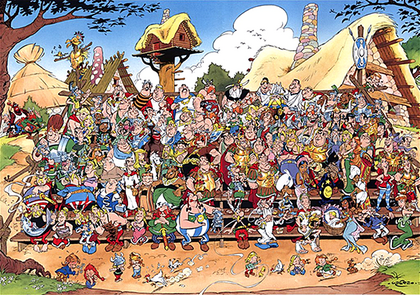
Soon footsteps crunched through the snow. One by one the villagers appeared, drawn by warmth and melody rather than logic. They gathered in a loose circle around the fire. Obelix lumbered forward first, Dogmatix yipping excitedly at his heels.
Bopa grinned and called out, “I am Bopa-ria!”
“Obelix here!” came the familiar grunt.
“Asterix!” shouted another voice.
Then the rest followed, proudly announcing themselves into the cold air—Vitalstatistix, Getafix, Impedimenta, Cacofonix (briefly, before being muffled by Fulliautomatix), Unhygienix, Geriatrix. Names spoken aloud seemed to warm the place further, as if identity itself were fuel.
Together they raised their voices toward the unmoved sky.

“WHERE ARE THE ROMANS?
WHERE ARE THE ROMANS?”
The cry rolled down the valley, echoing off snow and stone, defiant and free.
No Romans came. Romans had gone to Venezuela to pillage and spill some blood, Cacofonix said Ca Ca Ca.
Instead, the Sun himself seemed to grow tired of hiding. With something like a triumphant tear, he tore open the veil of clouds and poured golden light over his favourite village—lingering longest on the small boy by the fire, whose stubborn motion and foolish song had willed the world back into play.
A cheer rose across the square.
“The Sun is up! The Sun is up!”
Boars were roasted. Ale flowed. Songs were sung—Cacofonix, safely tied to a tree, contributed enthusiastically. The indomitable Gauls feasted beneath a sky that now seemed almost approving.
And so the day ended—not with battle, but with full bellies, loud laughter, and the quiet promise that tomorrow the sun would return, thanks to one small fire, one ancient song, and the unbreakable spirit of a tiny village in Alsace.
May it warm the readers too.