
Culila Dinma Panchtantra of Persians and Shatranj
The Bored Khusro
Naushirwan was down with a sickness of the spirit, restless, neither living nor dead. He summoned wise Old Man Bujurg Mihir. Mihir is the name of the Sun; in those days, Mithraism was the dominant religion. So this bright and wise old man presented himself before Khusro and asked what he could do for the great Khusro. Khusro, old and bored, sick with war and affairs of state, sick of sumptuous food, and sick of the smell of blood, which lingers like uncertainty in the mind. A declaration of mortality and of insipid life. Give me a pill that will banish these crippling thoughts.
Bujurg Mihir
Bujurg Mihir prostrated himself and said, “O King, if my life be spared, I will fetch the same from Hindustan. They have made great progress in medicine, and with your permission, I will proceed immediately to search in Hindustan for a solution to your malady. Having received permission, Mihir prepared the entourage. He summoned Bopa Rai, who was the Indian Ambassador from the King of Kannauj. Mihir questioned Bopa closely and decided that Kashmir, in the vicinity of Kannauj, was the right place to start, being a mountainous place full of herbs and wise ascetics, Sadhus and Sanyasis, a place of higher learning.
Kashmir
He took Bopa along. Kashmir was not far, and on horseback and their war-laden bullock carts, it took them a few weeks to reach Kashmir. There, they met a hermit, and they requested to serve him if he could tell them of the pill for removing disillusionment and for long life. The hermit told them there is no such pill and that death is certain, but disillusionment has a solution, and that he, as an ascetic, would be happy if they could construct an Ashram for him and his students with 6000 men and 6000 women slaves at their disposal.
The Panchtantra
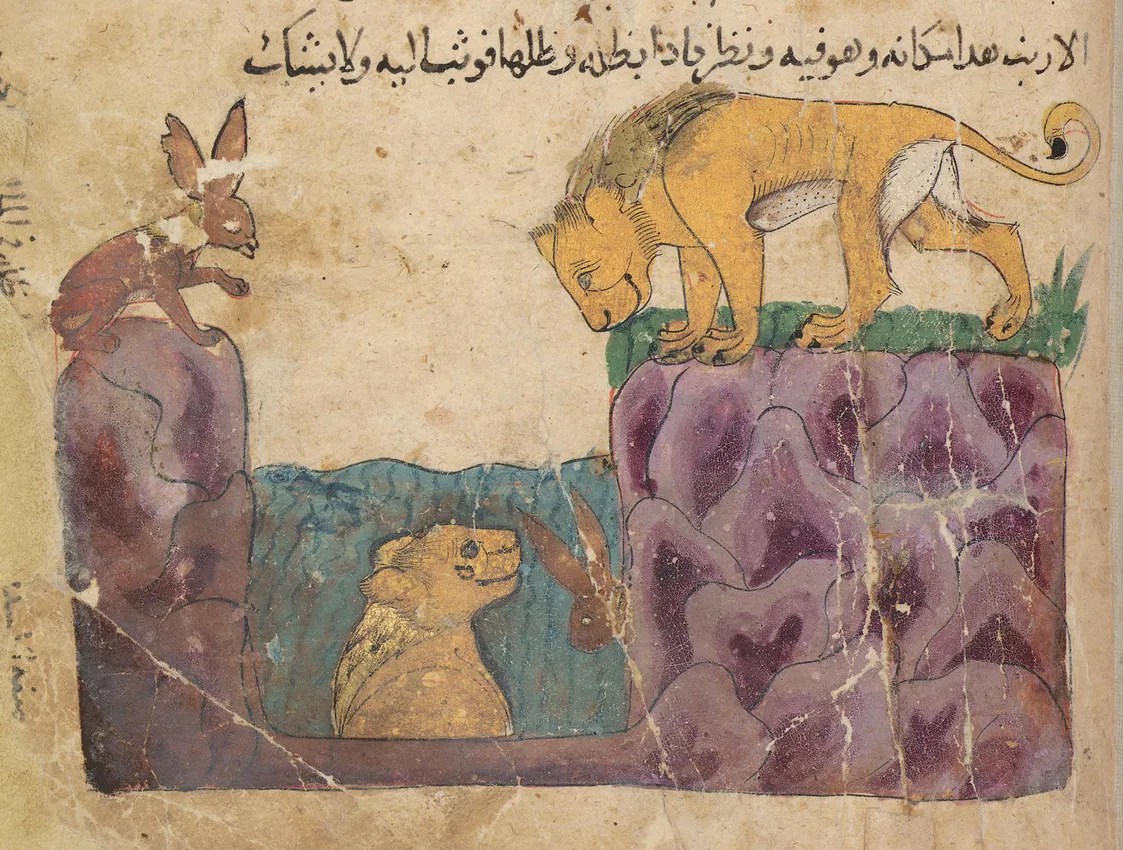
The Hermit gave a Sanskrit pratilipi of Panchtantra and asked Bopa and Mihir to translate it into Persian. The work took as long as the translation; in the meantime, the ascetic. In the meantime, he also introduced Chaturanga to both of them and explained the movements of Hasti, Aswa, and Padatun, all of whom served the King and the Queen. The game was hypnotising, war-like, and absorbing in the extreme. Six months passed, and Sun was furthest to the South when Ashram was built. Mihir asked again for the pill so that he could be on his way. The ascetic replied, “The pill is knowledge, Mihir and Bopa, you have that in the book you translated, and the Chaturanga is the remedy for malaise for the spirit, for it engages the mind in ways the mind can not comprehend entirely ever.” Mihir and Bopa Rai, the Ambassador to Persia from Kannauj, departed with a light heart, achieved only after a vision so expansive of the world, so naturally explained, a game that treated the malaise and taught principles of war.
Persia

Bujurg Mihir was honoured by Khusro, and Bopa was offered a reward, which he refused when the king insisted. “What could he give Bopa?” Bopa replied. “The company of the great king was enough for him.” Still, the King insisted again and asked him to ask for anything, for it was not his habit to leave anybody unrecompensed. So with great reluctance, Bopa asked a grain of wheat on the first of the square, twice that much on the second, double what was on the second on the third square, and doubling every time till the 64th square. Naushirwan was furious at such a little demand from such a great King; he instructed his treasurer to comply with the request, and he counted the number of grains and soon, to his chagrin, realized the eventual number was so large that the whole kingdom could not provide it from treasure, and not for many years. None could count the actual number, and the Bopa said it was astronomical and showed them how to calculate it to $2^{64} – 1$, which is 18.4 quintillion grains, far beyond the world’s capacity.
The King was humbled again and asked Bopa Rai to join his court as a royal minister, which Bopa gladly accepted.
Afterword: The Mathematics of the 64th Square
Bopa Rai’s request is a profound demonstration of Geometric Progression. To calculate the total number of grains, we sum the series where each square doubles the previous:
1. The formula for the total sum ($S$):
$$S = \sum_{i=0}^{63} 2^i = 2^{64} – 1$$
2. The Result:
$$18,446,744,073,709,551,615$$
3. Physical Reality:
- This number represents 18.4 quintillion grains.
- In modern terms, this would weigh approximately 450 billion metric tonnes.
- The pile would be roughly 300 km long, 25 km wide, and 300 meters high, or simply put: a mountain of wheat larger than Everest.
Historical Context: The Sassanian Bridge
The Sassanian Empire (224–651 AD), particularly under the reign of Khusro I (Anushirvan), served as the world’s greatest intellectual laboratory.
- The Transmission: The story mirrors the historical mission of the physician Borzuya, who traveled to India to retrieve the Panchatantra. The Persian Pahlavi translation was the “missing link” that allowed these Indian fables to eventually reach the Arab world (as Kalila wa Dimna) and later Europe.
- Cultural Synthesis: During this era, the Sassanids integrated Indian mathematics and medicine with Greek philosophy and Persian statecraft.
- Chaturanga to Shatranj: In the Sassanian court, the Indian game of Chaturanga was codified as Shatranj, which eventually evolved into the modern game of Chess.