Bopa’s Homecoming
Bopa Rai was on his first home leave after having been commissioned as a lieutenant in the Mahar Regiment. The Regiment was known for its innocence, intense patriotism, and unwavering loyalty. It was also known, for better or worse—for the lethargy of its jawans and the brilliance of its officers. Impulsive, on-the-spot decisions ran in their blood. Bopa was well acquainted with the fact. He had this mantle of memory from the past. It aided him in prompt decisions in difficult situations. It was like reading from Bopa Rai Chronicles, a book no body had ever written.
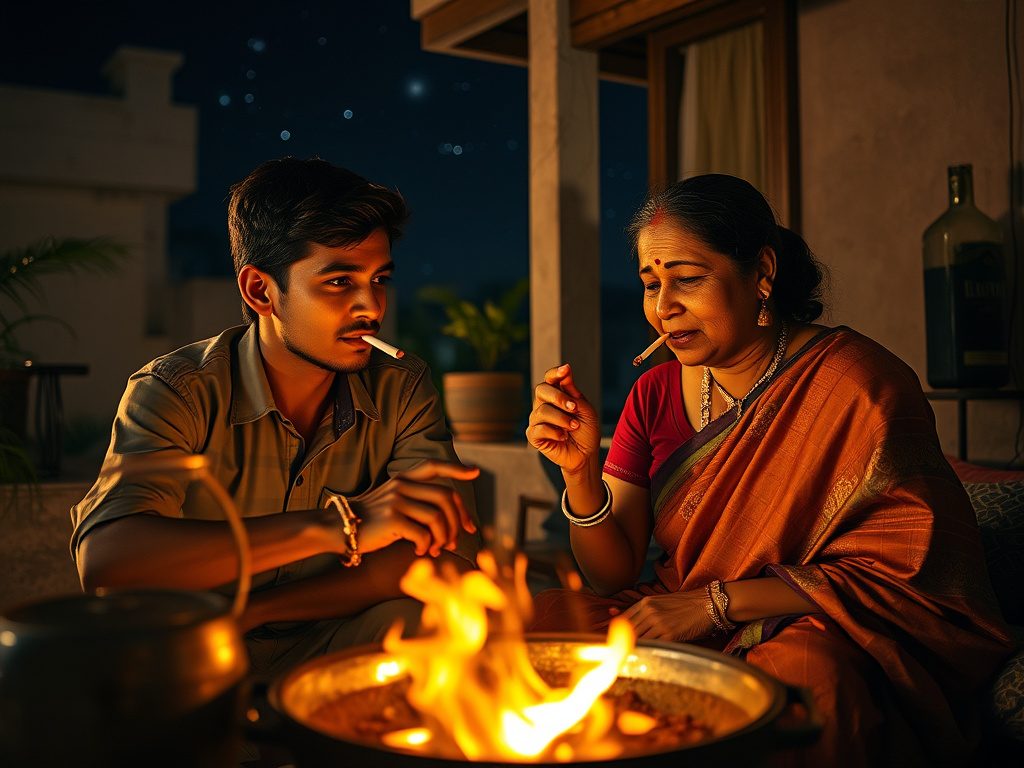
That evening, meanwhile, Bopa sat beside the chulha, the earthen stove still warm with the day’s meals. His mother sat beside him, stirring something invisible, more with her thoughts than her hands. In her motherly way, she asked how life was treating her Bopanna. “Bopa” was what they called him at home, Bopanna—the name proper meant prince, or lord.
She lit a cigarette, drew in, then passed it to him. Bopa hesitated.
“Beta, smoke. Everybody smokes,”. The mother casually added, but with a hint of sly knowing. Still a little shy, Bopa took it, and then, too fluently—smoked like a professional.
His mother smiled. There was no judgment there—only recognition.
Later, on the rooftop, meanwhile, his father was nursing his glass, the night was still. The stars watched like silent ancestors. He poured a drink into another glass and handed it to Bopa. Before the young officer could politely refuse, his father spoke with a mix of pride and ceremony. “I would like to have a drink with my newly commissioned son.”
This time, Bopa didn’t hesitate. He took the glass gladly. It was an honour.
The Cup-Bearer’s Memory
Father and son stood together on the dark veranda, overlooking the silent stretch of the coffee plantation. The trees whispered some rustling. Small animals scurried by, as they always did at night. It was as if the trees were carrying old secrets in the rustle of their leaves.
“This land,” the father said, lifting his glass slightly toward the horizon, “was bestowed upon us by Vikramaditya VI. The Tribhuvanmalla himself.”
Bopa Rai nodded. He had heard this a hundred times. But tonight, it felt truer than ever. Not merely because his father believed it, but because he remembered it. He remembered the glint of gold on the emperor’s sandals. The clink of goblets. The scent of sandalwood. He had been there, not here, in uniform, but in a silken tunic, a cup-bearer in Vikramaditya’s court.
And somehow, before he turned twenty-six, he had become a general. A boy among men, but with the eyes of someone who remembered battles before they were fought.
“Appa,” Bopa said, “Vikramaditya wore a red stone on his middle finger, didn’t he?”
The father turned slowly. “How do you know that?”
Bopa smiled. “I was his cup-bearer, once.”
The father chuckled, took a sip, and said, “Of course you were.”
Shame and Doubt
His father knew he had passed something of himself to his son—and he was relieved. The memories, heavy as they were, had been received.
But Bopa was still finding his balance. Torn between being a boy in his mother’s eyes and a man in his father’s. He recalled the night he had visited a brothel. One of the girls had slowly unbuttoned her blouse. Her breasts—serene, unashamed—had not aroused him. They had flustered him. He had come back untouched. Unspent. Uncertain. He confessed to a close friend, who laughed. “You shag three times a day. That place doesn’t mean a thing.”
But the doubt remained. What if all triumphs, all memory, all past lives meant nothing in the face of one moment of failure?
The Passing
His father ached for his beautiful son. Not for his youth, or his innocence—but for the burden. He knew his own time had come. He was immortal, but not in body. Immortal in memory, in legacy, in the weight he now passed. He said nothing. Some mantles are not spoken of.
From the rooftop, the father watched him vanish into the trees. He whispered, not to the wind, but to the gods: “Let him find what I can’t.” He laughed, a quiet, knowing sound suspended between absurdity and Moksha. Which is better? He shook his head; his son’s path would tell.
The Dream of a Life
The Old Monk was a warm, heavy anchor in Bopa’s belly. The day’s emotions and the unfamiliar weight of his father’s ceremony settled upon him. He lay down on the cot in his room. The afternoon sun pressed heavily on the tin roof. A deep, profound drowsiness pulled him under. He did not fall into sleep; he fell through time.
The Mountain Path
Chronicles of Bopa Rai
He was Bopanna again and found himself walking in a hundred-strong reconnaissance party. He was a wraith-like figure on a narrow mountain trail in the chilly predawn hours. They were deep in the Satpura range. Their location was nestled between the Narmada River to the north and the Tapti to the south. King Vikramaditya VI himself led them. His son Someshwar accompanied him. The exile poet Bilhana, known as Vidyapati in the court, was there. The King’s purpose was a secret to most. Only the elite few knew it. His goal was to familiarise his successor with the land. He also aimed to prepare for the coming wars.

The dark silhouette of the Vindhyachal range loomed to their left. Below, the Narmada flowed serenely in the deep gorge of a rift valley. He heard the King’s voice, quiet and resonant. “Look at Narmada. It seems as if the land has been ripped apart violently for the Goddess to pass.”
Anointing by the Boar
It was dark except for starlight and a sliver of a pale moon. A short rustle came from the dense bushes on the right. Everyone froze. With a sudden loud rasp, the bushes parted and a king of Boars charged, head lowered, tusks up. It ripped through a small gap in the column. Brushing the King but just so, before rushing down towards the bushes on the left. The King stood still, raising his hand to signal the men not to attack. It was auspicious, a blessing from the totemic animal of his lineage, the Varaha himself.
But a weapon had already been drawn. He, Bopanna, in a flash of instinct he couldn’t control, had released his spear. It found its mark in the Boar’s neck. A brief shriek, and all was silent.
Will of the Varaha
The King, enraged, shouted “Bopanna!” The shout, nonetheless, had the opposite effect on the meat-starved troops, who chorused “Bopanna! Bopanna!” and lifted him onto their shoulders. He cringed, for he had heard the rage in the King’s voice.
He was brought triumphantly before the King and stood with his head bowed. On Vikramaditya’s hand, Bopanna saw it clearly—the large, square-cut red stone on his middle finger.
“You didn’t see my hand,” Vikrama said, his voice low.
“I was focused on the kill. Any punishment is acceptable, lord,” Bopanna replied.
Vikramaditya looked from Bopanna to his cheering troops. He understood the strange look in the Boar’s eyes had been a message for him. Yet, the anointing of blood and courage was meant for his cup-bearer.
“Your punishment for feeding my troops is that you will now be a Captain,” the King declared. “To start with, you will carry out the duties of my ADC. You will speak as I do. The order is immediate.”
A Song at Dawn
The company reached a glade sloping to a small lake. The crystal water of the lake reflected the darker shadows of the pine trees. The sheer majesty of the place quietened and humbled them all. As the beautiful Usha, the Goddess of dawn, smiled in the east, their hearts became full. There was nothing to say. Vidyapati sang. His clear, high tone whispered of bewilderment. It spoke of walking from sleep into a marvelous light. The song told of a river hurrying to reach Nirvana and the sea.
Bilhana, the Vidyapati, was an exile from his beloved Kashmir. He was a wandering poet who had lost his love, his family, and his land. After travelling the length of Bharata, he had found refuge and kinship in the court of Vikramaditya.
A Fated Union
The dream shifted. The patrol was over, and was heading south to meet the main army and the queens. The retinue waited at a temple by the river Tapti. They were camped in a place called Lila’s Garden of Mathematics. The King intended to meet with the great astronomer Bhaskara II there.
There, the eldest queen spoke with the King. “There is a prodigy here, my lord. Bhaskara’s daughter, Lilawati. But her stars are cursed. It is prophesied that any man who marries her will die shortly after the union. I was thinking of adopting her, to save her from such a lonely fate.”
The King listened, his gaze thoughtful. Then he called out, “Bopanna.”
He came forth and bowed. The queen looked at the handsome, fierce young captain. “How is this boy as a groom?” she mused aloud, “But the prophecy?”
Vikramaditya placed a hand on Bopanna’s shoulder. “The Varaha himself anointed him,” the King said with finality. “He defied my command and, in doing so, was blessed by a god. He is the most suitable candidate. Relate this to Bhaskara and ask for Lilawati’s acceptance. This boy has no family of his own. Lila can’t have a family. Together, they will build a hearth and home in Kalyani under our tutelage.”
War and Memory
And so it was. The dream washed over Bopa in a torrent of colour and sound. He experienced the scent of marigolds and sandalwood, saw the crimson and saffron of the wedding. He remembered the shy, intelligent eyes of Lila. It a joy so profound it was an ache.
Then, the dream’s season turned. The shriek of a war horn tore away the joy. The softness of Lila’s touch was replaced by the cold grip of a sword’s hilt. The dream became a chaotic, visceral montage of a life lived at the blade’s edge. A clash of steel against a Kalchuri shield in the driving monsoon rain. The thunder of cavalry hooves shaking the Deccan plateau. Arrows raining like black rain from the north, carrying with them a new, fanatical ferocity. As Muslim invaders pushed south. He saw himself, older, his face grimed with dust and blood. His voice hoarse from shouting orders he hadn’t learned but had always known. He was General Bopa Rai, a bulwark against the coming storm. His love for Lila the anchor, his loyalty to the King the compass.

The Mantle Settles
Bopa woke with a gasp, his body flinching. The air in his lungs felt ancient. For a terrifying second, the phantom weight of a leather cuirass was on his shoulders, the scent of iron and old sweat sharp in his nostrils.
He sat bolt upright. The room swam back into focus. The familiar cotton of his bedsheets. The distant clatter of his mother in the kitchen. He was young a lieutenant in the Mahar Regiment. He was home.
But it was not a dream. It was a memory.
In that single, torrential download from the past, he understood. He had a three-dimensional view of the map of his soul. It explained the rifle that felt like an extension of his arm, explained the instinctive way he could read men’s fear and courage. It also described the deep, unspoken loneliness his father saw in his eyes.
And finally, it explained the unspent shame of a brothel. The serene, unashamed peace of a woman’s body had not aroused him. Yet, it had reminded him of a long-lost home. It evoked memories of marigolds, sandalwood, and a garden he was still fighting to return to. The mantle had settled. And in the hush before dawn, Bopa slipped outside. The air was soft with marigold and sandalwood. She was ready to walk again. She bore the mantle, unafraid, into the waiting light.
Comments
4 responses to “Bopa Rai and the Mantle of Memory”
[…] their long sojourn at Kedarnath, where snow and prayer had mingled into a rare stillness, Bopa Rai and Tara returned to the plains. The body had healed, but the spirit was restless. They had seen […]
[…] Bopa Rai and the Mantle of Memory […]
[…] Bopa Rai and the Mantle of Memory […]
[…] Bopa Rai and the Mantle of Memory […]