Watershed in Sangla
In the northern reaches of Himachal lies the Sangla Valley, a once-secluded watershed cradling the Baspa River. Oriented towards the west, its eastern flank is a tapestry of moraines crisscrossed by rivulets hurrying to the main river. The construction of a dam downstream has broken its isolation. This change has ushered in a wave of tourism. New hotels are steadily replacing old ancestral buildings. The valley’s unique Kinnauri culture is slowly eroding.
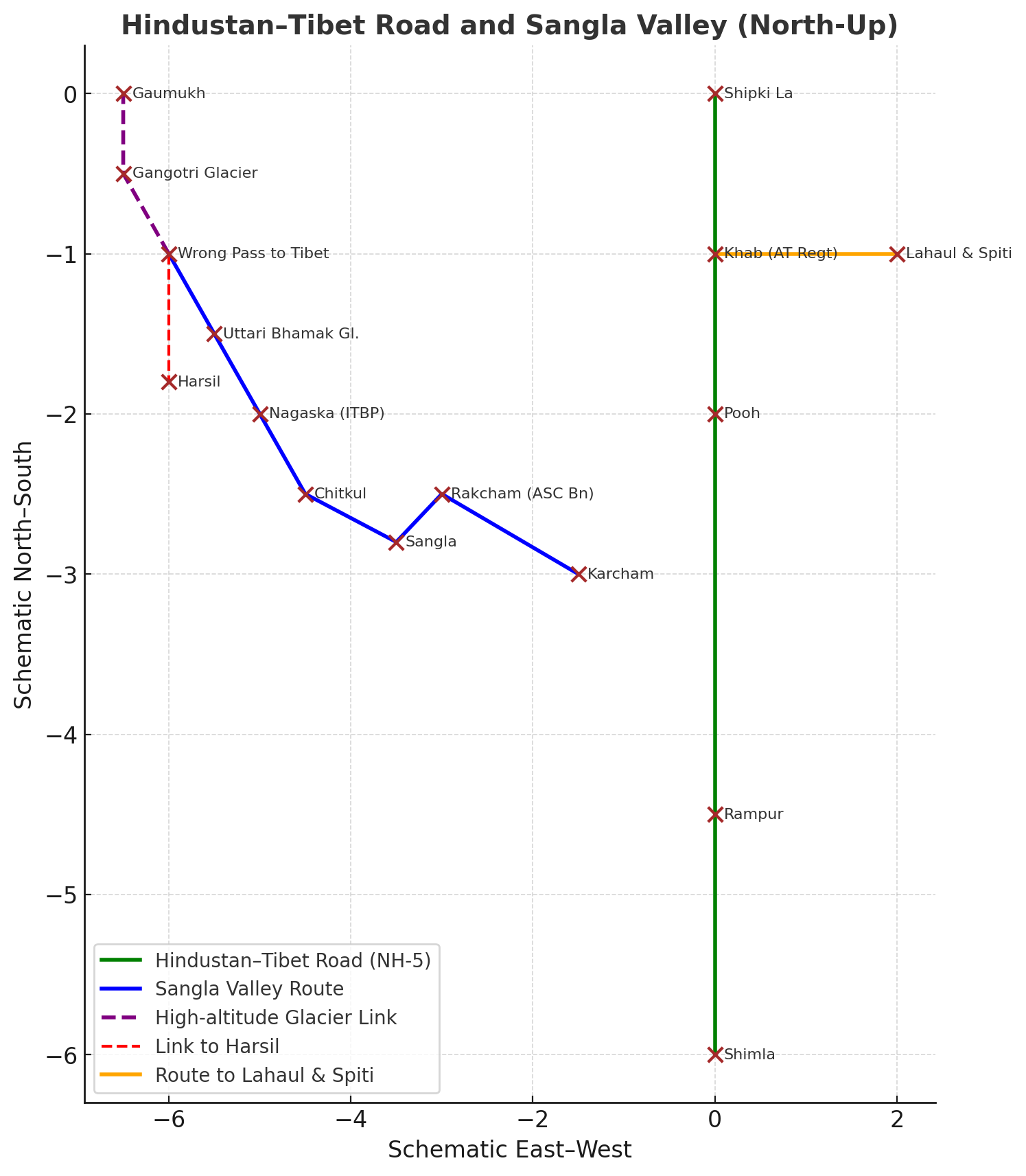
The road up this valley ends at Chitkul, which is the last inhabited village. It is four kilometers short of the final Indo-Tibetan Border Police post. Beyond lies a formidable spread of moraines and the west-sloping rivers and rivulets all merging into Baspa. At 12,000 feet, there is a flatland. In this flat grassland one comes across a pristine lake completely in shadows of tall trees around it. Their leaves make a thick, cool, moist cushion. People take off their shoes. They sit in that cool glade and rest. They look at dark images of tall trees in ripple less water. Then, they look at the trees themselves, mesmerized.
One spies an easy pass going east one walks into it naturally. Soon down that road, one sees piled stone markers. These markers are called cairns and show sheep movement and a used path. There is no habitation or a path sign that says “this way to Tibet”.
We were, expecting the pass to go north. We felt doubtful. We took out the compass and the GPS. Along with Map located North, we discovered an ice wall there. It didn’t look like a pass at all. it was a a rocky overhang. It could only be traversed by using rope, carabiner and Jumar. We had all three and it was not difficult to go through that 12-15 foot overhang.
At the top, the glorious glacier tempts adventurers. Its pristine snow slope to the north invites a reckless slide on a rucksack. It is a glacial gauntlet leading to a pass into Uttarakhand’s Gangotri Glacier system. This eventually drains into Bhagirathi. Bhagirathi originating from Gaumukh moraines of Gangotri Glacier passes to the left of Harsil Village, the “Hari Shila.”
The story goes that a powerful demon named Jalandhar could not be defeated in battle. The only way to make him mortal was through his wife, Tulsi. Tulsi was pativrata. Vishnu went to her in the form of Jalandhar and said, “I have conquered the three worlds, my dear wife.” At this, Tulsi made ablutions, fed him, and did what wives do: “LOVE”. This broke the protection of the monster. The boon was that he would stay invincible until his wife remained inviolate. As a result, the Asura fell.
Tulsi, in her anger, cursed Vishnu to become Harishila, a stone. Vishnu said, “You will live by my side here as Tulsi. Know that you are my wife now.”
This is the land of myths and the life-saving Himalayan Yew. So on one side of watershed is Baspa, Spiti and Sutlej complex and on the other Bhagirathi, Alaknanda Ganga basin.
Between them is Rupin Pass, a valley where the blessed Rupin flows. It meets Tons, which is the major tributary of the Yamuna. Rupin pass is at 15000 ft plus, a proper high altitude. It is the source of the Rupin River. The name “Rupin” reflects excessive innocent beauty. In fact, the name is based on Roopmati, a beautiful girl. The gods were so impressed by her beauty. They transformed her forever into a river of transcendent beauty that flows forever. Rupin flows into Supin and then both waters join Tons. Tons River is the largest tributary of Yamuna.
The Baspa and Sutlej meet at Karcham. Following the Baspa brings you there. This confluence is under the gaze of an Army Service Corps Battalion. The road climbs past Pooh, with its Brigade Headquarters further at Khab—the stark confluence of the Spiti and Sutlej. An Animal Transport Regiment is stationed here. The troops acclimatize to the conditions. Mules carry out a daily climb of nearly 3,000 feet. The mule drivers and their animals are inseparable partners; no outsider ever rides a mule without the driver’s consent. Mule drivers are probably, the strongest group in Indian army, spending most of their life in harsh terrain
Day One: The Mule Dispute
One morning, the climbing exercise was interrupted by a commotion. A burly mule driver stumbled down from the slope, scalp streaming blood, the wound yawning open like a red seam. Dr. Yashpal, the veterinarian, called for me—Dr. Bopa Rai—suspecting a head injury.
As I readied the suture tray, I suggested a local anaesthetic.
“Let this be his punishment,” Yashpal said, not unkindly, but with a mountain man’s sense of justice.
The iron smell of blood hung in the air as the needle bit into skin. The man did not flinch.
The cause soon emerged: another driver, fresh from leave, had reclaimed his mules—except one. That mule had stayed with the wounded man, who refused to part with it, claiming a bond deeper than any duty roster. Resentment fermented into an iron rod swung in anger; the sound of metal on bone had echoed briefly up the slope.
By nightfall, the wound was stitched, a head injury ruled out, and the man kept under observation. The incident was never put on paper. The mule returned to its original driver, and the mountains, indifferent as ever, swallowed the story whole.
Day Two: The Mule on the Table
The next morning, Maj. Yashpal sent for me again.
“Come,” he said, “I’ll show you a laparotomy in a mule.”
The operating shed smelled of hay and cold iron. A metallic cage sat near the mule’s head, lined with linen and cotton soaked in chloroform. The sharp, sweet vapour stung the nostrils, making the eyes water. Slowly, the animal’s breathing deepened, its massive frame slackening.
We opened it along the midline. Steam rose from the incision in the cold morning air. Inside, the stomach bulged with undigested hay, which we scooped out in armfuls. A drainage tube was fixed into the dependent region of the abdomen to draw away inflammatory fluid.
By dawn the next day, the mule’s condition had worsened—convulsions rippling through its flanks. Yashpal watched for a moment, his decision already made.
“Useful life is over,” he said. “Not fit for civilian work either. We decide early—unlike you doctors, who take years to come to this conclusion.”
The syringe was loaded with potassium chloride. One steady push, and the great chest stilled. The shed was suddenly quiet except for the faint clink of metal instruments being set down. In the high mountains, where life is measured against load-bearing strength and the next climb, such decisions are final, and mercy is practical.
Reflections
Two days, two wounds. One healed with sutures and silence, the other closed with a final injection. Both resolved without paperwork, without appeals, without the slow grind of formal justice. Here, among the cliffs and glaciers, decisions are made with the same clarity as the mountain air. Bonds—whether between man and mule, or between comrades—are honoured in ways outsiders might never understand. And when life can no longer serve, the end comes swiftly, without ceremony. In the shadow of the high passes, sentiment yields to survival.
Reflections in Thin Air
These stories do not belong to the world of bureaucratic justice. No files, no official reprimands—just consensus in the cold. Everything is pared down to its essentials. Survival, honour, and mutual recognition form an unwritten law, one respected with a gravity outsiders rarely glimpse.
Sangla Valley’s transformations are visible—from the new hotels and fading traditions to the daily calculus of who carries what, and whom, up the next slope. But the mountains remain steady, indifferent to both human conflict and animal suffering: they bear witness to a justice as efficient and silent as falling snow. What outsiders might call cold-heartedness is, up here, clarity—a way of honouring the labour, pain, and endurance necessary to live where winter is never far away.
In the shadow of glacial passes, every decision is sharpened by altitude. Life serves until it cannot. Bonds endure until survival demands otherwise. The paperwork that governs lowland disputes is replaced by a mountain air that brooks no delay—a dispatch from a place where mercy and utility are twinned. Justice is administered with a needle, a stitch, or simply silence.
Reflection River Types
The mountains maybe conceived as Hard Sponges or even balloons. Sponges release a little bit of water. Many such rivulets form streams like Rupin, steady and peaceful. There are other ancient rivers. Some are antecedent to the Himalayas. They gush as a torrent from their glacial mouths. Moraines make their flow braided, they twist, turn, sinuous, and looping. Gangotri, Alaknanda. Yamuna Sutlej fall into this category. They become rivers after carving out deep gorges. They mature into slow moving women in their later phase in the plains. Yet their are other torrents, one example is Nubra which remains a torrent through it 45 Km Journey. Forever Young. Nubra meets Shyok at Khalsar. Then both go on to meet Indus. Janskar River has already attached itself to Indus.
The two images one in 3 D and other in 2 D provide different perspectives of river data.
| River/Basin | Bubble Size (Drainage Area, km²) | Elevation Range (m) | Flow Type (Per Your Reflection) | Ocean Destination | Pass Connection |
|---|---|---|---|---|---|
| Baspa | ~1,000 | 2,680–5,000 | Braided moraines, rivulet-fed | Arabian Sea (via Sutlej) | Lamkhaga (ice overhang to Bhagirathi) |
| Bhagirathi | ~7,000 | 3,000–6,900 | Glacial torrent, sinuous gorges | Bay of Bengal (Ganga) | Gaumukh moraines; Hari Shila myths |
| Rupin | ~350 | 4,500–15,300 | Steady “innocent beauty” rivulet | Bay of Bengal (via Yamuna/Tons) | Rupin Pass crest; Roopmati legend |
| Sutlej | ~20,000 | 3,000–6,000 | Antecedent torrent, looping plains | Arabian Sea | Karcham confluence; Spiti join at Khab |
| Yamuna (via Tons) | ~1,500 (Tons alone) | 2,000–4,500 | Mature, slow in plains | Bay of Bengal (Ganga via Allahabad) | Rupin–Supin merge; high-altitude source |
Comments
5 responses to “In the Northern Reaches of Himachal”
[…] whispered of him as a manifestation, a spirit testing their faith. At Taklakot, he clashed with Tibetan and Qing forces, holding ground where even eagles faltered.But the mountains claim what they wish. […]
[…] In the Northern Reaches of Himachal […]
[…] In the Northern Reaches of Himachal […]
[…] In the Northern Reaches of Himachal […]
[…] In the Northern Reaches of Himachal […]