https://en.wikipedia.org/wiki/Symbolism_of_Freemasonry
Bopa Rai and the Eternal Tooth
The Den and the Eternal Bopa Rai – Part 2: Tooth
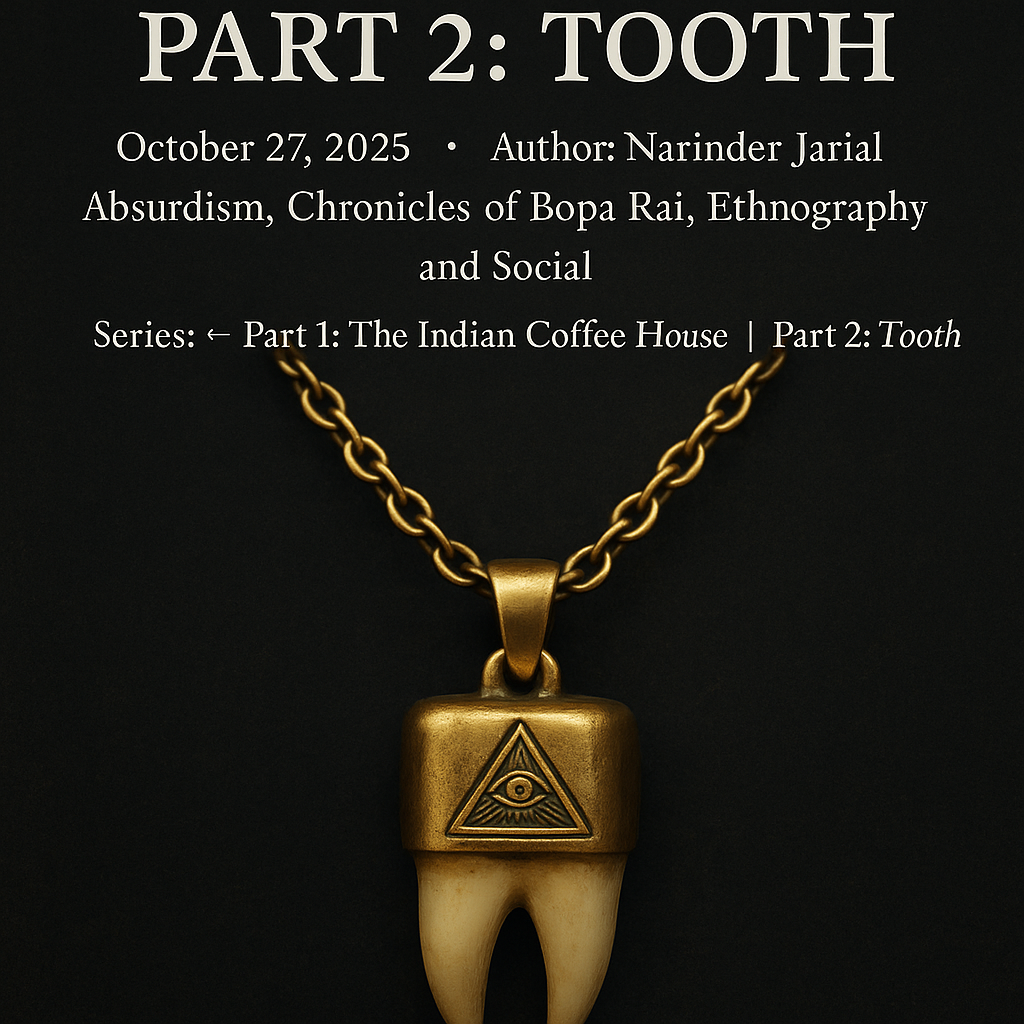
The parcel arrived three nights later, delivered by a boy in a torn school blazer who vanished before Bopa could tip him. No postmark, no return address—just a square of turquoise cloth knotted tight around a metal box the size of a cigarette case. Inside: the same molar, now encased in a silver tooth electroplated with gold, Masonic symbols etched so fine they looked grown rather than carved. A malmal cloth, soft as breath, cushioned it. A gold chain threaded through the root canal. A slip of paper, no bigger than a matchbook, inked in the same vermilion the coven used:
Wear it. You are known as Tooth.
Bopa laughed until the coffee house windows rattled. The eternal, reduced to a dental relic. He slipped the chain over his head. The tooth settled against his sternum, warm as living bone.
The eruption hit first.
He was twenty again, Delhi 1398, the night the city burned. The lower right quadrant split like a fault line. The tooth crowned in a gout of blood and pus. He remembered the taste—iron, mare’s milk, terror. He remembered the spear in his hand, the child’s rag doll hitting the dust. He remembered laughing then, too, because pain was cleaner than guilt.
Three days later he invited the spear into his own chest.
The Rajput’s eyes—calm, almost gentle. The steel grating between ribs. The world tilting. The tooth throbbing in time with his failing heart.
But the memory kept going. He saw the tooth pried from his jaw centuries later, in the den beneath MG Road. Saw it crack open on the obsidian slab, spilling liquid gold. Saw the coven drink it like communion wine. Saw himself walk out lighter, hollowed, free.
The tooth pulsed. Not warm now—hot. It burned a circle into his skin, branding the Masonic eye into his flesh. The chain tightened, links fusing into a single band of gold. He clawed at it, but the metal had become part of him, a second skeleton.
Across the coffee house, Hakim watched from a corner table, eyes unreadable. He raised his cup in salute. Bopa tried to stand, but the tooth dragged him down, root-first, through the floorboards, through the city’s concrete arteries, down to the den that should have been empty.
The chamber was full.
The coven stood in a circle, robes replaced by everyday clothes—sari, lungi, school blazer. Bhai held the obsidian slab like a tray of sweets. Bhabhi’s hennaed hands cradled the brass compass, its needle spinning wild. The masked man was gone. In his place: the boy who’d delivered the parcel, face smeared with vermilion, eyes ancient.
“You gave us the capstone,” the boy said, voice layered with every tongue Bopa had ever heard die. “Now we give you the pyramid.”
They pressed the tooth—his tooth, their tooth—into the hollow of his chest. Bone knit to gold. Memory flooded back, not in flashes but in architecture: every life a corridor, every death a keystone. Alexandria, Delhi, Thelema, Dublin, MG Road—all converging here, now, in the shape of a man who had forgotten how to end.
Bopa opened his mouth to laugh, but the sound that came out was the creak of a door long sealed. The coven stepped back. The den folded in on itself, sugar sacks and oil lamps collapsing into a single point of light.
When the Indian Coffee House reopened at dawn, the table where Bopa had sat was empty except for a small brass compass, needle still. The server swept it into his apron pocket without a second glance.
Outside, MG Road hummed with neon and exhaust. Somewhere beneath it, the pyramid was complete. And Tooth walked its corridors, eternal, embodied, no longer carrying his grave but buried alive inside it.
Hakim’s laughter rolled through the den like thunder trapped in a well. It was the same laugh Bopa had heard in 1398, only then it had come from a Rajput prisoner’s throat, raw with grief and mare’s milk. Now it issued from Hakim’s mouth, polished by centuries of coffee-house murmurs and brown-sugar deals.
He stepped forward, maroon coat unbuttoned, the brass buttons catching lamp-flame like tiny suns. In his right hand he held a short kirpan, its blade no longer than a man’s palm, the kind street barbers use to shave beards and fates. The edge was dark with old blood, flaking like rust.
“Welcome to the brotherhood, Tooth,” Hakim said, and the title landed heavy as a coffin lid.
Bopa felt the tooth fused to his sternum pulse once, a warning. He did not flinch. He had invited worse.
Hakim’s eyes—those calm, gentle eyes Bopa remembered from the riverbank—were bright now, fever-bright. “You asked for an honest Mason,” he said. “Here I am. I was the Rajput. I was the spear. I was the hand that ended you so you could begin again.”
He pressed the kirpan to the hollow where the gold-encased molar had rooted. The point found the seam between metal and flesh, the place where the pyramid’s capstone kissed the eternal’s heart.
“I remember the smell,” Hakim whispered. “Delhi, 1398. The child’s blood first—sweet, thin, like watered rose syrup. Then yours—thick, hot, full of iron and idiot regret. I carried that smell across every life, same as you carried the tooth.”
He drove the blade in.
There was no pain, only pressure, the way a glacier remembers the mountain it once was. Bopa felt the kirpan slide between ribs that had knit and re-knit for seventeen centuries. Felt it kiss the back of the tooth, felt the gold crack like an eggshell. Liquid memory spilled out—not gold this time, but black, viscous, smelling of burning thatch and the Jumna at dawn.
Hakim twisted the blade, gentle, almost loving. “We are bound now,” he said. “Spear and chest. Tooth and tongue. Every time you laugh at your idiocy, I laugh with you. Every time you remember the child, I remember the spear. We are the brotherhood of the wound that never closes.”
The coven watched in silence. Bhai’s belly trembled with suppressed mirth; Bhabhi’s hennaed fingers drummed a wedding beat on the brass compass. The boy in the school blazer licked vermilion from his lips and smiled with too many teeth.
Bopa’s knees buckled. He sank to the stone floor, the kirpan still in Hakim’s fist, its hilt now flush against his sternum. Blood—his, Hakim’s, the child’s, the city’s—pooled around them, black in the lamplight, reflecting the pyramid’s inverted eye.
Hakim leaned close. His breath smelled of coffee and brown sugar and 1398.
“Laugh, brother,” he said. “Laugh with me.”
And Bopa did. The sound that came out was not human. It was the creak of Delhi’s gates giving way, the hiss of scrolls burning in Alexandria, the wet pop of a wisdom tooth crowning through bone. It was the laughter of two men who had killed each other across centuries and found, in the killing, the only honest handshake left.
Above them, in the brown-sugar shop, Bhabhi called out to a customer: “Arre, jaldi! Coffee thanda ho raha hai!” The everyday world went on, oblivious.
Below, the brotherhood laughed until the den itself cracked along its ancient lines, until the pyramid folded inward like a paper lotus, until there was no up or down, only the smell of blood and the sound of two eternals remembering the same mistake forever.
When the laughter finally stopped, the kirpan was gone. The tooth was gone. Only a scar remained, shaped like an eye within a triangle, pulsing gently with every beat of a heart that had forgotten how to die.
Hakim offered his hand. Bopa took it. They stood together in the dark, brothers at last, bound by a wound older than empires and sweeter than sugar.
Comments
One response to “The Den and the Eternal Bopa Rai – Part 2: Tooth”
[…] The Den and the Eternal Bopa Rai – Part 2: Tooth […]