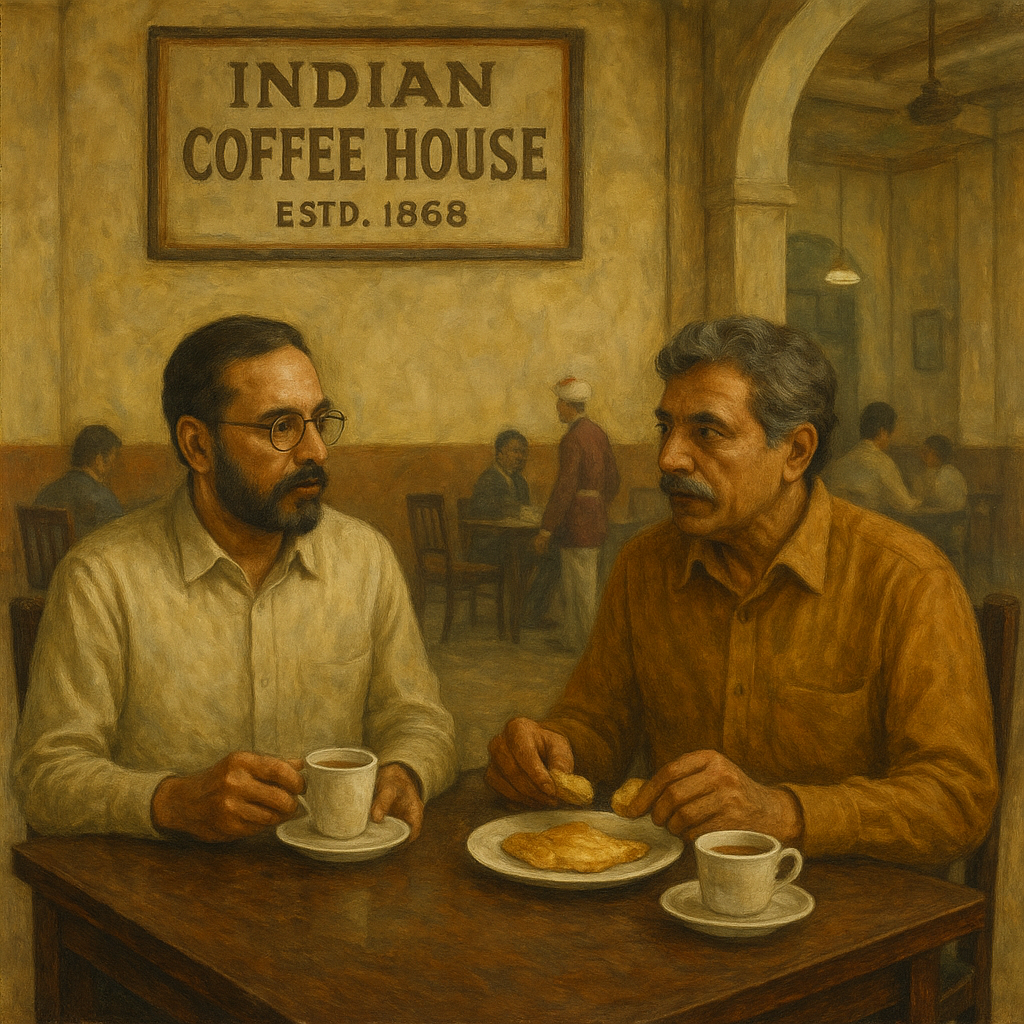
1. The Indian Coffee House
Hakin was having a cup of coffee at the Indian Coffee House, an ancient landmark dating back to 1868. Its decor seemed unchanged for the last twenty years. In contrast, the rest of MG Road had a facade of neon-lit modernity. The shops were still recognisable by the trade they carried out. Indian Coffee House still proudly declared “Indian Coffee House” on the ancient-looking board. The place had an aura of intrigue, giving rise to what could be called the Indian Coffee House mystery. It was a place where people would have a hurried coffee out of habit and leave. Inside, however, some customers lingered. They savoured small eats and coffee, and the slightly run-down ambience.
Bopa Rai entered and found a vacant chair in front of Hakim. He sat down and ordered a cup of coffee. He also ordered a bread omelette.
The servers were efficient. They wore maroon coats, ties, and black trousers. They were busy going here and there. Sometimes they brought food to the customer. Other times they served a bill. And in activities that could not be understood without really figuring out the heart of the coffee house, its Kitchen.
Despite the bustle, the place was discreet enough for state secrets to be traded there.
Breakfast
Hakim waited till Bopa Rai had sipped coffee and taken a bite of savoury omelette.
“Are you sure you wish to visit the den? It is not a very congenial place, not for everybody.”
Bopa Rai replied that it is not every time that one gets to see an honest Mason. He thought they had disappeared despite so many Masonic lodges scattered about.
Hakim smiled. “My advice is: don’t wish for a thing you don’t understand; you get embroiled in them. There are secret societies, you know, complex to get in and difficult to get out.”
Bopa laughed. “What do I have to fear? My job description is to get embroiled.” He thought he had met all the bright charlatans. These included Aleister Crowley, Yeats, and Mason—the man after pyramid mathematics himself. Not for nothing was he an eternal.
Bopa paid the bill. They got up and crossed the broad avenue. It was no more than a road. They went into a narrow street where the brown-sugar dealer with a considerable wife lived. He was a giant of a fellow; everybody called him Bhai, and his wife Bhabhi. A large-eyed, confident woman asked, “What do you want?” It was clear that Bhai was under Bhabhi’s thumb. He was called Bhai because he was a scary figure himself. Lungi and banian-clad, a giant servile to his wife, but Bhai to everyone. They had a strange respect there; it was evident in the demeanour of people in that vicinity.
2. The Brown-Sugar Shop
Hakim led Bopa Rai past the sagging wooden door of Bhai’s shop. The air hung thick with the cloying sweetness of brown-sugar sacks. These were stacked like sandbags against the wall. Bhai lumbered forward from behind the counter. His banian stretched taut over a belly. It spoke of too many idle evenings. His lungi was hitched high on tree-trunk thighs. He nodded deferentially.
His eyes flicked to Bhabhi. She perched on a stool like a queen on her throne her backside hanging on both sides . Her large eyes were unblinking. She appraised the newcomers as if weighing their souls against a measure of contraband.
“Arre, Hakim bhai,” Bhai rumbled, voice like gravel underfoot, “kya laaye ho aaj? Yeh nayaa aadmi kaun?”
But it was Bhabhi who answered for him, her voice sharp as a betel-stained knife. “Chup, Bhai. Yeh Hakim ka mehmān hai. Andar le jaao.” She waved a hennaed hand toward the back room, where shadows pooled deeper than the alley outside.
The Coven of witches
Bopa Rai stepped in, the eternal wanderer masking his curiosity behind a journalist’s nonchalance. He’d chased whispers of the occult from Crowley’s Abbey of Thelema to Yeats’s misty towers in Dublin.
This felt different. It was raw and unpolished, like a ritual etched in the grime of everyday survival.
The back room was a cavern of crates and cobwebs, lit by a single bulb swaying from a frayed wire. In the corner stood a low wooden table, scarred with knife marks and stained rings from countless illicit deals. Upon it: a small brass compass, its needle twitching erratically, and a folded square of yellowed parchment.
Hakim closed the door behind them, the click echoing like a seal on a pact.
“The den isn’t a lodge with gilded aprons. It doesn’t have handshakes under chandeliers,” he murmured, his voice low enough to blend with the distant honks from MG Road. “It’s here, in the underbelly. Masons? Ha. The real ones don’t advertise on signboards. They hide in plain sight, trading not gold, but truths that bend the world.”
Bopa leaned over the table, unfolding the parchment with fingers that had turned pages of forbidden grimoires. It was a map, crude yet precise: lines converging on a point beneath the city, marked with symbols that twisted like serpents—pyramids inverted, eyes within triangles, but warped, Indianized, fused with yantras and swastikas older than the Raj.
“This leads to the den?” he asked, tracing a vein of ink that pulsed faintly, as if alive.
The Sacrifice
Hakim’s smile was thin, cautionary. “It does. But entry demands a toll. Not money—Bhai handles that upstairs. Something personal. A memory, perhaps. Or a secret you’ve buried deeper than your bones.”
He glanced at Bhai, who had squeezed his bulk into the doorway, blocking escape like a living portcullis. Bhabhi’s voice floated in from the shop: “Jaldi karo, mehmān. Raat lambi nahi hoti.”
Bopa chuckled, but it rang hollow in the dimness. Eternal he might be, unbound by flesh’s frail clock, yet even immortals feared entanglement in webs spun by men who believed their myths real. He’d met the charlatans, yes—the showmen with their theatrics—but these? These were the quiet architects, the ones who measured empires with compasses dipped in blood and sugar.
“Lead on, then,” he said, pocketing the map. “I’ve danced with devils before. What’s one more den?”
3. Descent
As they descended a hidden stair behind a false crate—creaking wood giving way to damp stone—the air grew cooler, laced with incense and earth. Whispers echoed from below: chants in a tongue that blended Sanskrit with something guttural, ancient.
Hakim paused on the threshold of a chamber lit by oil lamps, where robed figures huddled around a stone altar, etching symbols into a slab that gleamed like obsidian. One looked up, his face obscured by a mask of beaten copper, eyes gleaming with recognition.
“Welcome, brother,” the masked man intoned. “The pyramid awaits its capstone. But first… your offering.”
4. The Offering
Bopa Rai stood at the edge of the stone altar, the oil lamps throwing long shadows that crawled up the walls like living things. The masked man extended a hand, palm up, waiting. Hakim lingered behind, silent as a sentinel. Bhai’s bulk blocked the stair; even Bhabhi’s sharp voice had fallen away, as though the den itself swallowed sound.
Bopa reached into the inner pocket of his worn linen coat—not for the map, but for something smaller, wrapped in faded silk the color of dried blood. He unfolded the cloth with deliberate care, revealing a single tooth: yellowed, cracked, the root stained dark as if it had been pried from a jaw still warm.
The masked man’s eyes narrowed behind the copper slits. “A molar,” he said, voice flat with ritual restraint. “Whose?”
Offering
“Mine,” Bopa answered. “From the first time I died.”
A ripple passed through the robed figures. One traced a yantra in the air; another pressed a thumb to the obsidian slab, leaving a smear of vermilion. Hakim exhaled, the first sound he’d made since descending.
Bopa laid the tooth on the altar. It rolled once, then settled into a shallow groove carved centuries ago, fitting as if the stone had been waiting.
“Alexandria,” he continued, voice low, steady. “Year of our Lord 312. I was a scribe in the Mouseion when the mobs came for the Library. A spear took me through the ribs. I bled out between scrolls of Euclid and Ptolemy. When I woke, the tooth was loose in my mouth—my body’s last keepsake before it forgot how to die.”
The masked man lifted the tooth between thumb and forefinger, holding it to a lamp. Light passed through the enamel, revealing faint etchings inside the dentin: microscopic glyphs, a lattice of numbers and angles no human eye could have carved without shattering the crown
Pyramid Mathematics
“Pyramid mathematics,” the masked man whispered. “The capstone ratio. You carried it in your bone.”
Bopa’s smile was thin, almost sad. “I’ve carried it through every life since. Through Crowley’s incense and Yeats’s séances, through wars and famines and the quiet deaths of languages. It’s the only secret I never sold. The only one that still hurts.”
The masked man placed the tooth in the center of the slab. At once, the etched symbols flared—lines of fire racing along the grooves, converging on the molar until it glowed white-hot. The chamber trembled; dust sifted from the ceiling like ash. Then silence. The tooth cracked open, releasing a single drop of liquid gold that hissed where it touched stone.
The masked man bowed. “The den accepts your offering, Eternal. The pyramid is complete.”
Bopa felt it then—a tug behind his sternum, as if a thread stitched through every incarnation had been snipped. For the first time in seventeen centuries, the weight of forever shifted. He was lighter. Hollowed. Free, perhaps, or merely unmoored.
Hakim’s hand settled on his shoulder. “You didn’t have to give them that.”
“I know,” Bopa said, staring at the empty groove where his tooth had been. “But even eternals get tired of carrying their own graves.”
5. Return to the Surface
Above them, in the brown-sugar shop, Bhabhi’s voice rang out sharp and mundane: “Arre, Bhai! Customers are waiting!” The den’s spell shattered like thin ice. The robed figures melted into shadows. The masked man was already gone.
Bopa climbed the stair alone, the taste of old blood faint on his tongue. On MG Road, the neon flickered over hurried commuters and the ancient sign of the Indian Coffee House. He ordered another coffee, black, no sugar. When the server set it down, Bopa smiled—truly, for the first time in centuries—and left the change on the table.
He had nothing left to offer. And everything to lose.