The Social Theater: “He is My Man”
The evenings always began with a ritual of transformation. Sharda would spend hours before the mirror, applying kohl with the precision of a surgeon and draping her saree so that every pleat was a sharp-edged warning. She didn’t dress for the party; she dressed for combat. When they entered a room, she walked half a step behind Hari Om, but her eyes were always in front, scanning the perimeter. She had a “sharp eye” for any woman whose gaze lingered on him for a second too long. Her posture was an unspoken declaration to the room: “He is My Man.”
Hari Om, meanwhile, moved like a man trying to apologize for his own shadow. He felt the weight of her possessive stare like a physical pressure on his neck, leading him to look at the floor, the ceiling, or the patterns on the wallpaper—anywhere but at his beautiful, terrifying wife. The moment they cleared the entryway, he made a straight, desperate line for the Bar, seeking the only liquid that could dissolve the awkwardness of his existence.
Sharda would watch him go, a flicker of disgust crossing her face before she slipped into a “congregation of women.” She was the perfect guest—until the second gin hit the back of her throat. Then, the “caretaker” emerged. She would lean in, her voice dropping to a conspiratorial whisper as she joined the other wives in calling their husbands “bastards.” She said it with a strange, biting affection, the way a shepherd might describe a particularly dim-witted sheep that keeps falling into the same ditch. To the world, they were a couple; to Sharda, they were a project that refused to be finished.
The Drive Home: The Archive of Grievances
The drive home was a pressurized chamber of “trivial forgotten histories.” As Hari Om navigated the dark streets, smelling of cheap whiskey and brass, Sharda would begin. She exhumed events from decades ago—a missed anniversary in 1998, a comment his mother made during a monsoon wedding, a forgotten debt. To Hari Om, these were hazy, gray shapes in the rearview mirror of his mind, but to Sharda, they were “fresh,” neon-lit, and ready for cross-examination.
“You don’t even remember, do you?” she would nag, her voice a rhythmic clicking against the silence of the car. “Much water has flowed under the bridge,” he would mutter, his grip tightening on the steering wheel, thinking she was impossible. But the bridge was Sharda’s domain, and she was the only one who kept the logs of exactly what had floated under it.
The Digital Shepherd’s Command Center
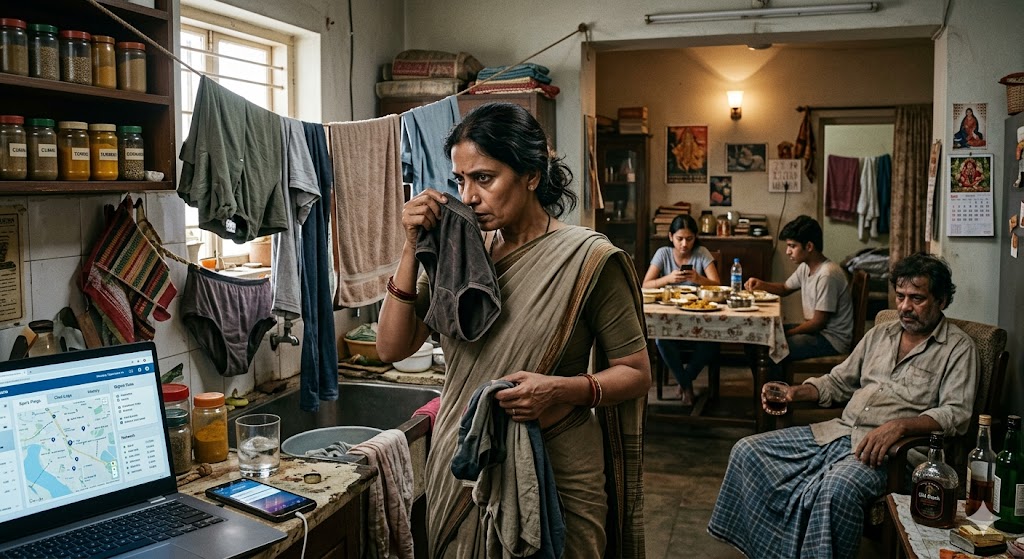
Once home, Sharda didn’t sleep. She moved to the corner of the living room where her laptop sat—her digital crook. She was a master of the “malicious tab.” While the house slept, she patrolled their virtual lives with spy tools that mapped their every move.
- The Son’s Vault: She monitored his “lurking” in encrypted gaming forums, noting the latency of his responses as a measure of his honesty.
- The Daughter’s Pings: She watched the GPS pings on her daughter’s phone with the intensity of a radar operator. A ten-minute detour through a local park wasn’t a walk; it was a “gap in the record” that required a morning interrogation.
She knew their passwords, their search histories, and the people they followed. To Sharda, a “private” profile was an admission of guilt. She was the shepherd, and the internet was just another fence she had built to keep the sheep from wandering into the dark.
The Museum of Smells and The Forensic Laundry
The sun brought the next phase of her surveillance: the biological audit. Sharda didn’t just wash clothes; she interrogated the fibers. She had a “museum of smells” in her mind, a catalog of every body part’s unique chemical signature.
She would pick up a pair of underwear, sniff it with a flared nostril, and if the musk didn’t match her teenage son’s established profile, she would tear it apart in a silent, vengeful fury, convinced he had brought home the “scent of a stranger.” Her daughter fared no better. Sharda could detect the “staleness” that arrived between periods from three feet away. “You haven’t changed, have you?” she would challenge, her nose detecting the heavy, copper-sweet scent of secrets that the girl thought were hidden behind deodorant and closed doors.
The Spice Laboratory: The Final Rinse
Even the food was a confession. Sharda would stand in the kitchen, swilling a spoonful of dal around her mouth not to taste it, but to analyze it. She could count every grain of cumin, every sliver of ginger, and every gram of turmeric.
- The Asafoetida: A raw, sulfurous edge that meant the cook was in a hurry.
- The Chili: A desperate, stinging heat meant to mask the blandness of their conversations.
She would rinse her mouth with a dish of the food, spitting the residue into the sink like a chemist discarding a failed experiment. It was a “bitter rinsing” of the palate, a way to clear the taste of her family’s small lies before she began the next cycle of nagging.
As the house settled into its nightly rhythm—Hari Om passed out in his chair, the children hiding in their digital shadows—Sharda remained the only one fully awake. She knew where they were, what they smelled like, and exactly what they had done wrong twenty years ago. Life was sweet and sour, but Sharda was the one who controlled the acidity.