By Narinder — Pao of Physics
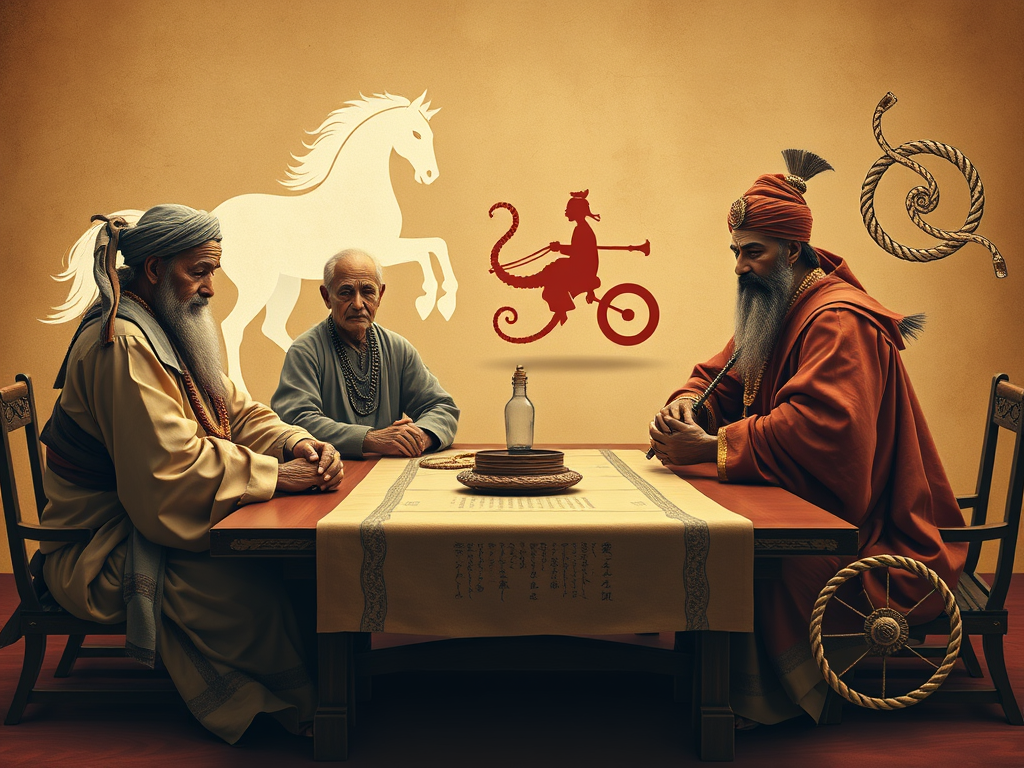
Thinkers across India and China grappled with the same mysteries. These mysteries later puzzled the Greeks. They included infinity, identity, language, motion, and the fragile boundary between illusion and reality.
Some paradoxes are logical traps; some are spiritual riddles; some are mathematical insights hidden inside folklore.
Here is a curated list of the most fascinating paradoxes from both traditions. Each comes with a crisp, short summary that captures its flavour.
Indian Paradoxes
1. Panini’s Grammar Paradox
Summary: Panini’s Ashtadhyayi contains rules that refer to other rules — and sometimes to themselves. Indian grammarians faced self-referential loops centuries before modern set theory.
The tension: Can a rule tell you when it does not apply?
2. Bhartrhari’s Liar Sentence
Summary: Bhartrhari examines statements like “I am speaking untruth,” which collapse into contradiction.
The tension: If the sentence is true, it’s false; if false, it becomes true.
3. The Self-Luminous Mind (Advaita Vedanta)
Summary: Consciousness is said to be self-revealing — it illuminates everything including itself.
The tension: If awareness reveals awareness, what reveals that?
A regress without regress.
4. Two Birds on a Tree (Mundaka Upanishad)
Summary: One bird eats the fruit (experiences life), while the other just watches.
The tension: How can one self be both the experiencer and the witness?
5. The Chariot Paradox (King Milinda & Nagaseṇa)
Summary: A chariot isn’t in the wheel, axle, or seat, nor in the sum.
The tension: Where does identity reside?
An early form of the Ship of Theseus.
6. Jaina Syādvāda:
The Sevenfold Paradox
Summary: Every statement can be true, false, true-and-false, indescribable, or combinations thereof — depending on viewpoint.
The tension: Reality shifts with perspective.
A logical system embracing multiplicity.
7. The Rope and Snake (Maya Paradox)
Summary: Mistaking a rope for a snake at dusk produces a real fear from an unreal perception.
The tension: Can something false produce true experience?
8. Karma vs Free Will
Summary: Karma governs destiny; free will determines moral responsibility.
The tension: If everything is predetermined, how can choice exist? If choices exist, how does karma bind?
9. The Zero Paradox (Śūnya)
Summary: Zero is nothing, yet it stabilises equations; multiplying by it destroys all numbers.
The tension: How can “nothing” have such power?
10. Buddhist Momentariness
Summary: In Buddhism, reality is composed of flashes that arise and perish instantly.
The tension: If everything vanishes each moment, what connects cause and effect?
Chinese Paradoxes
1. The White Horse Paradox (Gongsun Long)
Summary: “A white horse is not a horse.” The category “horse” doesn’t include the qualifier “white.”
The tension: Is a subclass the same as the class?
A linguistic and logical puzzle.
2. Hard-and-White Paradox
Summary: A stone is both hard and white — but these qualities belong to different senses.
The tension: Can two incompatible modes of perception inhabit one object?
3. The Arrow-Splitting Paradox (Hui Shi)
Summary: “The world is as small as a mustard seed; the sun is as large as a chariot.”
The tension: Relative scale changes the truth-value of observation.
Perception bends reality.
4. Infinite Division Paradox (Hui Shi)
Summary: “A foot-long stick, halved daily, will never be exhausted.”
The tension: Finite length, infinite divisibility.
Zeno’s twin born independently.
5. The Boundaries Paradox
Summary: “Heaven is as low as earth; mountains are level with marshes.”
The tension: Perspective collapses distances.
Reference frames change meaning.
6. The Hair Paradox
Summary: Cut a hair into a hundred pieces — is each still a hair?
The tension: At what point does something stop being what it is?
A Sorites problem in classical China.
7. Fast and Slow Paradox
Summary: “The fastest runner cannot overtake the slowest when the slowest does not move.”
The tension: Motion depends on relational reference points.
A variant of Zeno’s Achilles.
8. Three-in-the-Morning Paradox
Summary: A monkey keeper gives 3 chestnuts in the morning, 4 in the evening. The monkeys complain. He switches to 4 in the morning, 3 in the evening. They rejoice.
The tension: Same total, different emotional truth.
Framing matters more than arithmetic.
9. The Point Paradox
Summary: A point has no size. A thousand points still have no size. Yet a line made of points has length.
The tension: How does “no size” accumulate into “some size”?
Cross-Cultural Echoes
1. The Heap Paradox (India) & the Hair Paradox (China)
Both ask when small changes create categorical shifts.
When does quantity become quality?
2. Infinite Regress
- India: self-revealing consciousness
- China: endlessly divisible space
- Greece: Achilles and the tortoise
Infinity behaves strangely across civilisations.
3. Identity and Change
- India: chariot of Nagaseṇa
- China: hard-and-white objects
- Greece: Ship of Theseus
What makes a thing itself?
Why These Paradoxes Matter
These puzzles are not academic diversions. They show how cultures across Asia wrestled with the same tensions:
- perception vs reality
- motion vs stillness
- identity vs change
- language vs truth
- infinity vs finitude
- illusion vs experience
They remind us that the mind, whether in Elea or Ujjain or Qin, repeatedly stumbles on the same fault lines in logic and being.
And every paradox, whether Indian or Chinese, is ultimately a doorway — leading us from the familiar world into the uneasy beauty of doubt, perspective, and conceptual surprise.