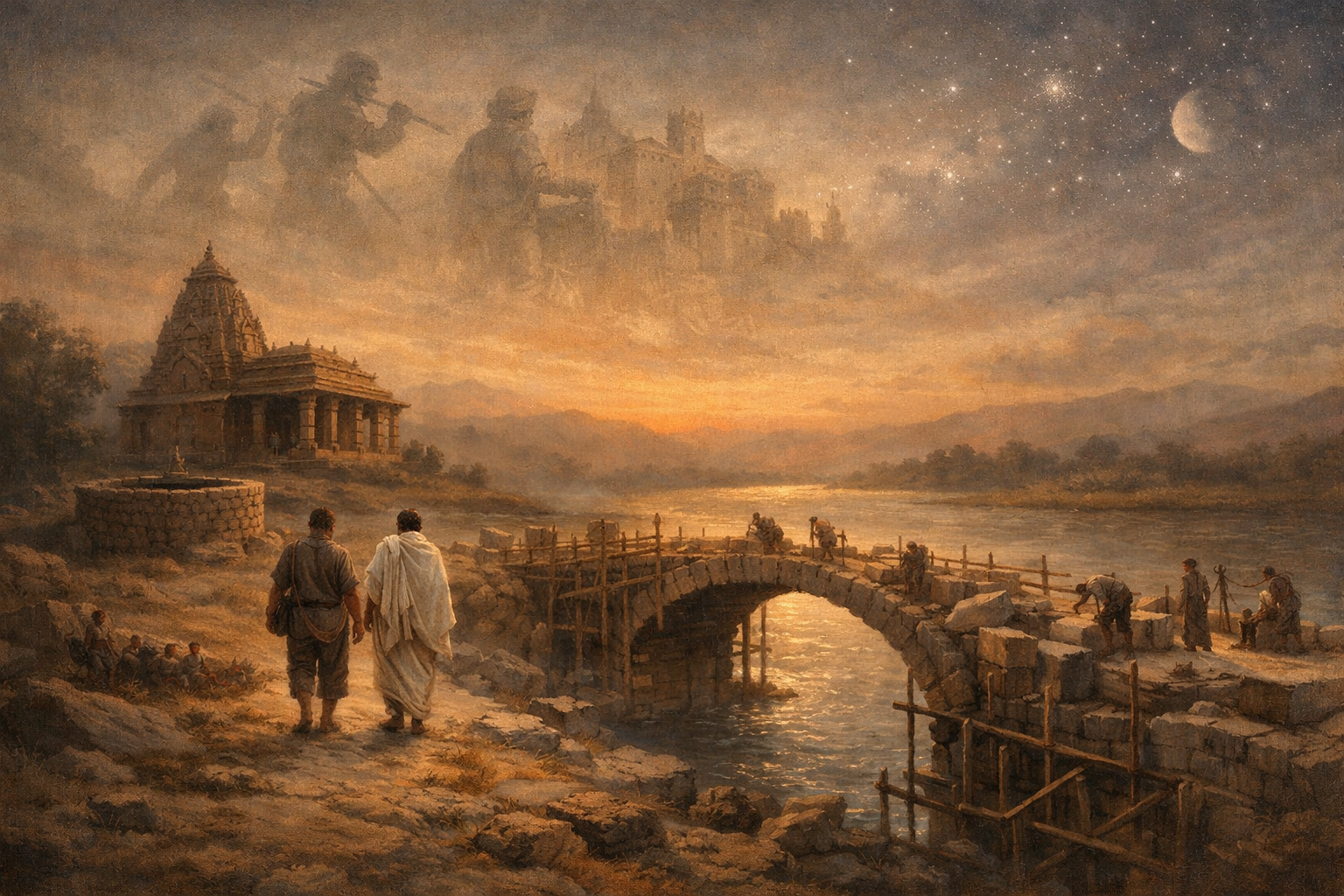
Seven Views of Olduvai — The Whole Account
The work demanded a slow concentration. Meat was not hacked, but understood—joints delineated, sinews traced, the knife cutting cleanly through what it had already learned. The blade had to be kept sharp, day in and day out, not for speed but for mercy. If the gods were kind, their praise came not as visions or signs, but as a clean cut—a death without panic, without tears, a mere flicker of pain in an animal unsuspecting, well fed, calm. Skinning was its own discipline. Preparing the hide was no simple task. Every part was used to the best possible advantage: skin for coats, hair and nails rendered into complex gelatin, excess fat stored carefully as lard. Nothing was wasted.
This routine did not end. It returned each morning.
By evening there was fatigue in the hands and shoulders, a heaviness that asked only for sleep. Before dawn they rose again to water and feed the animals, to walk among them, to choose with care, to bathe those that would be slaughtered. Not all. Not at once. Balance had to be maintained. The living depended on the dead, and the dead on restraint.
A continuous fire burned for making gelatin. It could not be allowed to die. The need for water became relentless, and finally unavoidable. They began digging a well. For four years they dug—steadily, methodically—descending two hundred feet into earth and stone. When the first water appeared, they went another ten feet and struck a steady vein. An artesian well opened. Soon the water rose of its own accord. It had to be aligned, channelled, persuaded to flow where it was needed, so a canal was cut by hand.
Time passed inside this labour.
Supervision became necessary. Administration followed. Labourers were engaged and paid, sometimes in cash, sometimes in kind. Disputes arose and were settled. Fatigue became familiar. A butcher’s shop, improbably, brought scarce water to villagers.
A butcher-guru and a Brahmin acolyte—the oddest of pairs—found acceptance without announcement. Not reverence. Not suspicion. Simply reliance. They fulfilled needs that could not be postponed: water, gelatin, meat, skins. Things used every day, without ceremony. They became indispensable not because of what they taught, but because of what they maintained.
The work grew. The scale widened. It became too much for two men alone. Workers were hired. Tasks were delegated. The rhythm of the place began to exceed its founders. They noticed this without alarm, and they thought.
There was, finally, one more need. The villagers were no longer anxious. Water flowed. Work was steady. Food circulated. They were not merely surviving now; they were at ease. At this point the thought arose—not as ambition, but as recognition—that a temple could no longer be postponed. Not for salvation, but for rhythm. Not for the gods, but for people. With water secured and commerce holding, a temple would complete the circuit. Pilgrims would come. Trade would follow. Offerings would return as grain, labour, repairs. The village would hold itself together.
So another project began: the making of a temple.
This change in work was preceded by a quiet happiness. Each venture had met with success. The style of labour shifted—not lighter, but surer. Decisions were made with less hesitation. If the gods took note, they did not alter their demeanour. They remained unchanged, untouched by outcome. Sisyphus, it was agreed, had contentment. His labour repeated endlessly, but it did not deceive him. That contentment was not to be disparaged. He was better than the gods, because he worked.
But the butcher and the Brahmin acolyte had something else.
They had happiness.
Not the happiness of arrival, but the happiness that comes when effort meets need and holds. “Sisyphus,” the butcher once said, “is better than the gods.” And then, after a pause, “By the gods, we are better than Sisyphus.” The acolyte agreed without irony—not because they escaped repetition, but because their repetition gave something back.
Yet even this had its cost. The work of temple construction and the commerce that grew around it began to turn them into cogs in a wheel. It took ten years to raise the temple. Another year passed before they could walk away from the first enterprise they had founded together.
One evening, standing apart from the work, the acolyte spoke.
“Guruji,” he said, “my first view of life was home. Then came the search—gurus, mantras, discipline. Both places were unsatisfactory in their own way. Now here too, I feel the same thing returning. I have become a cog. Useful, perhaps necessary—but still a cog. The thrill of doing something else feels more alive to me now. Something like the seven views of Olduvai Hill.”
“You know the story,” the butcher replied. “But I would like to hear it again—refreshed through your agency.”
So the acolyte spoke.
“Olduvai,” he said, “is a place, not a life. But in stories, the two are the same. A place acquires a life of its own, and that gives it sacredness—not because it is holy, but because it endures. Over time, the same ground witnesses survival, craft, violence, care, repetition, and departure. Each layer leaves a trace. Each trace alters what follows.”
Then he paused, and said, “Listen. Olduvai is no longer a place. It is the whole Earth now.”
Civilisation had been wiped away. A few animals remained. Fewer men. Not enough to call it a species, only enough to call it a memory. Those who came now were not gods, but advanced men, arriving from elsewhere—interstellar not in romance, but in method. They came to look, not to intervene. Using time as traversal, they moved through seven epochs of the old Earth.
The last time they visited was in the twelfth century of the Common Era.
That was when they left me behind.
Not as a ruler. Not as a prophet. To increase the speed of progress, nothing more. I was known then as Bopa Rai, a soldier first, because soldiers understand order before they understand meaning. They left, and four hundred years passed—a brief interval for those who travel between stars.
Now it is the sixteenth century.
And once again, they are watching.
Olduvai, Resolved
Olduvai, in the record, is not a ruin. It is a beginning.
It lies in the Rift Valley of Africa, layered with stone tools, bones, hearths, and footprints that span nearly two million years. There was no civilisation to be wiped away there—only hominins learning, slowly and without awareness, how to persist. Progress, if it can be called that, arrived unevenly. Tools refined and then stalled. Species appeared and vanished. Hunger returned. Shelter returned. Violence returned. Nothing moved in a straight line.
That is the archaeological Olduvai.
But Olduvai is also something else.
It is the first place where repetition becomes visible—where work, survival, and return leave marks deep enough to be read across time. In that sense, Olduvai is not merely a site but a condition. A way of living before history knows itself, and therefore before it can congratulate itself.
In this work, Olduvai is carried forward as a mirror rather than a location. What began as humanity’s unconscious apprenticeship is reimagined as its destination after knowledge has run its course. The Olduvai of this story is not prehistoric, but post-civilisational: an Earth stripped of momentum, where advanced observers look back not to admire progress, but to understand recurrence.
This is not a claim about the past.
It is a question posed to the future.
If humanity were reduced again to essentials—work, water, meat, shelter, repetition—would it resemble its beginnings, or would it behave differently, having once known cities, gods, equations, and escape?
Seen this way, Olduvai becomes a hinge between epochs, a place where beginnings and endings are indistinguishable.
The butcher’s work, the well, the bridge, the temple, and the decision to leave are not anachronisms imposed on archaeology. They are thought experiments set in deep time. They ask whether meaning arises from progress, or from balance; from permanence, or from knowing when to move on.
In the end, Olduvai is neither ruin nor origin alone. It is the reminder that civilisation is an episode, not a destiny—and that beneath it lies a more durable human rhythm: labour, restraint, repetition, and the occasional, fragile happiness of work that gives something back.
Olduvai, once resolved, fell quiet in their minds. With that quiet came recognition.
“We are in danger again,” the butcher said. “Not of hunger, nor of ignorance—but of becoming fixed. A cog, once more. A brick mortared into place.”
The acolyte nodded. “Then let us leave as bricklayers, not as bricks. We are not Sisyphus, condemned to lift the same stone. Nor are we gods, fixed in sameness. We are men. We seek.”
The decision followed naturally. After the completion of the Chamunda temple, raised over the original well that had once forced their hands into the earth, they stepped away. Not abruptly, not in protest—but cleanly, leaving functionaries, rhythms, and continuity behind.
They walked until they reached the riverbank.
Gautama was there still, ferrying men, animals, and materials across the current with the patience of one who has accepted water as his element. When they greeted him, they asked him to stay awhile. That evening they shared a meal—mutton slow-cooked, roots and green vegetables, goat cheese, and buttermilk to drink. It was food without ceremony, eaten without haste.
As the fire settled, Gautama spoke. “I can no longer manage the boat as I once did. I have grown old. Perhaps even useless.”
The butcher looked at the river, then at the opposite bank. “No,” he said. “You have given us a need.”
He went on, “We will make a bridge here. You know the depths, the swiftness of the water, the hidden rocks. You will guide us.”
Gautama laughed softly, almost to himself. “You are the first itinerants to have fed me,” he said. “And now you make me useful again. For both, I am obliged.”
He rose, brushed the ash from his hands, and looked once more at the river.
“Let us plan tomorrow.”