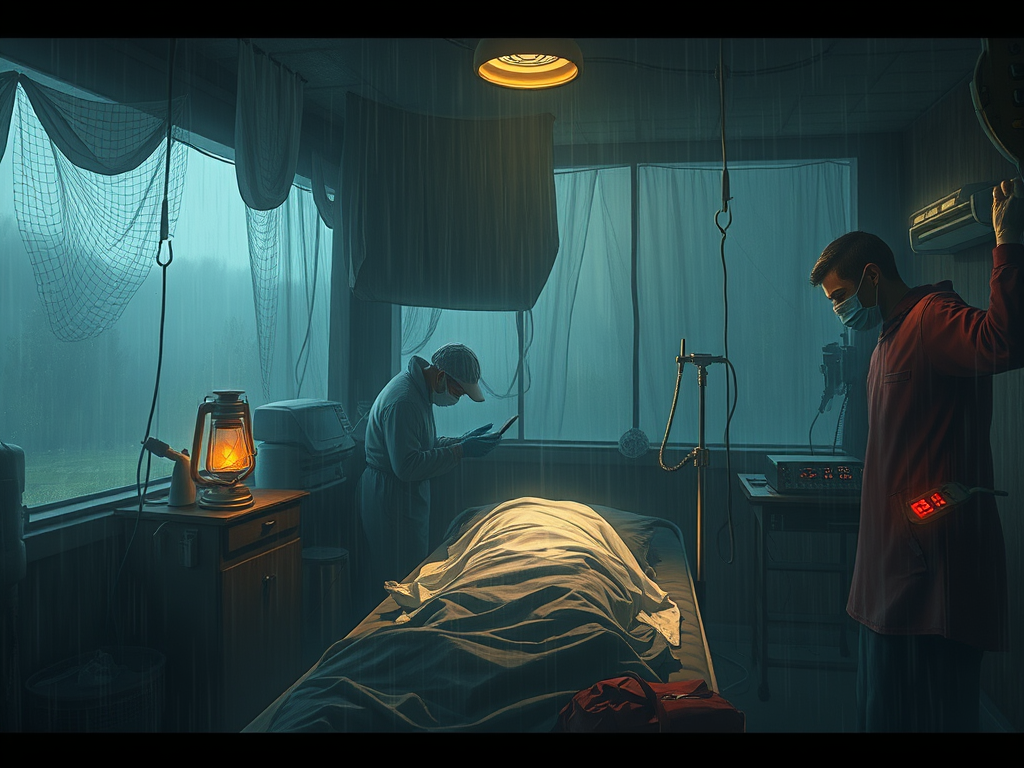
Constant winter rain had turned Hayuliang into a cold, wet hell, with living conditions so harsh that people were always prone to freezing, coughing, and fevers. But miserable first of all. Dry clothes a fantasy. Even within the shelters, the damp was pervasive, seeping into bedding and bones alike. One can only imagine the plight of personnel working in the open, enduring constant wetness and cold during exercises with the troops. Not one of those on the sand or those on the screen with heaters on. That week, following a deceptive run of sunny days, the patient load increased manifold. The 45-bed wards were full, a cacophony of coughing and shivering men. Only one room, converted into an impromptu ICU, was vacant. On that godforsaken day, the ICU welcomed Bhure Lal, suffering from an acute abdomen, into its dubious comfort.
The Geography of Isolation
Hayuliang serves as a District HQ in this remote corner bordering China. To the south roars the Lohit river; to the northeast looms Barfu Top, while Hamlets of Meshai, Dichu, and Kibithu mark the easternmost frontier. Southwest, over the torrent of the Lohit river, hung a rope bridge. Traversing it created a fearful lurching storm in the pit of your stomach as it careened and swung, threatening a fall into the river below.
Just beyond the narrow gorge where the river thundered, a wide beach, the river slowed here at the edges—gathering more pressure for thunder downstream, its edges spreading into a fishing area interspersed with massive stone blocks. Across the gorge lay a terrifying bridge and beyond it a cardamom-producing village. Still the chiil flow restricts fishing to tying a fishing rod, merely a stick, actually, with thread and a bunch of hooks at the end, a technique was to bury the sticks in the beach sand and throw the stone with bait and hooks in some still water collection down where the fish will gather in the depth. A string of such apparatus marked the beach, the catch to be collected in the afternoon only. Trout were prized for their white, soft meat.
Bopa recalled a visiting the village on a sunny day for a patient call. The villagers were drying wet currency notes after disgorging them from a sack. With no banks or markets nearby, the notes were useless for daily transactions, yet they formed a steady, hidden stream to that hard-to-reach hamlet, honoured nevertheless as wages for the cardamom abundance in that area, that might be useful some day.
The Healers of the Frontier
But the sunny days were gone. Bhure Lal arrived just as the rain began to trickle down again, a prelude to the deluge. He looked and felt ill, gray-faced and clutching his stomach. We doubled our efforts, rushing him into the ICU, firing up the kerosene heaters to battle the creeping chill. Swaddling him with blankets.
I had invited Dr. Hari from a nearby district Hospital for a cup of tea just as the ambulance Sumo pulled in. The local District Hospital, while technically a headquarters, was hardly better than our Advanced Dressing Station (ADS). Two unique figures staffed it:
- Dr. Agapo Mihu Tayang: The Arunachali Mishmi doctor who had remarkably become a grandfather at the ripe old age of 35.
- Dr. Hari Kumar: A recluse from UP. He had been in Hayuliang for 35 years, aged 55—a coincidence of numbers—and was childless, a coincidence of fate. Far from his ancestral home and with no initiative to keep his village in the loop of his life, he had become the de facto Mishmi CMO honoured by one and all…
Dr. Hari sipped his tea as he watched us work. He was a man of few words, his silence heavy with three decades of border medicine. He had taught himself forceps delivery and was much in demand, but he had also seen how mountains often defeated medicine.
The Diagnosis
I proceeded with the examination: it appeared to be pancreatitis, characterized by severe epigastric tenderness and a basal pleural effusion. A blood sample confirmed it: a high white blood cell count, massive lipolysis causing white colored blood, pancreatic enzyme leakage, intense inflammation, high amylase and Lipase. The body was digesting itself. Only conservative management was indicated and was given with sufficient painkillers and fluids a watch on creatinine and urea.
I requested an immediate air evacuation to the hospital. The radio crackled back:
Negative. Weather impermissible.
The next day, the rain intensified, drumming against the tin roof like shrapnel. Seeing the patient settle slightly, I attempted a halfhearted road evacuation. The ambulance lurched out, mud spraying, but I called it back after just a few kilometers. The roads were turning to slush; the jostling would kill him faster than the disease.
The Long Vigil
So began the long vigil. For three days, the ADS became a capsule of suspended time. The main enemy was hypoxia. We had no ventilators, only oxygen cylinders that hissed rhythmically, counting down the minutes. I sat by his bedside as the power flickered and died, leaving us in the glow of emergency lamps.
Dr. Hari stopped by on the second evening. He checked Bhure Lal’s pulse, then looked at the rain lashing the window. “The mountains decide, Doctor,” Hari said softly, his voice devoid of cynicism, just filled with a tired acceptance. “We just keep them warm until the sky clears.”
Bhure Lal remained conscious for parts of it. He didn’t speak of the pain, though it must have been searing. He watched me with trusting eyes, tracking my movements as I adjusted the oxygen flow. We fought the developing hypoxia with conservative treatment, fluids, and sheer will.
The Departure
By the third day, the clouds finally broke. The sun hit the wet earth, raising a mist over the Lohit. The chopper was inbound. As Bhure Lal was loaded onto the stretcher, he looked frail but stable. I gripped his hand.
“Bhure Lal Ji, Aap theek Ho Jayenge,” I told him. You will be fine.
It was compassion speaking. I truly believed it. I thought if Bhure Lal could pull through three days of darkness in a freezing ADS, he would surely survive in a fully-fledged hospital with specialists and ventilators.
He evacuated with hope. He died the very two days later.
The news came over the radio, spreading a heavy gloom throughout the ADS. It felt like a personal defeat, a mockery of our three-day vigil. The silence in the empty ICU was louder than the rain had ever been.