A War, Not of Gods but of Men
There is an ongoing insidious war between temples, Bopa writes. It is not a war among gods but among men who subvert the divine for their own purposes. The true battlefield is power — and through power, money — a vicious cycle that feeds on itself.
From Highway Shrines to Expanding Altars
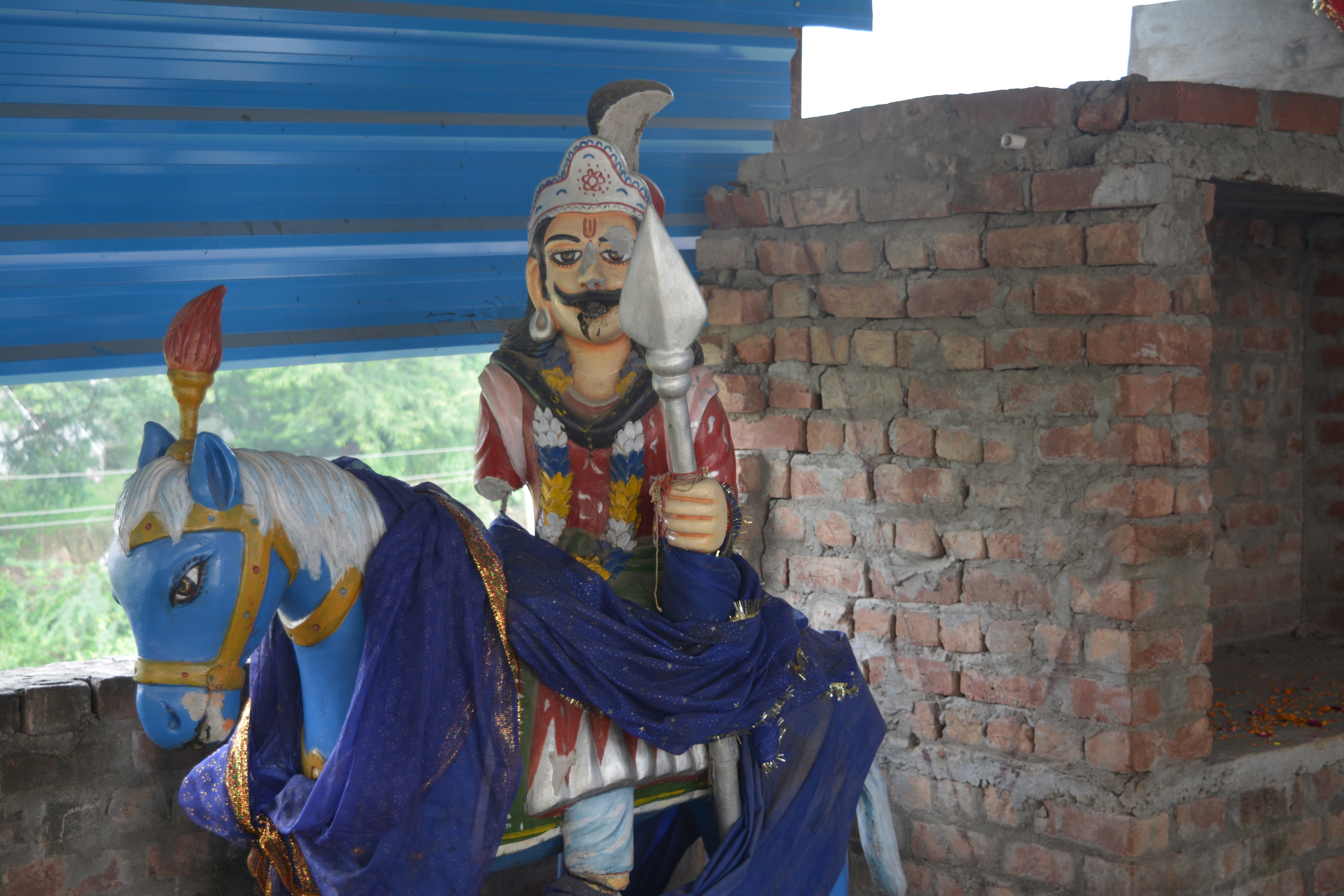
The first inkling of this misadventure comes right off the national highway. What once was a simple roadside shrine near a garbage dump now has ambitions — a wide roof, niches for eight more deities, and an expanding façade. A red Hanuman temple already exists just a stone’s throw away. This is not coincidence but contest. The highway left old shrines stranded, where once only goatherds passed — and now the contest for space has begun.
Gogaji’s Claim to Inheritance

The shrine lays claim to Gogaji, a Chauhan warrior-king from the 10th century. Locals revere him as both Vir (hero) and Pir (saint), a devotee blessed by Baba Gorakhnath, and worshipped by Hindus and Muslims alike. His story intertwines devotion, twin sisters, divine trickery, and serpentine blessings from Sarplok. Followers say his legacy was sidelined when highways bypassed his stone-seat shrine. Yet his presence resurfaces, demanding space on the map crowded by “mainstream” gods.
Sati becomes Hanuman — Transformation of a Temple

Not far away, in Panchkula’s Sector 28, stands another battlefield of memory and erasure. What is once a Chandela-era temple dedicated to Sati, Shiva’s immolated consort, was repurposed in the 1960s. The Sati idol pushed to the back wall, while Hanuman’s mountain-lifting form claimed the central niche. Yet the traces of guilt remain — the Hanuman idol oddly dressed in women’s clothes, perhaps a concession to the displaced Goddess and the sentiment of female devotees. The temple only flourished decades later, with the arrival of a Pandit from Garhwal Hills.
The Silent Garrison of the Kabristan Mosque

The third site is in stark contrast — a mosque attached to a Kabristan. It remains closed most of the time, visited only by groups of men from afar, with disciplined silence and guarded mannerisms. Its role feels less liturgical, more like a watchful garrison.
Faith, Power, and Conflict
From Gogaji’s reclaimed stone shrine, to Sati’s temple rebirthed as Hanuman’s, to the silent kabristan mosque — these temples do not war in the heavens. Their conflict is rooted in land, politics, and the human hunger for authority disguised as holiness. Faith remains, but it is power that is contested.
Comments
5 responses to “The Insidious War Between Temples Sector 28 Panchkula”
[…] The Insidious War Between Temples Sector 28 Panchkula […]
[…] The Insidious War Between Temples Sector 28 Panchkula […]
[…] The Insidious War Between Temples Sector 28 Panchkula […]
[…] The Insidious War Between Temples Sector 28 Panchkula […]
[…] The Insidious War Between Temples Sector 28 Panchkula […]