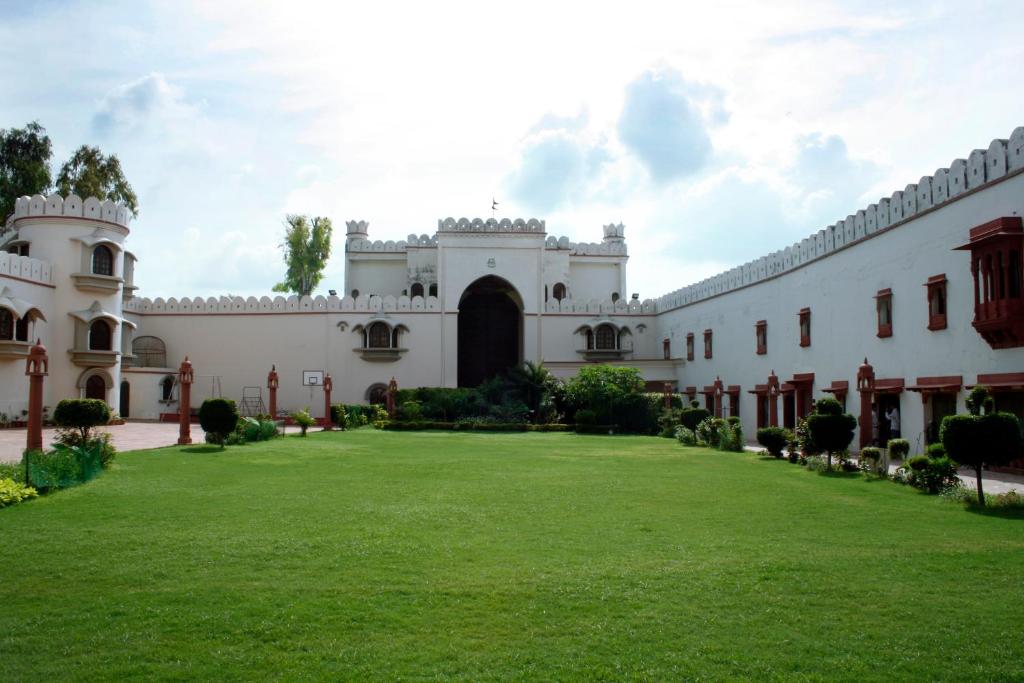
You don’t see Ramgarh Fort if you stand at the carwash at the end of the overbridge. The historic Ramgarh fort Panchkula remains hidden from view by the curves of the landscape.
Not because it is small.
Because it is hidden.
The slope is crowded with houses — stacked, multiplied, earnest — rising like a confused audience before a forgotten stage. Somewhere behind them, the fort exists. You think you glimpse a rampart here, a crenellation there. But then you notice that even the houses have adopted the same architectural grammar. Everyone seems to be building in rampart style now. History has been plagiarised by concrete.
It becomes impossible to tell where fort ends and suburb begins.
Bopa Rai, walking beside me, smiles at this confusion.
“Of course,” he says, “this is what always happens. First the clan builds on the hill. Then its servants build on the slope. Then the town builds on the servants. And finally, everyone pretends to be a fort.”
While my car stood in obedient line, foamed and forgotten, I decided to walk down.
The neighbourhood is cluttered, busy, slightly apologetic. Shops press against each other, cables hang like tired vines, scooters nose into improbable spaces. And then — suddenly — a gate. Small, almost shy, for what it contains.
You step through and the world opens.
An unexpected expanse. A large parking area. On the right, a reception desk. On the left, a restaurant. A wide verandah surrounded by rooms — not hotel rooms, but proper rooms, generous rooms, some even two-room sets. The architecture is unmistakably Rajputana: thick walls, deep shade, a sense of defensive hospitality. Chandel-built, from Bilaspur roots nearly 400 years old, with walls 18 feet thick.
“Now this,” Bopa says, surveying the courtyard, “is Kachwaha. Jaipur blood. Amber grammar. Elephant logic.”
I tell him I had thought Tomar.
He nods. “The Tomars owned the memory of this hill. Anangpal’s people. Delhi builders. Haryana wanderers. Their shadow is everywhere here. But the walls you see? The ceremony? The geometry? That is Kachwaha. Raja Ram Singh. Sixteenth century. Hence Ram-garh.”
It makes sense suddenly.
The slope was Tomar memory.
The summit was Kachwaha assertion.
And the houses in between are the long echo of service.
The receptionist, efficient and mildly triumphant, informs me that a three-day wedding here usually costs around twenty-two lakh rupees.
Then, as if offering a footnote to history, she adds that while the fort is from the Chandel period, the present royal family is from Hamirpur in Himachal — the result of marriages, inheritances, and the slow, silent amalgamation with local Pahari royalty.
History, it seems, does not only conquer.
It marries.
Bopa’s eyebrow rises. “Ah,” he says. “So the fort has climbed the hills as well.”
“One marriage at a time,” I say.
He smiles. “That is how empires actually move.”
One is told — with practiced pride — that the groom can enter on an elephant. The elephant is inclusive.
History, apparently, is now a package deal.
Bopa chuckles. “Once elephants came for war. Now they come for Instagram.”
He pauses, then adds more seriously, “It is good as a wedding destination only. And even that is barely enough — to pay for the maintenance, the staff, the plaster, the pride. Old forts are expensive children.”
We step out. The road lies below. And across it — on the other side, near the graveyard, safely away from the waters of the Ghaggar — stands the Sati temple.
It is not inside the fort.
It is not part of the wedding brochure.
But it is part of the land.
Bopa grows quiet here.
There was a time, he tells me, when after a defeat by the Mughals, a widow chose to immolate herself. Chose — or was taught to choose — the word has always been flexible. One shivers at such decisions now, from the safety of another century. But then, great pride was taken. It was honour. It was bravery. It was applause in a cruel theatre.
It was an insult that Sati has never been able to reply.
Now the custom has changed. Sati honour is no longer important.
The temple was built in her memory.
Originally, only Sati.
Just her.
But in the last fifty years, other gods have come visiting. They always do. A large idol of Lord Hanuman arrived, impressive, muscular, east-facing. Sati was quietly shifted. She now faces west.
Bopa murmurs, “Even gods get displaced.”
In Hanuman’s court, there are now twenty-three other deities. Devotees drift from one to another, donating impulsively to whichever face looks most likely to listen that day. The small, desperate democracy of prayer.
But Sankat Mochan Hanuman is the great attraction. The crowd’s favourite. The problem-solver.
The others perform grandeur.
He performs hope.
The temple is deserted at night. Edge of graveyard. Edge of habitation. Edge of relevance.
A theft occurred once. Some cash. Some copper utensils. The thieves were never caught. Likely scrounging addicts. Hungry, frantic, invisible.
People were angry. Hurt. Offended on behalf of God.
Security was installed. Donations poured in. The temple was rebuilt, brighter than before. More marble. More paint. More lights.
The grandeur increased.
Piety was mollified.
Bopa watches this silently.
Then says, very softly, “See? Even loss becomes capital.”
We stand there — between fort and graveyard, between wedding and widow, between elephant and ashes.
Above us, royalty survives on catering.
Below us, gods survive on fear.
I return to the restaurant. Order tea.
And there I am — Bopa Rai beside me — sitting with a cup of tea inside a fort I could not see from outside, watching history rehearse itself in different costumes, while the neighbourhood continues its industrious anonymity.
The fort remains.
The temple glows.
Everything is maintained.
Everything is repurposed.