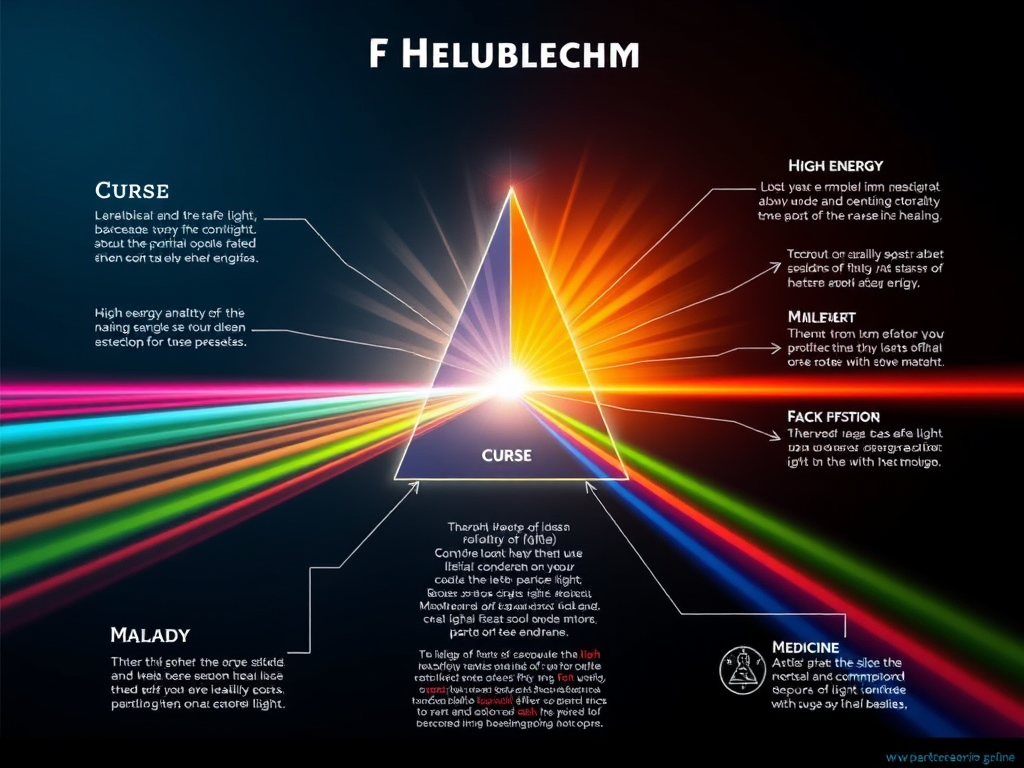
🌈 The Spectrum Between Cure and Curse
Light as Medicine, Light as Malady
Pao of Physics
Various types of light have long been harnessed for healing—ultraviolet rays for psoriasis, infrared for muscle recovery, lasers for surgical precision. Yet, paradoxically, light is also implicated in harm: skin cancers, sunburns, cataracts, and photo-allergic disorders. These effects—both curative and carcinogenic—are mediated by light’s fundamental characteristics: wavelength, frequency, and energy.
Let us pause, and turn our gaze to the spectrum.
🔭 The Nature of Light: A Dual Legacy
Light, in its deepest identity, is a paradox—both wave and particle, both continuous and discrete. It travels not just across distances but through dual realities.
The wave nature of light is revealed in phenomena like diffraction, refraction, and interference. Waves have two defining properties: Wavelength (λ): the distance between two successive peaks, and Frequency (ν): how many cycles pass a point per second. Together, these satisfy the equation:
$$
c = \lambda \cdot \nu
$$
where c is the speed of light, a universal constant.
On the other hand, light’s particle nature emerges when it interacts with matter. Each photon carries a packet of energy quantified as:
$$
E = h \cdot \nu
$$
where h is Planck’s constant. This quantum idea—that energy is not continuous but comes in lumps—revolutionized physics and opened a new view of the biological world.
🌡️ Energy and Penetration: The Invisible Rulers
High-frequency waves (like X-rays and gamma rays) carry immense energy. They penetrate deep, ionize molecules, and can damage DNA. Hence their dual use: treating cancers or, if unchecked, causing them.
In contrast, infrared and microwaves are gentler. They vibrate molecules, warm tissues, soothe joints—but rarely penetrate beyond the skin.
| Region | Wavelength (nm) | Frequency (Hz) | Clinical Use | Biological Risk |
|---|---|---|---|---|
| Gamma rays | < 0.01 | >10²⁰ | Radiotherapy for cancers | High mutagenicity |
| X-rays | 0.01–10 | ~10¹⁶–10²⁰ | Diagnostic imaging | DNA damage |
| Ultraviolet | 10–400 | ~10¹⁵–10¹⁷ | PUVA therapy, sterilization | Skin cancer, cataracts |
| Visible (Blue) | ~450 | ~6.7×10¹⁴ | Resin curing, neonatal jaundice | Circadian disruption (chronic) |
| Visible (Green) | ~530 | ~5.6×10¹⁴ | Migraine therapy, cosmetic lasers | Minimal at therapeutic doses |
| Visible (Red) | ~650 | ~4.6×10¹⁴ | Photobiomodulation | Negligible |
| Infrared | 700–10⁶ | ~10¹¹–10¹⁴ | Thermotherapy, wound healing | Burns with overuse |
| Microwaves | 10⁶–10⁹ | ~10⁹–10¹² | Diathermy, microwave ablation | Cataracts (chronic exposure) |
| Radio waves | >10⁹ | <10⁹ | MRI | Currently minimal biological risk |
🧪 Light in the Clinic: From Psoriasis to Prosthodontics
Light, in trained hands, becomes both scalpel and salve.
🌞 PUVA Therapy (Psoralen + UVA)
In PUVA therapy, patients with psoriasis or vitiligo ingest or are bathed in psoralens—light-sensitizing compounds—followed by exposure to longwave UVA light. The light activates psoralen, which intercalates DNA and suppresses unwanted cell growth.
UVA: the sword of psoralen, drawn in light.
🔵 Blue Light in Dentistry and Neonatology
Dentistry uses blue light (470 nm) to cure resin composites—transforming soft pastes into rock-hard fillings in seconds.
In neonatology, the same spectrum is used to break down bilirubin in jaundiced newborns.
A gentle blue baptism that saves the yellow child.
🔴 Red and Near-Infrared for Photobiomodulation
Low-Level Laser Therapy (LLLT) uses red and near-infrared light to stimulate mitochondrial respiration, reduce inflammation, and accelerate wound healing.
Red light whispers to cells: heal faster, suffer less.
💠 Intense Pulsed Light (IPL) and Aesthetic Lasers
IPL uses bursts of broad-spectrum visible light to treat acne, pigmentation, vascular lesions, and even unwanted hair. It is medicine woven in light.
🌞 Heliotherapy, Sauna, and Hot Springs: Ancient and Modern Healing
Heliotherapy—therapeutic, controlled sun exposure—has roots deep in antiquity. Before antibiotics, the Greeks, Norwegians, and early modern physicians harnessed sunlight’s cleansing fire to treat wounds and skin tuberculosis. Modern clinical studies confirm that 2 to 4 weeks of heliotherapy at sun-rich sites can significantly reduce psoriasis and atopic dermatitis severity, often leading to long-lasting improvements in skin condition and quality of life.35
Heliotherapy’s benefits come from the anti-inflammatory action of ultraviolet rays, vitamin D synthesis, and circadian rhythm regulation. Its psychological effects—enabling social interaction, increased physical activity, and mood lift—further enhance recovery. Nonetheless, safe exposure is crucial to avoid sunburn, photoaging, and cancer risks.53
Sauna bathing is another cornerstone of healing traditions. It uses intense heat to relax muscles, dilate blood vessels, improve circulation, and reduce chronic pain and inflammation. Regular sauna use correlates with reduced cardiovascular risk and enhanced respiratory and mental health, although caution is needed for those with heart conditions.8
Hot springs, natural geothermal mineral pools, offer mineral-rich soaking that soothes chronic skin diseases and joint conditions. Their warm water fosters muscle relaxation, increases blood flow, supports detoxification, and relieves pain, contributing to both physical healing and relaxation.910
⚖️ Comparing Heliotherapy and Phototherapy for Psoriasis
Both heliotherapy and phototherapy leverage ultraviolet (UV) light’s immune-modulating power to treat psoriasis, but differ in source, control, accessibility, and outcomes.
| Aspect | Heliotherapy | Phototherapy |
|---|---|---|
| Source | Natural sunlight, especially UVB/UVA spectrum | Artificial UVB (especially narrowband UVB) or PUVA lamps |
| Dose Control | Less precise; depends on weather, time, skin type | High precision, tailored to skin type and severity |
| Treatment Setting | Often requires residential stay in sun-rich areas (Dead Sea, Canary Islands) | Clinical or outpatient dermatology settings |
| Typical Duration | 2–4 weeks | 20–36 sessions over weeks |
| Cost/Accessibility | Often costly due to travel/accommodation | More accessible and economical |
| Clinical Effectiveness | Very high with median 94% improvement at lower UV dose; additional psychosocial benefits | High (median 86% improvement); allows precise safety monitoring |
| Safety | Risk of sunburn, photoaging | Very controlled; risks minimized by dose management |
Insights from Research
- A study comparing the two found heliotherapy more effective per erythemal UV dose in producing psoriasis remission than artificial UVB phototherapy.1
- Both therapies produce significant clearing and symptom relief, but sunlight’s full UV spectrum and associated psychological benefits can enhance outcomes.65
- Phototherapy is more widely available and controlled, suitable for most patients as first-line UV treatment.111213
- Heliotherapy, while powerful, is less pragmatic for long-term or recurrent treatment due to logistics and cost. It is ideal for patients able to undertake specialized treatment courses, often in conjunction with phototherapy maintenance.714
🧠 To the Enlightened Mind
Light, when fully understood, ceases to be just wave or particle—it becomes a medium of intervention: a force shaping cell biology, modulating circadian rhythms, healing scars, or altering DNA.
This duality—the angel and the assassin—makes light not just a phenomenon to observe, but a force to govern wisely.
The very photons threatening life, in the right context and dose, may be the agents that save it.
This is a philosophy of balance—of knowing how much light is enough, and when it crosses the threshold into fire.
This combined perspective showcases light as both a healer and malady, a scientific marvel and a poetic symbol, reminding us that nature’s forces are inseparable from human responsibility.
