The Rhapsody
Invocation
O child of the digital century,
rocked not by lullabies but by the hum of machines —
you are fed on junk,
and you call it wisdom.
O traveller of the internet,
you wander endlessly, yet arrive nowhere.
Once, messengers crossed mountains and deserts for a single word;
you drown in torrents of words,
and remember nothing.
O laptop-clutching savant,
your seniors carved truth on stone,
sang it in hymns,
bled it in wars of spirit.
And you?
You cut, copy, paste —
a shadow mouthing borrowed voices.
O consumer of instant light,
every spark shrivels before your eyes
because you cannot wait for the fire to build.
Know this:
they who walked before you were not merely as smart —
they were deep,
while you skate on surfaces.
They were rooted,
while you float hollow as straw.
Raise your gaze then —
to history,
to myth,
to blood and bone beyond the glowing glass.
For if you do not,
you shall know the fate of the hollow men:
stuffed, leaning together,
heads filled with nothing.
The Magician Abroad
19th century Spain is a hotbed of smugglers running contraband. Spain is tolerant of the many sects and cults that have mushroomed; after all, they do bring in welcome money. An Englishman, Aleister Crowley, with a fearsome reputation as a wizard of some repute, has convinced some of his rich and bored admirers to buy a large villa to continue his magical practice and establish a cult of his own.
A hot summer afternoon saw Aleister Crowley crouched on the ground, holding a hen by its neck. Uttering incantations in a strange language, he drew a circle on the ground around the hen and then stepped out of the circle. The hen, unharmed, remained transfixed and rooted to the spot until she was sacrificed. His friends thought that she stretched her neck at the time of sacrifice. They looked on in awe and horror. Soon the locals grew uncomfortable, and his rich friends left him. Bereft, he moved on to other pastures.
India: Magic Meets Mountain
A few years later, lured by tales of easy money in the colonies, Crowley visited India. He befriended a group planning an assault on Mount Godwin-Austen. A gifted rock climber himself, Crowley quickly convinced them of his prowess. The group was convinced and included him as a highly valuable addition. At the base camp, however, Crowley wished to become team leader. He was rebuffed by the group, who decided not to indulge capricious Crowley. Crowley threatened them with dire consequences and walked off from the base camp in a huff — a no mean feat in that mountainous isolation. Three of his teammates, who made the attempt, died in an avalanche while going to Camp One. The legend of Crowley was firmly established.
Calcutta and the Vanishing Men
Calcutta — In a lonely back alley, Crowley, walking back to his hotel with friends, spied three hoodlums stalking them. In the ill-lit street, he willed himself and his friends to become invisible. The hoodlums passed them by. The friends reported a curious sensation but refused to corroborate that they had indeed become invisible. The incident added to his sinister reputation — as did the story at the time of his death in 1947, aged 72: his doctor died within 24 hours. It was rumored that Crowley had cursed him.
The Age of Revival
The 19th century was a time of magic revival, a time for occultists of every hue. Dr. Annie Besant, a familiar name as one of the founders of the Indian National Congress, was also an active member of the Theosophical Society of India. She was writing a book on what happens to the soul after death — its passage to the afterlife. Theosophy, an arcane magical philosophy, was co-founded by her and the powerful figure Madame Blavatsky. Madame Blavatsky received messages from her secret masters in the Himalayas. These messages came in a wall-mounted locked box and, after an elaborate opening ritual, were read out to the faithful. The doctrine was slowly revealed.
But not without its own shenanigans — Madame Blavatsky was caught red-handed putting the messages in the box herself. The head of the movement thus discredited, Theosophy received a jolt. However, it survived under the able Ms. Annie Besant, with a dream of nurturing a World Teacher. A Tamil boy’s training had begun. Jiddu Krishnamurti, however, would renounce not only the claim of being a world teacher but theosophy itself.
Yeats and Crowley: A Meeting of Shadows
Meanwhile, William Butler Yeats was composing his masterpiece, A Vision, a book of rich, powerful poetry based on occult and mysticism — full of imagery and symbolism, all characteristics of old magic. For instance, consider the rich allusion:
Why should you leave the lamp
Burning alone beside an open book,
And trace these characters upon the sands?
A style is found by sedentary toil, and by imitation of great masters.
Yeats had his differences with Aleister Crowley in the Order of the Golden Dawn, a cult founded by Mathers. Crowley fled the cult after stealing its secret dogma and rituals. He later founded the magical cult of Thelema. Curiously, both Yeats and Crowley were prolific writers, and at one time, both had their wives dictating them arcane philosophies. Yeats based A Vision on these dictations; Crowley wrote the central dogma of Thelema. The wives, ostensibly, were receiving their messages from secret masters — spirits evoked and eager to impart knowledge.
Thrill with the lissome lust of the light,
O man! My man!
Come careering out of the night
Of Pan! Io Pan!
Io Pan! Io Pan! Come over the sea
From Sicily and from Arcady!
This passage from Hymn to Pan by Aleister Crowley contrasts considerably with Yeats. The former — flamboyant and yearning; the latter — restrained, elegant.
Not for nothing was Crowley called The Beast and the wickedest man in the world by the European press.

The Modern Healer and the Ancient Spell
The 19th century, as is well known, was a time of turmoil. The old order was changing. There was high science — the theory of relativity, quantum physics, many inventions that would shape the modern world. The old occult sought a new paradigm, with proponents like Blake, Yeats, Crowley, and Annie Besant. The philosophy of Bertrand Russell was already turning grey and mature. The sexual revolution, two world wars, social upheaval, and political unrest defined the age.
Words became powerful. Magic was reduced to craftily stated definitions. Each borrowed from the other, enriching all — philosophy, science, magic, political thought, social understanding. The old medicine man became the doctor, the modern-day sorcerer, the healer, the keeper of the secret doctrine.
You would do well to remember: not for nothing is medicine still called an art.
You are welcome into the esoteric world of medicine.
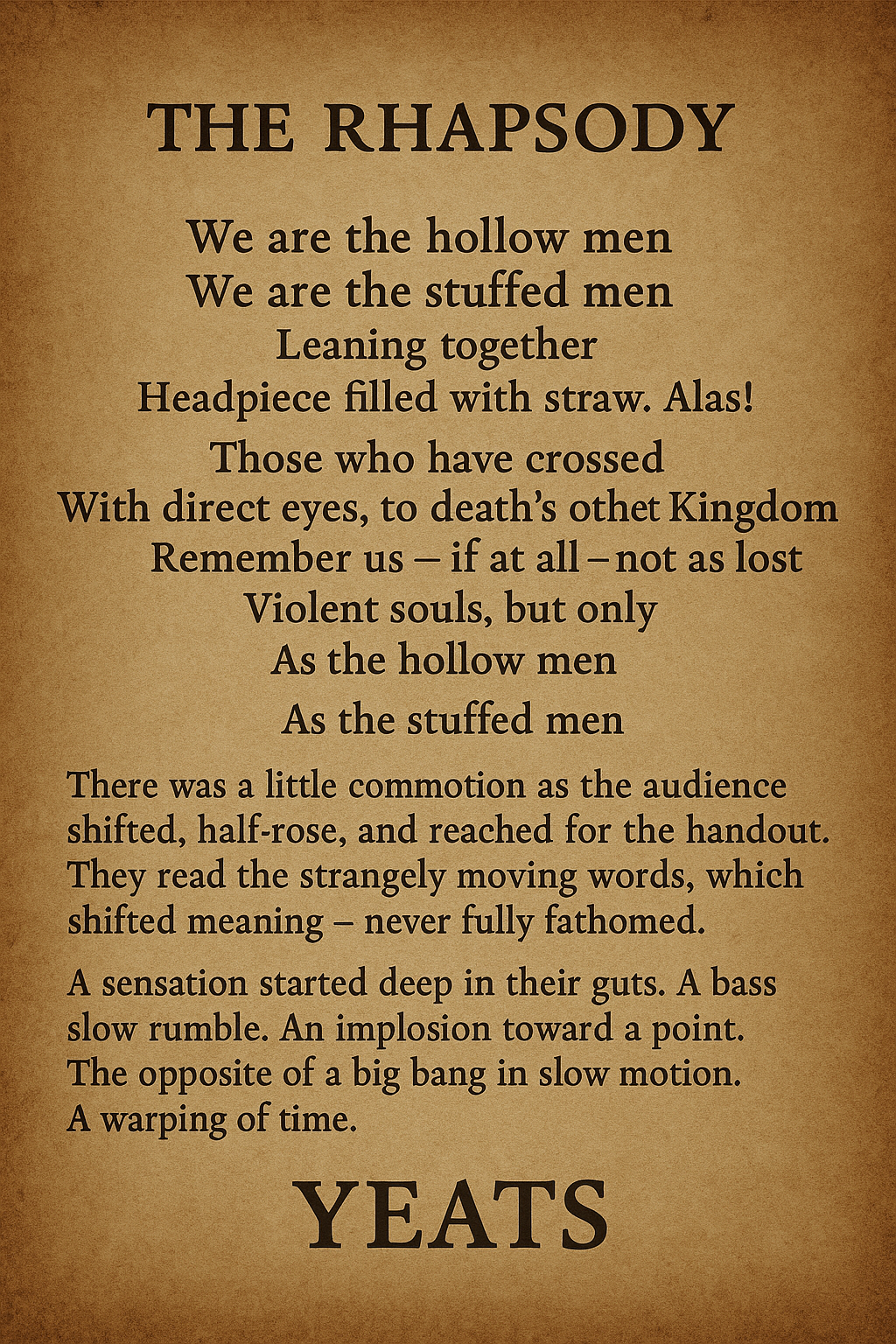
The Rhapsody: A Dramatic Coda
We are the hollow men
We are the stuffed men
Leaning together
Headpiece filled with straw. Alas!
Those who have crossed
With direct eyes, to death’s other Kingdom
Remember us — if at all — not as lost
Violent souls, but only
As the hollow men
The stuffed men.
There was a little commotion as the audience shifted, half-rose, and reached for the handout. They read the strangely moving words, which shifted meaning — never fully fathomed.
A sensation started deep in their guts. A bass slow rumble. An implosion toward a point. The opposite of a big bang in slow motion. A warping of time.
A wail floated over them. Whispering, shuffling, receding and approaching, caressing and threatening.
From afar came a keening. Deepening, then reducing in pitch. A human echo whispering:
“We are the hollow men”
The audience recognized the words and involuntarily shivered.
Those of scientific bent of mind thought it utter balderdash:
“We are full of blood and bones, muscle and sinew! How then are we hollow?” — came a dissenting voice.
“No, silly,” came the reply. “We are hollow from the inside. Hollow because we are sad. In happiness, the cup brimeth over.”
“We are stuffed, leaning together
Heads filled with straw”
“I like ‘stuffed’,” someone muttered. “That ‘hollow’ business is scary.”
Billy, you miss the point. We are not stuffed with good things — we are stuffed with straw. Why straw? Because cattle eat straw. Cattle are brainless. There is a void in their eyes — a sea of idiocy.
Yet behind expressionless faces is wisdom. Cherubic worlds. Laughing eyes.
The author has been kind. He could have said we are stuffed with shit — and been closer to the truth.
We loathe ourselves — enduringly, collectively. We loathe humanity.
Who feels so?
We all do.
A genius — mad, in utter despair, in metaphysical anguish. Hating others, hating himself. Needing others, yet never rid of the loathing. That man gave us these lines. So generations could mull over them — not knowing whether they are genius or charlatanry. They would, in their unease, choose materialism. And work toward happiness.
The music reasserted itself. It had always been there, subliminally. As the voice rose, the music receded — giving way to it.
Those who have crossed
With direct eyes, to death’s other Kingdom
Remember us — if at all — not as lost
Violent souls, but only
As the hollow men
The stuffed men.
But there is something better, says the poet. Those who cross over with direct eyes are not hollow. Blessed are they. We, lost violent souls, are hollow and stuffed together. In pursuit of material — this materialistic world, the world where we breathe and live.
Dim lights dimmed further. The darkness focused on a fuzzy light showing the letters: Y E A T S.
Drained,
Like in a hangover,
The audience walks out.
Based on “Vision” by YB Yeats and The Occult by Colin Wilson
Io Pan: The Forgotten Cry
O Pan! Io Pan!
Hoof-beat on the hollow hill,
Where did you go, goat-footed god?
Once you danced through Arcady —
Now you hide behind glass and asphalt.
They called you obscene,
Unwashed, impure —
But we, who sip sterilized wine
Under fluorescent moons,
Have grown far filthier.
Io Pan! Io Pan!
Once a shepherd heard you in the wind,
Once a woman felt you in her skin,
Now no one hears —
But the tremor of your name
Still stirs the mulch beneath our shoes.
O lord of leaping lust and lightning,
Come back —
Not as plague, but as pulse.
Come, not to curse
But to coax us back to our roots.
They made you the symbol of sin
Because you smiled too freely.
They exiled you from temples
Because you did not kneel.
But you were worshipped
In the sway of hips,
In the sudden laughter,
In the cry that escapes
Before thought returns.
Io Pan! Io Pan!
Come across the seas again —
From Sicily, from Arcady, from the marrow.
From the dream where we left you,
Horned one, hidden one,
Old god with eyes of sunlight on wet stone.
We call not with fear,
But fatigue —
From the long plague of reason
And the hollowing of joy.
Come now,
If only to remind us
That man, too, is animal —
And that even beasts
Can pray.
Comments
4 responses to “Ferments”
excellent read
Beautiful expression of thoughts
[…] Ferments […]
[…] Ferments […]
[…] Ferments […]