On the Strange Reluctance to Let Ancient India Be Ancient
The Harappans may have been ecological refugees, building with foresight because they had already learned the cost of crowding and filth.
The demographic and cultural core lay further south.
Indian civilisation is indigenous, continuous, and self-evolving.
The rest is noise.
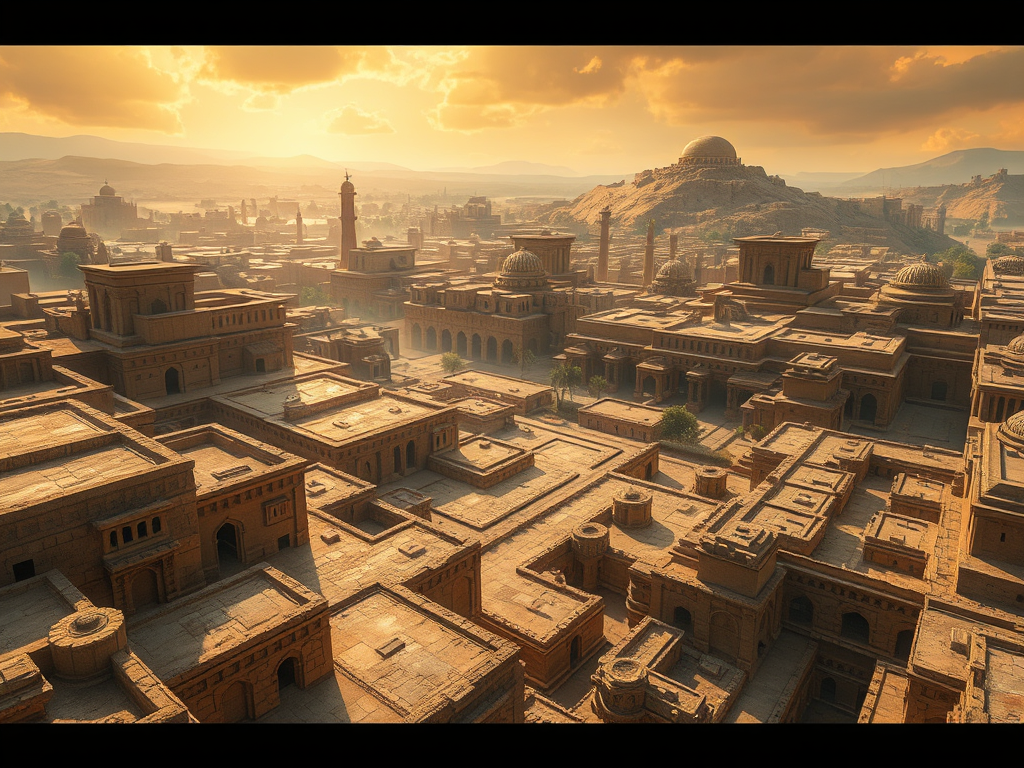
After such statements, one is expected to argue. To marshal citations, summon authorities, line up genetic charts and archaeological maps like witnesses in a trial. But this is not a courtroom matter. It is, at heart, an observation about temperament — about how civilisations behave when they know themselves, and how they behave when they do not. The Indus cities, with their drains, grids, and almost obsessive concern for order, do not read like experiments. They read like corrections. As if someone, somewhere, had already learned what happens when people pile too close, when waste is ignored, when water is taken for granted. Harappa does not feel young. It feels instructed.
The contrast with London is instructive. Medieval London grew the way many cities do — by accumulation, not intention. Houses pressed against houses, lanes narrowed into alleys, waste found its way into streets, and streets into the river. Chamber pots were overturned with casual efficiency, animals shared space with humans, and water carried whatever it was given. Filth was not a problem to be solved; it was a condition to be endured. The city learned sanitation the hard way — through plague, through fire, through cholera, and finally through the humiliation of the Great Stink. London did not plan its hygiene. It earned it.
Harappa, by contrast, appears to have arrived educated. Covered drains run beneath homes as if they were part of the foundation, not an afterthought. Streets meet at right angles with quiet discipline. Houses turn inward, guarding privacy and order. Industrial areas are separated. Water is channelled, respected, controlled. There is no visible improvisation here. No chaos tamed later. This is design from the first brick.
Cities do not usually behave this way unless they remember something.
Which raises the uncomfortable possibility that the Indus cities were not the beginning of an urban experiment, but the response to a previous failure. That the people who built them were not innocents discovering density, but migrants escaping it. That they carried with them the memory of crowding, of disease, of collapse — and built against it.
It is fashionable to imagine ancient peoples as naïve. They were not. They were observant. They had time. They had generational memory. And when they moved, they moved with lessons.
This is where the idea of the Harappans as ecological refugees begins to feel less speculative and more intuitive. The world around 2200 BCE was not stable. Rivers shifted. Monsoons weakened. Landscapes changed. Settlements failed. In such times, people do not vanish; they redistribute. They seek water, space, safety. And when they find it, they do not repeat old mistakes. They overcorrect. They build carefully. They build defensively. They build as if order itself were a form of survival.
Harappa reads like that — a city built by people who had already paid the price of negligence.
And then there is the matter of ancestry.
Modern genetics, stubborn and indifferent to ideology, tells a simple story beneath all the complexity: the deepest layer of the Indian population is ASI — Ancestral South Indian. Not imported. Not intrusive. Not secondary. Foundational. Everything else is admixture, layering, movement. But the base is here. Old. Enduring.
This quietly unsettles the neat picture of Harappa as the womb of Indian civilisation. It suggests something more interesting and more difficult: that Harappa was an expression, not an origin. A flowering, not a seed. That the civilisational current ran deeper and further south, and that the Indus cities were one of its organised manifestations, not its beginning.
This does not diminish Harappa. It liberates it.
It allows us to see it not as an isolated marvel, but as part of a long, continuous cultural intelligence — one that did not need invasion to awaken it, nor instruction to shape it. One that learned, adapted, migrated, and rebuilt.
Which brings us, inevitably, to the strange persistence of the argument.
Why is this still noisy?
Why do we keep reopening the question of “who came from where” as if it were a moral referendum? Why the obsession with arrival, with infusion, with external spark? Why the discomfort with continuity?
Perhaps because a civilisation that arises from its own soil is difficult to control. It cannot be claimed. It cannot be gifted. It cannot be credited. It simply is. And that is deeply inconvenient to empires, missionaries, and ideologues alike.
There is also, perhaps, a quieter discomfort. To accept that people here understood sanitation before Rome, urban planning before London, and social order without visible kings or palaces, is to accept that wisdom is not linear. That progress is not guaranteed. That modernity is not necessarily superior — only louder.
And that is a hard thing for the present to concede to the past.
So the debate continues. The lines are redrawn. The maps are argued over. The genetics is politicised. The archaeology is conscripted. History is made to testify.
When, in truth, it needs no defence.
At some point, one wants to say: enough.
Enough excavation of identity.
Enough political anthropology.
Enough genetic weaponry.
Let Harappa be careful.
Let India be old.
Let migration be human.
And let the past be a record, not a battlefield.
History is not on trial.
It is only waiting to be understood — and then, finally, left in peace.