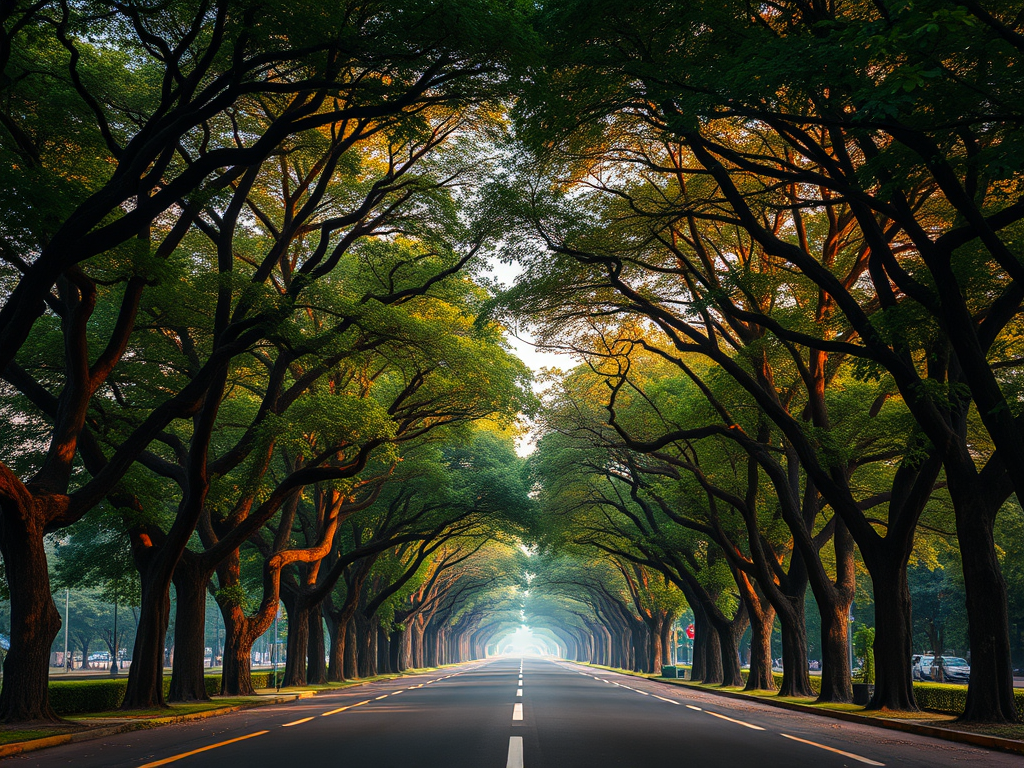
In the world of urban planning, there is a legendary “elusive list.” It dates back to the Town Planning report of 1913, written while Edwin Lutyens was designing the imperial heart of Delhi. The report contained a revolutionary yet simple piece of sound advice: the size of the trees selected for an avenue must determine the width of the road on which they stand.**
| Planning Era | Core Philosophy | Resulting Landscape |
| Lutyens (1913) | Imperial grandeur & shade | Dense, cathedral-like green tunnels. |
| Chandigarh (1950s) | Functionalism & Sun/Space | Structured rows with a mix of flowering trees. |
| Panchkula (Modern) | Pragmatism & Fast Greening | Mixed species, often lacking the original geometric intent. |
Panchkula Urban Planning
This wasn’t just aesthetic whimsy; it was a mathematical relationship between biology and asphalt. Lutyens and his horticulturists selected 13 kinds of avenue trees to act as “biological engineers.” This pattern was followed in Chandigarh and eventually implemented in Panchkula. However, somewhere along the Shivalik foothills, the intended effect deviated from the achieved.
The “Mainline 8”: The Original Engineering
According to Pradip Krishen, author of Trees of Delhi, the backbone of the original plan relied on specific species selected for their predictable growth and “orderly” behavior. These were the giants meant to create the “cathedral ceilings” of our boulevards.
| The “Mainline 8” | Growth Habit | Botanical Purpose |
|---|---|---|
| Imli (Tamarind) | Massive, High Crown | Longevity (300+ years) and deep, cooling shade. |
| Arjun | Columnar/Vertical | Tall, pale trunks that act like architectural pillars. |
| Jamun | Dense, Rounded | Evergreen “walls” of foliage that block dust and noise. |
| Neem | Diffuse/Hardy | Medicinal air purification and extreme drought resistance. |
| Pilkhan (*Ficus virens*) | Enormous Umbrella | Used for major intersections to provide maximum coverage. |
| Peepal | Statuesque/Broad | Spiritual significance and massive oxygen production. |
| Baheda | Symmetrical/Airy | Provides shade without feeling “heavy” or cluttered. |
| Sausage Tree | Architectural/Sturdy | A wind-resistant exotic with a unique silhouette. |
Additional species, such as Putrajiva, Mahua, and Jadi (River Red Gum), were used to provide texture and seasonal variation to the secondary residential streets.
The Deviation: The Saptparni Trap in Sector 27
As we examine Saptparni Avenue in front of AWHO Sector 27, we see where the modern plan has struggled. The basic idea—to have a shady, green road—is sound. However, the choice of Saptparni (Alstonia scholaris) on a 60-foot highway has become an administrative nightmare.
The Saptparni was not on Lutyens’ original list for narrow roads. It is a forest giant that has been forced into a residential corset.
The Botanical Breakdown of a Mismatch:
- Height & Girth: In an urban setting, it easily hits 50–60 feet, towering over the very streetlights meant to illuminate the road.
- Lateral Growth (The “Whorl”): Unlike the “Mainline 8,” which often has rounded or vertical crowns, the Saptparni grows in rigid horizontal layers (whorls).
- The Math of Overlap: On a 60-foot road with a median, you have trees on both sides and in the center. With a natural spread of 30–50 feet per tree, they interlock in the middle. They don’t just “touch”; they “roof over” the road.
- The Cleaning Liability: * Flowers: In October, the greenish-white star-shaped flowers release a pungent, cloying scent that is a potent allergen for many.
- Fruits: The trees produce 24-inch pendulous pods (looking like long green beans) that eventually burst, releasing “silk-cotton” fluff that clogs AC units and drainage grates.
| Lutyens’ Logic (for 60ft Road) | Modern Reality (Saptparni) |
| Species: Amaltas or Kachnar | Species: Saptparni (Alstonia) |
| Height: 25–30 feet | Height: 50–60 feet |
| Structure: Light, airy, non-meeting tops | Structure: Dense, tiered, interlocking canopy |
| Maintenance: Minimal “deadwood” removal | Maintenance: Constant pollarding & leaf clearing |
Why It’s a “Nightmare” for the Administration
Because the Saptparni is a fast-growing, soft-wooded species, the “meeting in the center” occurs every 2-3 years. To keep the road functional, the city must engage in Pollarding (aggressive topping).
This triggers a biological defense mechanism: the tree sends out dozens of thin “water shoots”—rapid, messy vertical branches that are weakly attached. This creates a cycle in which the more you prune, the “messier” and more dangerous the tree becomes, necessitating even more frequent cleaning and cutting.
The Take-Home Message
The elusive “Thirteen Trees” of 1913 were chosen because they were self-regulating. They were designed to fit the road like a hand in a glove. By ignoring the rule that a tree’s spread must be less than half the road’s width, we have traded long-term sustainability for short-term greening.