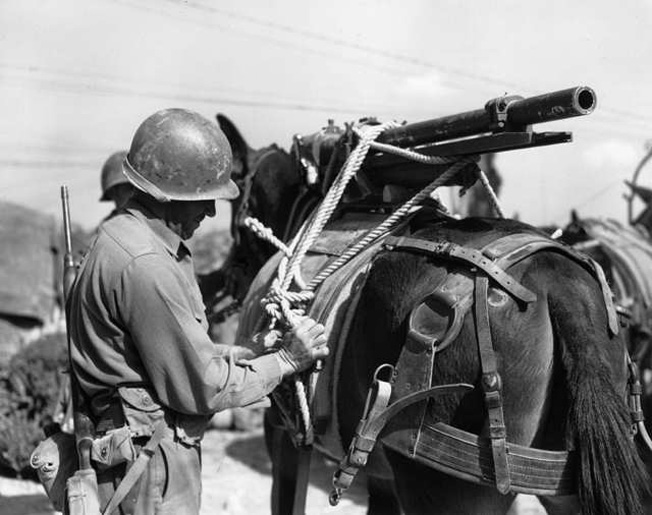
In the shadowed annals of history, where the thunder of tanks and the roar of artillery claim the spotlight, there march quieter heroes—men who coaxed stubborn mules through hellish terrains, carrying the burdens that machines could not. Krishan Chand was one such man, a soldier of the Royal Indian Army Service Corps, a mule driver whose life spanned the frozen mud of Europe, the choking jungles of Burma, and the thin air of the Himalayas.
Born in the rugged hills of Punjab, Krishan Chand enlisted young, drawn to the Animal Transport companies where tough men like him—hardened by village life and the rhythms of beasts—found their calling. Mules were the unsung backbone of the army in those days. Where Western troops relied on engines that sputtered and stalled in mud or monsoon, the sure-footed mules pressed on, hauling ammunition, rations, and wounded men. As one veteran later reflected, mule drivers were among the toughest soldiers, coaxing loads up impossible slopes, whispering commands in the dark, sharing their own scant food when fodder ran low.
Krishan Chand’s war began in the bitter winter of Europe. His unit, part of the Indian pack transport, trudged through the Ardennes forests during the brutal German offensive of 1944-45—the Battle of the Bulge. The ground was a quagmire of frozen slush; trucks bogged down, tanks froze. But the mules endured, their drivers like Krishan Chand leading them through blinding snow and artillery fire, delivering vital supplies to forward lines where mechanized forces faltered. In that frozen hell, mules did the heavy lifting, saving lives with every stubborn step.

Then came Burma, the forgotten theater of mud and malaria. Transferred to the China-Burma-India front, Krishan Chand and his mules plunged into the steaming jungles, supporting the Chindits and the Fourteenth Army’s grueling push against the Japanese. Leeches, torrential rains, and enemy ambushes turned paths into nightmares, but the mules navigated where jeeps sank. De-voiced to silence their brays from betraying positions, they carried howitzers disassembled on their backs, food for starving troops, and evacuated the wounded under fire. Krishan Chand knew the bond: a good mule driver treated his animals like comrades, for in those green infernos, they were often the difference between victory and defeat.

Years later, long after the World War ended, Krishan Chand served again—in 1962, when China invaded across the high Himalayas. Now older, but still tough as the hills he came from, he joined the animal transport units supplying posts in Ladakh and the North-East Frontier Agency. Mules were indispensable there: no vehicle could climb those razor-thin ridges at 15,000 feet, through oxygen-starved air and blizzards. They hauled artillery shells, food, and fuel to outnumbered Indian troops holding desperate defenses. Krishan Chand’s experience from decades past guided younger drivers, ensuring supplies reached the front amid the chaos of retreat and counterattack.

Through it all, he earned a chestful of medals—more than most, ribbons from the Ardennes campaigns, the Burma Star, defense and war medals, and later honors from 1962. Papers perished over time, lost in the chaos of partitions and moves, but those trinkets remained, hard-won proof of a life in service.
One day, decades later, a massive stroke struck—a left hemisphere insult that left him with right-sided weakness, aphasia silencing his voice, hemianopia blurring half the world. Limping into Military Hospital Pathankot without ID, he scattered his medals on the table with his good left hand: a silent testament, a plea for the dignity he had earned.
Young intern Bopa Rai admitted him without question, earning a rare nod of approval. The ward gathered around this wondrous figure, poring over the faded ribbons under magnifying glasses—Ardennes, Burma, 1962. They tended him with tea, placebos, and nourishing meals for fifteen days, honoring the man who had carried nations on mule-back.
On discharge, Krishan Chand managed a crooked salute with his weakened right arm, head bent in quiet pride. Not a word spoken, yet his story roared.
To Krishan Chand and the mule drivers like him—unsung, unbreakable—we salute you. You bore the loads others could not, in mud, jungle, and mountain. Your medals may fade, but your honor endures. Jai Hind.
