Tetrachromatic Women and the Hidden Texture of Reality
There are no new colors in the world.
And yet, for some people, the world contains more color.
This is not poetry. It is biology.
The World Before Names
The Rig Veda speaks often of brightness—dawn, radiance, shining, darkness—yet gives surprisingly few color descriptions. Ancient Greek writers described the sea not as blue but as wine-dark. Even the rainbow in early cultures was often divided into three parts rather than seven.
The world itself did not change. Human perception did not suddenly evolve in the last few thousand years. What changed was resolution—the fineness with which differences could be noticed and therefore named. Most humans see color in three dimensions. A minority of women see it in four.
The Biology of the Fourth Channel
Color vision comes from cone cells in the retina. Ordinary human vision uses three:
| Cone Type | Wavelength Sensitivity |
|---|---|
| Short | Violet–blue |
| Medium | Green |
| Long | Yellow–red |
This creates trichromatic vision—a three-axis coordinate system in the brain. Every color we experience is a combination inside that space.
The genes for the red and green pigments sit on the X chromosome. Men have one X; women have two. Usually this makes no difference. But sometimes the two X chromosomes carry slightly different red-sensitive pigments. Because each retinal cell randomly activates only one X chromosome, the retina becomes a mosaic: some cells use one pigment, some the other.
The brain now receives four independent signals instead of three. This condition is called tetrachromacy.
Not a New Color—A New Separation
Tetrachromatic women do not see ultraviolet halos or supernatural hues. They see distinctions where others see identity. Two fabrics that appear identical to most people are clearly different to them. Two lipsticks labeled the same shade are not remotely alike.
A sunset does not contain “orange”—it contains a slow gradient of copper, apricot, coral, rose, and fading ash. Where trichromatic vision groups, tetrachromatic vision resolves.
The Metamer Problem
In physics, two completely different mixtures of light can look exactly the same to a normal observer. These are called metamers. Your brain compresses infinite wavelengths into three coordinates. Information is lost.
Tetrachromatic vision restores part of that lost information. What appears a single color patch to most observers becomes textured—almost granular—to them. They do not see more colors. They see structure inside color.
Why Language Came Late
Human cultures named colors in a predictable order:
- Dark / light
- Red
- Yellow or green
- Blue
- Brown
- Subtle hues
Language grows where perception becomes socially useful. If only a small fraction of the population perceives a distinction, language rarely stabilizes around it. The experience remains private.
The world always contained millions of hues. Human vocabulary only gradually approached them. Tetrachromats may have existed throughout history—simply living in a slightly sharper world that no one else could verify.
A Different Kind of Detail
Imagine listening to a musical note and hearing a chord within it. Not louder—just internally structured. That is close to tetrachromatic perception.
A painted wall is not flat. Skin tones are not uniform. Clouds are not white. The difference is subtle but persistent—a continuous fine grain across reality.
The Quiet Implication
Human beings do not all inhabit identical sensory worlds. We agree on objects because our brains compress reality similarly. But small genetic variations change how finely reality is partitioned.
For most of us, color is a category.
For some, it is a landscape.
They do not see a new rainbow. They see the spaces between its bands.
Other Eyes, Other Worlds
How Dogs and Cats Paint Reality
If some humans live in a four-dimensional color world, most animals live in fewer. The question is not who sees correctly. The question is what each species needed to notice in order to survive. Color is not truth. It is selection.
The Dog’s Palette — Motion Before Hue
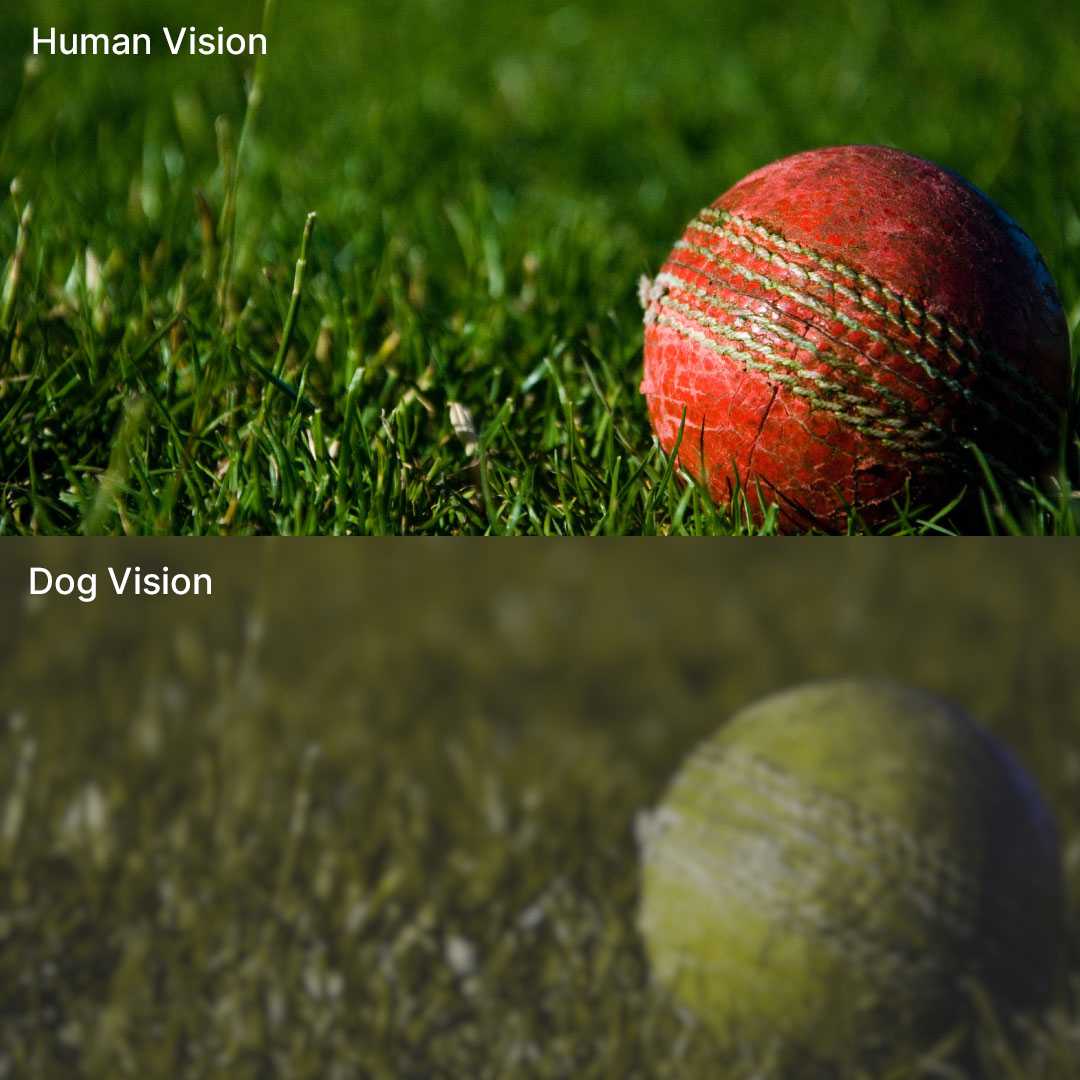
Dogs possess two cone types instead of three. Their vision is dichromatic. They see mainly blues and yellows. Warm colors collapse into similar shades.
| Human Color | Dog Perception |
|---|---|
| Red | Dark gray or brown |
| Green | Yellowish gray |
| Orange | Muddy yellow |
| Yellow | Yellow |
| Blue | Blue |
| Purple | Bluish |
To a human: a red ball in green grass is obvious.
To a dog: it blends into a dull earth tone.
This is why blue toys excite dogs more than red ones—they are not brighter, only distinguishable.
Dogs compensate not with color discrimination but with motion sensitivity and smell. A moving object exists; a still object fades. Their world is less painted—but more animated.
The Cat’s Palette — Twilight Vision
Cats also have two cones, but tuned differently. They detect blues and greenish tones while warm hues weaken or merge. Reds and pinks lose identity.
This trade-off grants something else: superior night perception. A cat does not need a colorful world. It needs a visible world at dusk. The retina sacrifices chromatic richness for sensitivity—more rods, fewer cones.
So the cat’s universe is not black-and-white. It is a soft, cool watercolor of evening.
Different Realities
- Humans — color analysts of daylight
- Dogs — trackers of movement
- Cats — hunters of darkness
Each species edits the same sunlight differently. Evolution never asked for accuracy. It asked only for usefulness.
Some humans see distinctions inside color.
Animals see meaning inside motion.
The world is not a single picture—it is many renderings of the same light.